
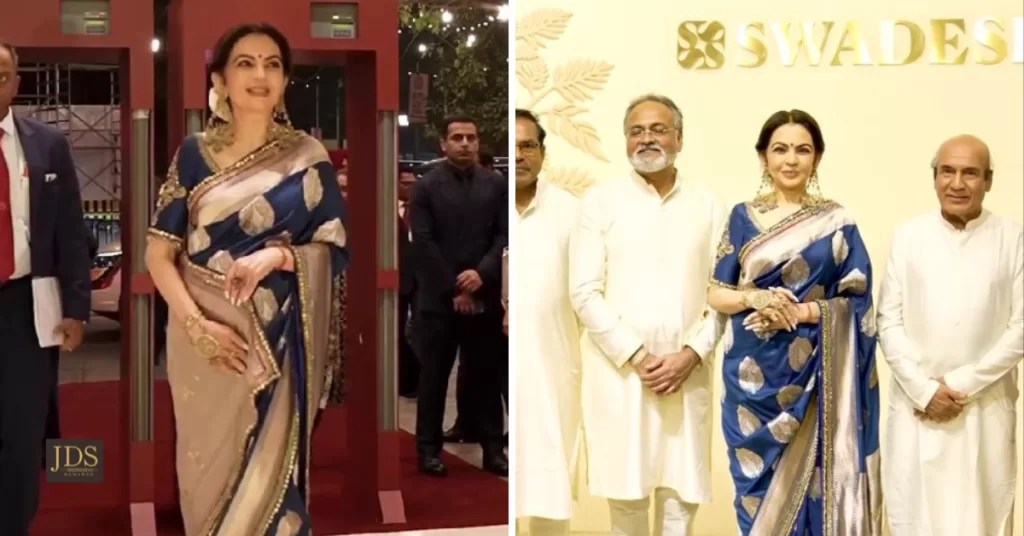
When tradition, artistry, and purpose come together, the moment becomes timeless. At the flagship Swadesh store at Eros, Mrs. Nita Ambani hosted a deeply meaningful celebration honouring India’s master artisans—an evening where craft was not only displayed, but lived, worn, and revered.
Draped in a regal peacock blue Banarasi saree from Swadesh, Mrs. Ambani embodied the spirit of India’s handloom legacy, showcasing how heritage textiles continue to speak powerfully in a contemporary world.
A Festive Installation Rooted in Artisan Hands
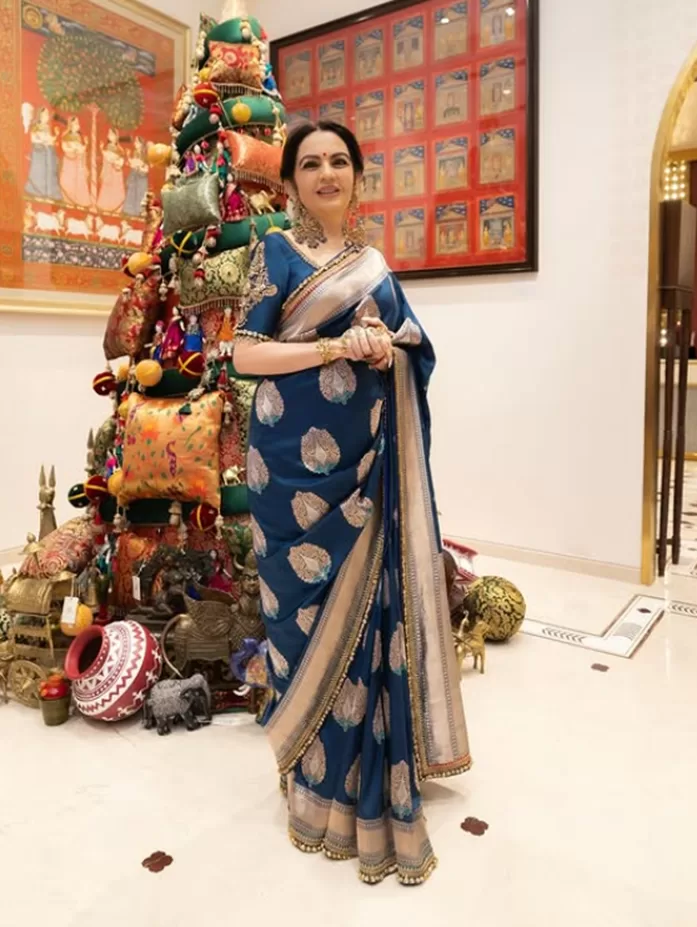
The celebration unfolded against a striking festive installation crafted entirely from handmade toys, figurines, textiles, woodwork, and sculptures sourced from across India. Every element of the installation represented the skill, imagination, and dedication of Indian artisans—echoing the same spirit found in an authentic Banarasi saree in Varanasi, where craftsmanship remains at the heart of creation.
Standing before this installation, Mrs. Nita Ambani reflected Swadesh’s vision—to honour India’s craft traditions in their purest form and reimagine festive storytelling through the very hands that keep these traditions alive. It was a moment that beautifully bridged art, culture, and community, much like heritage-driven Banarasi houses in Varanasi such as JDS Banaras, which continue to preserve time-honoured weaving traditions.
Draped in a Peacock Blue Banarasi Saree
For this special occasion, Mrs. Ambani chose a Banarasi saree from Swadesh, woven using the ancient Kadhua weaving technique—one of the most revered and intricate methods of Banarasi handloom. This technique remains a hallmark of an authentic Banarasi saree in Varanasi, practised by master weavers across generations.
The saree featured:
- Rich peacock blue silk, symbolic of grace and royalty
- Intricate Meena motifs, adding jewel-like vibrancy to the weave
- Kadhua craftsmanship, where each motif is woven individually, ensuring unmatched precision and durability
Kadhua weaving is celebrated for its clean finish, reversibility, and the immense skill it demands—qualities that transform Banarasi sarees into enduring heirlooms rather than seasonal garments. These same principles guide heritage-focused Banarasi saree showrooms in Varanasi, including JDS Banaras, where purity and craftsmanship remain paramount.
Couture Details with Deep Cultural Meaning
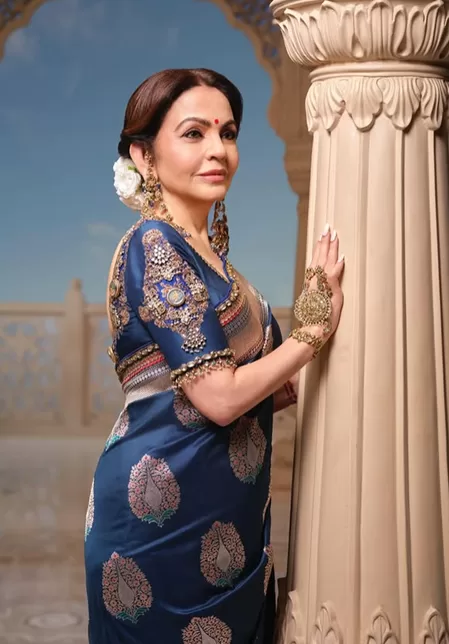
The saree was paired with a custom blouse by Manish Malhotra, designed exclusively for the occasion. The blouse featured a refined polki border, elevating the ensemble with understated opulence.
What made the blouse truly exceptional were its details:
- Each button was a miniature painting, hand-painted by traditional artists and depicting beloved Hindu deities
- The tassel featured vintage spinel jewellery, drawn from Mrs. Ambani’s personal collection
These thoughtful elements transformed the blouse into a canvas of storytelling—where fashion became an extension of faith, memory, and artistry, much like the philosophy behind every handcrafted Banarasi saree in Varanasi.
Jewellery That Carries History and Heirloom Value
Mrs. Ambani completed her look with an exquisite pair of antique kundan polki earrings, handcrafted over a century ago—an enduring testament to India’s jewellery heritage. Her statement bird ring from Swadesh, set in traditional jadau technique and adorned with polki diamonds and rubies, added symbolic depth to the ensemble.
Adding the most intimate layer, she wore her mother’s heritage haath phool—an heirloom steeped in generations of love and blessings. This emotional connection mirrors the way Banarasi sarees are cherished as family legacies, especially when sourced from trusted names like JDS Banaras in Varanasi.
An Evening Dedicated to India’s Master Artisans
The celebration brought together some of India’s most accomplished and nationally honoured artisans, reinforcing Swadesh’s commitment to recognising excellence at the grassroots level. Mrs. Nita Ambani joined:
- Shri Biren Basak, Padma Shri Awardee (2021), Tangail & Jamdani weaver
- Shri V. Panneerselvam, master Tanjore painter, Shilp Guru Awardee (2019)
- Shri Shammi Bannu Sharma, seventh-generation miniature painter
- Shri GhanShyam Sarode, Paithani textile revivalist
- Ms. Gunjan Jain, Odisha Ikat textile artist and National Award winner (2024)
This gathering celebrated the same artisanal spirit that sustains Banarasi weaving communities in Varanasi and empowers heritage houses like JDS Banaras to keep these traditions alive.
Banarasi Sarees as Living Heritage
Mrs. Nita Ambani’s Banarasi saree was more than a garment—it was a belief woven into silk. A belief that true luxury lies in craftsmanship, that heritage thrives when artisans are honoured, and that a genuine Banarasi saree in Varanasi represents centuries of cultural continuity.
Through platforms like Swadesh and legacy brands such as JDS Banaras, Banarasi sarees continue to be celebrated not merely as textiles, but as living legacies—woven with patience, precision, and pride.
Final Thoughts
Nita Ambani’s appearance in a Banarasi saree at Swadesh was a powerful reminder that India’s greatest stories are still told by its artisans. In every Kadhua motif, every Meena detail, and every handwoven thread lies a tradition worth preserving.
As festive celebrations evolve, moments like these ensure that India’s craft heritage remains vibrant—rooted in history, elevated by vision, and carried forward with purpose, just as it is in every authentic Banarasi saree in Varanasi curated by heritage-driven names like JDS Banaras.
Pictures Credit: https://www.instagram.com/swadesh_online/
FAQS
1. Why is Nita Ambani’s Banarasi saree significant?
Nita Ambani’s Banarasi saree is significant because it represents India’s living handloom heritage. Crafted using the ancient Kadhua technique, the saree celebrates skilled artisans and reinforces the importance of preserving traditional weaving practices.
2. What is Kadhua weaving in Banarasi sarees?
Kadhua weaving is a traditional Banarasi technique where each motif is individually handwoven rather than cut from a larger design. This method ensures superior durability, sharp detailing, and heirloom-quality craftsmanship.
3. What makes Banarasi sarees from Varanasi unique?
A genuine Banarasi saree in Varanasi stands out for its pure silk base, intricate zari or Meena work, and centuries-old weaving traditions passed down through generations of master weavers.
4. Which Banarasi saree did Nita Ambani wear at Swadesh?
Nita Ambani wore a peacock blue Banarasi saree from Swadesh, featuring intricate Meena motifs and woven using the revered Kadhua technique, highlighting exceptional craftsmanship and cultural depth.
5. How does Swadesh support Indian artisans?
Swadesh supports Indian artisans by creating a curated platform that honours traditional crafts, provides fair recognition, and presents heritage textiles like Banarasi sarees in a contemporary, global context.
6. What role do couture designers play in traditional Banarasi sarees?
Couture designers add refined detailing—such as custom blouses or zari borders—while respecting the original handloom weave, helping Banarasi sarees remain relevant in modern luxury fashion.
7. Why are Banarasi sarees considered heirloom garments?
Banarasi sarees are considered heirlooms due to their meticulous handweaving, durable silk, timeless designs, and emotional value, often passed down through generations.
8. Where can one buy an authentic Banarasi saree in Varanasi?
Authentic Banarasi sarees can be purchased from reputed heritage stores and Banarasi saree showrooms in Varanasi, such as JDS Banaras, known for preserving traditional weaving techniques.
9. What jewellery complements a Banarasi saree best?
Antique kundan, polki, jadau, and heirloom jewellery beautifully complement Banarasi sarees, enhancing their regal and traditional appeal.
10. How do brands like JDS Banaras preserve Banarasi weaving traditions?
JDS Banaras preserves Banarasi weaving traditions by working closely with skilled artisans, maintaining purity of materials, and ensuring authentic handloom techniques remain central to their creations.