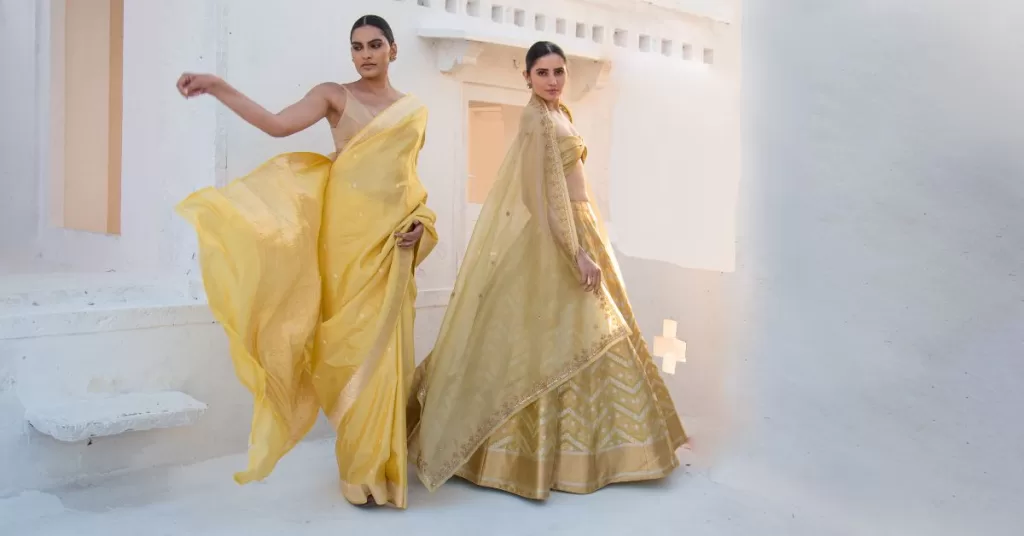
For years, Banarasi lehenga has been seen as the symbol of timeless elegance, craftsmanship, and heritage. Known for its rich and intricate designs, which includes Mughal-inspired motifs and zari work, a woman’s love for pure Banarasi silk lehenga is never ending. This has resulted in soaring demand over the last few years. However, with the rising demand and increasing production, figuring out what is genuine and what is fake has become a difficult task.
If you are also one of those who is trying to know how to identify pure Banarasi lehenga, then you have come to the right place. In this article, we will provide you an authentic Banarasi lehenga guide along with Banarasi lehenga buying tips.
What Makes a Banarasi Lehenga Special?
Before we delve into how to identify pure Banarasi lehenga, let us tell you a bit about what makes it so special. The Banarasi sarees and lehengas are made using weaving techniques that goes back centuries. Even the royal families were in awe of these weaving techniques and used to wear the colors of Banarasi fabrics on various occasions.
Being said that, the authenticity of the Banarasi lehenga lies in its pure silk fabric, handwoven craftsmanship, real god and silver threads, and the intricate motif designs inspired by Mughal patterns. Notably, a genuine Banarasi lehenga carries the legacy of centuries old weaving techniques, which cannot be replicated by machine-made lehengas.
How to Identify Pure Banarasi Lehenga?
- Check the Fabric Quality
The first and the foremost thing is to examine the fabric of the Banarasi lehenga. It is important to know that pure Banarasi lehengas are made of organza or Katan silk. These fabrics offer a smooth, rich, and slightly heavy feel. The artificial silk, on the other hand, is much lighter and does not offer the same depth.
Moreover, when you burn down pure silk threads they smell like burnt hair. Artificial silk, on the other hand, smells like plastic. This is one way to identify pure Banarasi silk lehenga.
- Examine the Zari Work
One of the most defining features of a Banarasi lehenga is the zari work. To know how to check original Banarasi lehenga, getting to know a bit about zari work can help. For instance, authentic Banarasi sarees are made using real gold or silver-coated threads. They have a subtle shine and are not glossy. Furthermore, the backside of the fabric will also show clean and neat weaving.
Some of the fake zari indicators are that the lehenga is too shiny or has a metallic finish. The texture is rough and it feels more like plastic.
- Look at the Weaving Technique
Weaving technique is another indicator to know a pure Banarasi lehenga. Notably, real and pure Banarasi lehengas are handwoven. This is one of those things that makes each and every piece unique. Being said that, one can see slight irregularities in patterns as they are handwoven. To say, it is a good sign if you see irregularities. Moreover, there are no loose threads and the designs appear a part of the fabric.
In fake Banarasi lehengas, the patterns are uniform as they are machine made. Furthermore, the cost of the lehengas is also on the lower end compared to handwoven lehengas.
- Inspect the Reverse Side
Another effective way to check Banarasi lehenga is to inspect the backside of it. Real Banarasi lehengas have floats of threads. They are not messy. The designs are woven and not printed. Moreover, the minimal thread cutting hints towards handwoven work and not machine-made work.
- Identify Traditional Motifs
Looking at the motifs is another mark of pure silk Banarasi lehenga. If you do not know it already, know that Banarasi designs are inspired by Mughal art and nature. Some of the common motifs are paisley, bel and kalga, jaal, and butidar.
If you see modern patterns on the Banarasi lehenga that might not be authentic. Thus, keep a closer look on the motif designs on the Banarasi lehenga.
- Check for GI Tag Certification
Geographical Indication (GI) tags protect Banarasi sarees and fabrics. When you buy a Banarasi fabric then lookout for GI tag or certification. It is a clear indication of a pure Banarasi silk lehenga. The tag means that the product has been manufactured in Varanasi. Being said that, sellers that are trusted provide the authenticity certificates on their own.
For instance, with JDS Banaras, there is no need to ask for certificates. They provide it on their own.
- Weight Matters
If it is a pure Banarasi lehenga then it has to be heavy. The real silk fabric, dense zari work, and handwoven detailing are the different factors that increase the weight of the Banarasi lehenga. If the weight is too light, it is potentially a replica and not the real deal.
- Price Indicator
Pure silk Banarasi sarees and lehengas are a piece of art. There is a reason why these fabrics are handed over from one generation to another. Because these are timeless beauty, they are also much costlier compared to other fabrics. For instance, pure Banarasi lehengas might cost you between ₹25,000 – ₹2,00,000+.
Semi Banarasi or machine made lehengas will cost you ₹5,000 – ₹20,000. If the price seems too good to be true, it probably is.
- Buy from Trusted Sources
Buying a Banarasi lehenga from a trusted source is as important as buying one. There is no point getting one for yourself or for your loved ones if it is not authentic. If it is not authentic then you are just buying a piece of fabric, you are not buying a piece of Indian tradition and heritage.
To buy an authentic piece, lookout for reputed Banarasi lehenga stores in Varanasi. You can also check out verified online brands that have customer reviews. Government emporiums and handloom exhibitions are other places to get your hands on a pure Banarasi lehenga.
- Ask the Right Questions
Before you make the buying decision it is always prudent to ask a few questions to the sellers. For instance, you can ask if the lehenga is made of pure Katan silk or if the zari is real or tested. You can also ask them about handwoven technique and certification. If they are selling real and pure Banarasi lehengas they will always be transparent with the buyers.
Common Types of Banarasi Lehengas
A little knowledge about the different types of Banarasi lehengas can also go a long way in identifying pure Banarasi lehengas. Here are the common types to know about.
- Katan silk Banarasi lehenga – These are made of pure silk with a luxurious finish.
- Organza lehenga – These are lightweight, having zari work on them.
- Georgette Banarasi lehenga – These are slightly lighter and have a flowy nature.
- Shattir lehenga – These have a contemporary design.
Final Tips for Buyers
Here are some of the things to keep in mind before you walk into the store to buy a pure Banarasi lehenga.
- Take the touch and feel of the fabric.
- Do not go for cheap deals.
- Go for a handwoven lehenga and not machine-made.
- Lookout the finishing details.
- Prefer legacy brands.
Conclusion
Banarasi lehengas are a piece of art and not just a fashion statement. It embodies centuries old weaving methods and traditions. If you give some attention to the zari work, weaving methods, fabric quality and certification, then differentiating a real one with the fake one is not difficult. This authentic Banarasi lehenga guide helps you understand the things in simple terms.
But if you just want us to tell you the place where you can find authentic Banarasi lehenga then JDS Banaras is the place for you. There is a reason why it is known as the best Banarasi lehenga shop in Varanasi. Whether you are buying for wedding or festivities, JDS Banaras offers you unmatched elegance and lasting value.
FAQs – How to Identify a Pure Banarasi Lehenga
1. How can I identify a pure Banarasi lehenga?
You can identify a pure Banarasi lehenga by checking the silk fabric quality, authentic zari work, handwoven patterns, traditional motifs, GI tag certification, and the overall weight and finishing of the lehenga.
2. What fabric is used in authentic Banarasi lehengas?
Authentic Banarasi lehengas are usually crafted from pure Katan silk, organza silk, georgette, or other premium silk fabrics that feel rich and luxurious.
3. How do I check if the zari work is real?
Real zari work has a subtle shine and smooth finish, while fake zari looks overly glossy and feels rough or plastic-like. The backside of authentic zari weaving also appears neat and clean.
4. Why are pure Banarasi lehengas expensive?
Pure Banarasi lehengas are handwoven using premium silk and real zari techniques that require skilled craftsmanship and significant time, making them more expensive than machine-made replicas.
5. What is the price range of a pure Banarasi lehenga?
A genuine Banarasi lehenga can range from ₹25,000 to ₹2,00,000 or more depending on the silk quality, weaving complexity, and zari craftsmanship.
6. What is the importance of the GI tag in Banarasi lehengas?
A GI (Geographical Indication) tag confirms that the Banarasi lehenga has been authentically produced in Varanasi using traditional weaving methods.
7. Are handwoven Banarasi lehengas better than machine-made ones?
Yes, handwoven Banarasi lehengas are considered superior because they showcase authentic craftsmanship, intricate detailing, and unique weaving patterns that machine-made lehengas cannot replicate.
8. Which motifs are commonly found in pure Banarasi lehengas?
Traditional Banarasi lehengas often feature Mughal-inspired motifs such as paisley, floral jaal, kalga, bel, and butidar patterns.
9. Where should I buy an authentic Banarasi lehenga?
You should buy Banarasi lehengas from trusted Banarasi stores, reputed online brands, government handloom emporiums, or verified sellers with authenticity certifications.
10. What are the common types of Banarasi lehengas?
Popular Banarasi lehenga types include Katan silk Banarasi lehenga, organza Banarasi lehenga, georgette Banarasi lehenga, and Shattir Banarasi lehenga.