
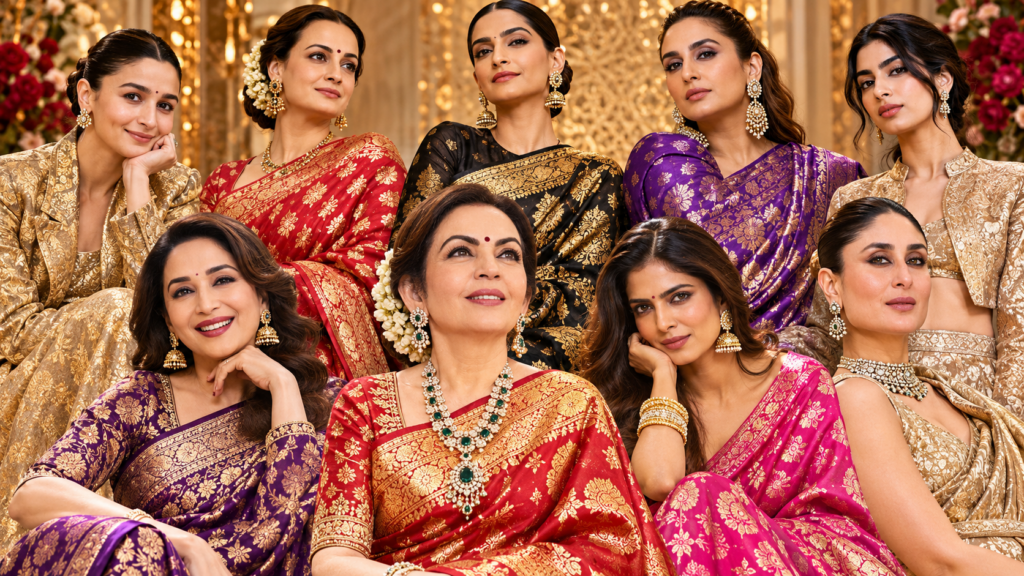
Banarasi sarees are once again drawing strong attention in celebrity fashion—and the timing is particularly relevant for India’s wedding season.
Recent celebrity looks have shown Banarasi silk in very different forms: traditional red sarees, jewel-toned brocades, Shikargah-inspired designs, vintage family sarees and even contemporary jackets and skirts made from Banarasi fabric.
The interesting part is not simply that celebrities are wearing Banarasi again.
It is how differently the textile is being styled today.
For brides, wedding guests and anyone building an occasion wardrobe, these recent looks offer useful ideas on colour, weaving, zari, blouse styling and how traditional Banarasi textiles can feel completely contemporary.
1. Nita Ambani: A Banarasi Saree That Took More Than Five Months to Weave
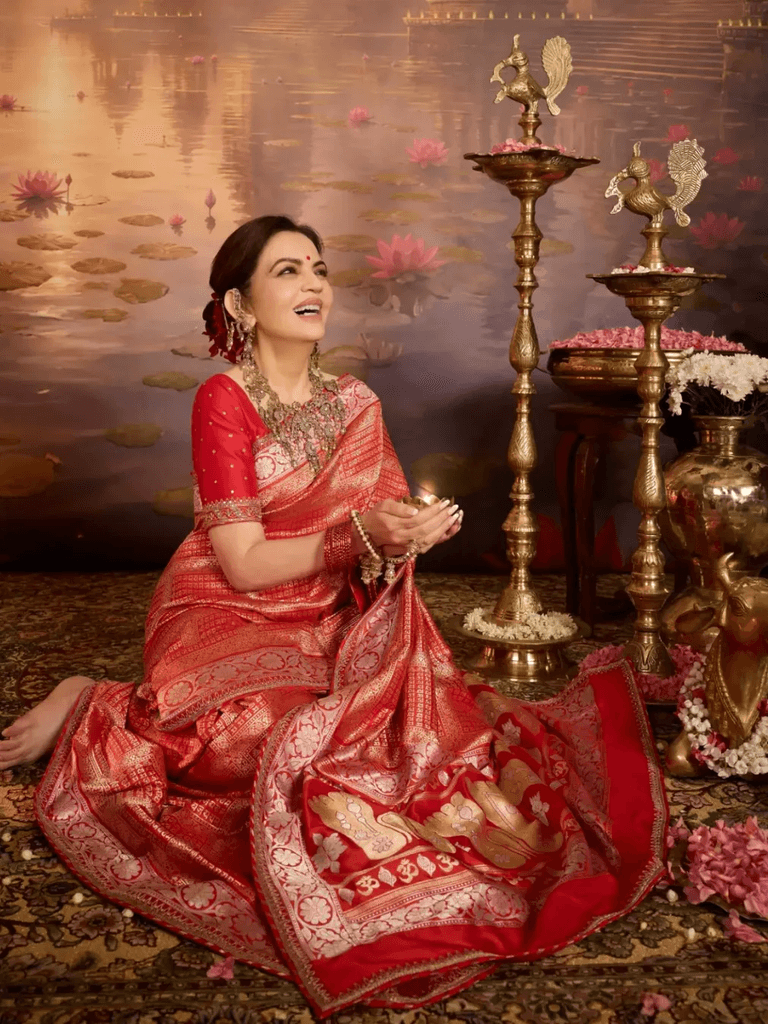
One of the most recent examples came from Nita Ambani, who wore a vermilion-red Banarasi silk saree for Diwali celebrations.
According to Vogue India, the saree—called Ramavali—was handwoven in pure silk by master artisan Ajay Bhoj and took more than five months to complete. It incorporated the name “Shri Ram” repeatedly into the weave along with sacred motifs, all worked through zari and traditional Banarasi craftsmanship.
Read the Vogue India report on Nita Ambani’s Banarasi saree
What makes this look particularly interesting is that the weaving itself becomes the decoration.
The saree does not need layers of crystals, sequins or heavy surface embellishment to appear ceremonial.
What brides can learn from this look
If you are choosing a Banarasi saree for the wedding ceremony or an important traditional function, consider the craftsmanship before simply looking at how heavily embellished the saree appears.
A beautifully woven saree with meaningful motifs and strong zari work can create more impact than excessive surface decoration.
2. Malavika Mohanan: Shikargah Inspiration With a Contemporary Bridal Look
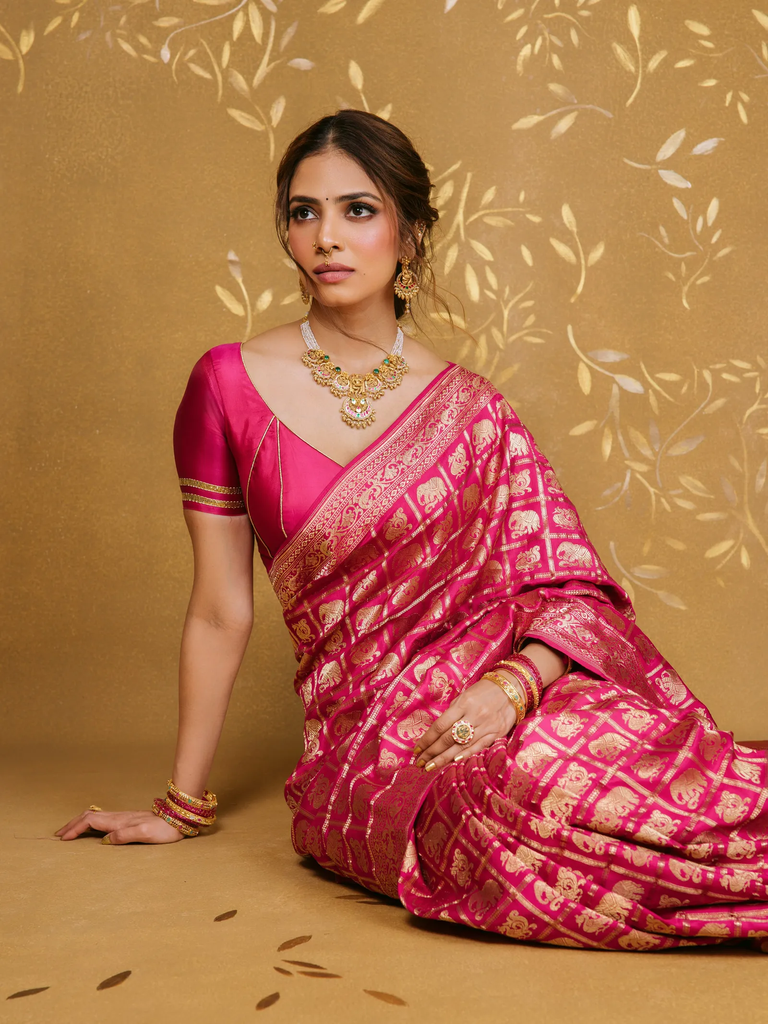
Malavika Mohanan recently wore a striking fuchsia Banarasi silk saree by designer Sourav Das.
According to Vogue India, the saree drew inspiration from an 18th-century Devadasi saree and reinterpreted Shikargah-style imagery through motifs including birds, elephants and annapakshi figures.
The saree was woven using the Kadwa technique, where individual motifs are woven separately rather than created through continuous floating threads.
See Malavika Mohanan’s Banarasi saree and the weaving story on Vogue India
What makes this look especially relevant for wedding fashion is the balance between a highly traditional textile and contemporary styling.
The saree itself carries complex heritage-inspired motifs, while the blouse, hairstyle and jewellery make the overall appearance feel current.
Vogue even described the look as particularly suitable inspiration for brides who want to wear a heritage saree for their main wedding ceremony.
What brides can learn from this look
You do not need to modify the textile itself to make a Banarasi saree look modern.
Instead, experiment with:
- blouse design,
- jewellery,
- hairstyle,
- makeup,
- and drape.
Let the saree remain traditional while the styling creates the contemporary element.
3. Madhuri Dixit: Purple Banarasi Brocade Inspired by Architecture
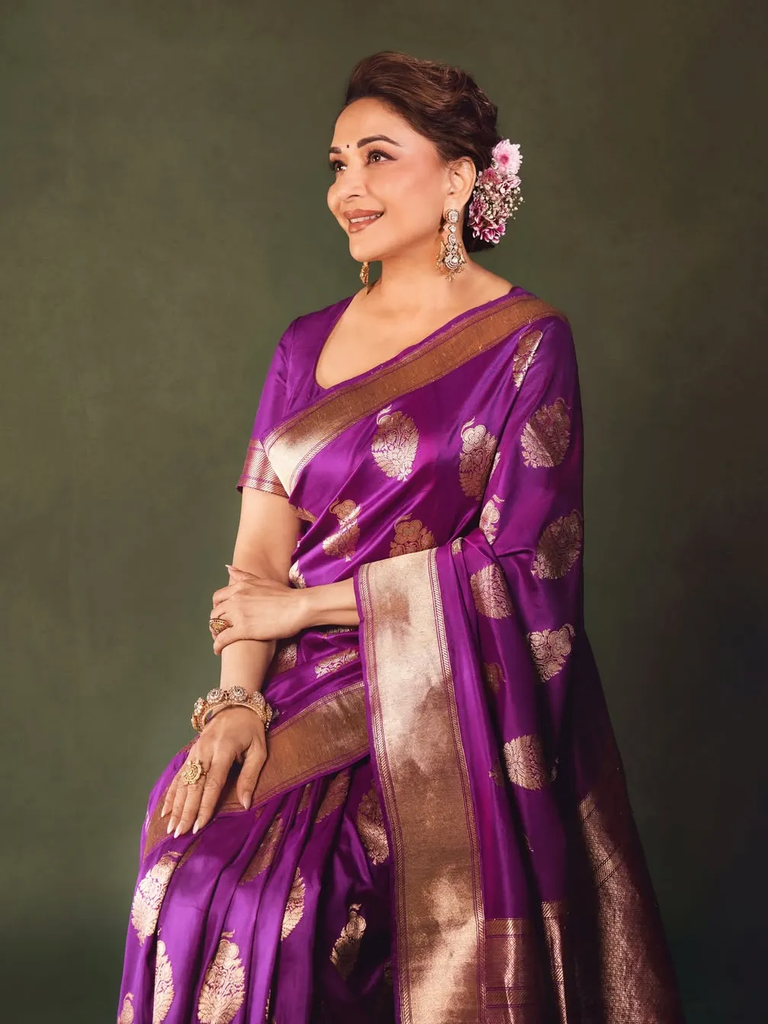
Madhuri Dixit Nene recently appeared in a purple Banarasi brocade saree by Raw Mango.
The saree featured floral forms contained within paisley-shaped buttas, with the design inspired by Mughal and Rajputana marble inlay work.
Vogue reported that the motifs were created using the Kadwa technique and that at least two artisans work on such a saree—one handling the body and another focusing on the motifs.
See Madhuri Dixit’s purple Banarasi brocade look on Vogue India
This look demonstrates that Banarasi design is not limited to familiar floral butis.
Architecture, historical ornament and different artistic traditions can all influence the weaving vocabulary.
What wedding guests can learn from this look
You do not need to choose red to make a Banarasi saree look formal.
Deep jewel tones such as:
- purple,
- wine,
- emerald,
- bottle green,
- magenta,
- and deep blue
can work beautifully for evening weddings and receptions.
They also create excellent contrast with gold zari.
4. Alia Bhatt: Banarasi Fabric Beyond the Saree
Alia Bhatt recently demonstrated a very different way to wear Banarasi textile.
Instead of a saree, she wore a gold Banarasi tissue kalidar jacket and trousers by Mayyur Girotra.
Vogue reported that the Banarasi fabric was specially woven by a craft cluster in Varanasi with whom the designer works. The look combined traditional textile with an androgynous contemporary silhouette.
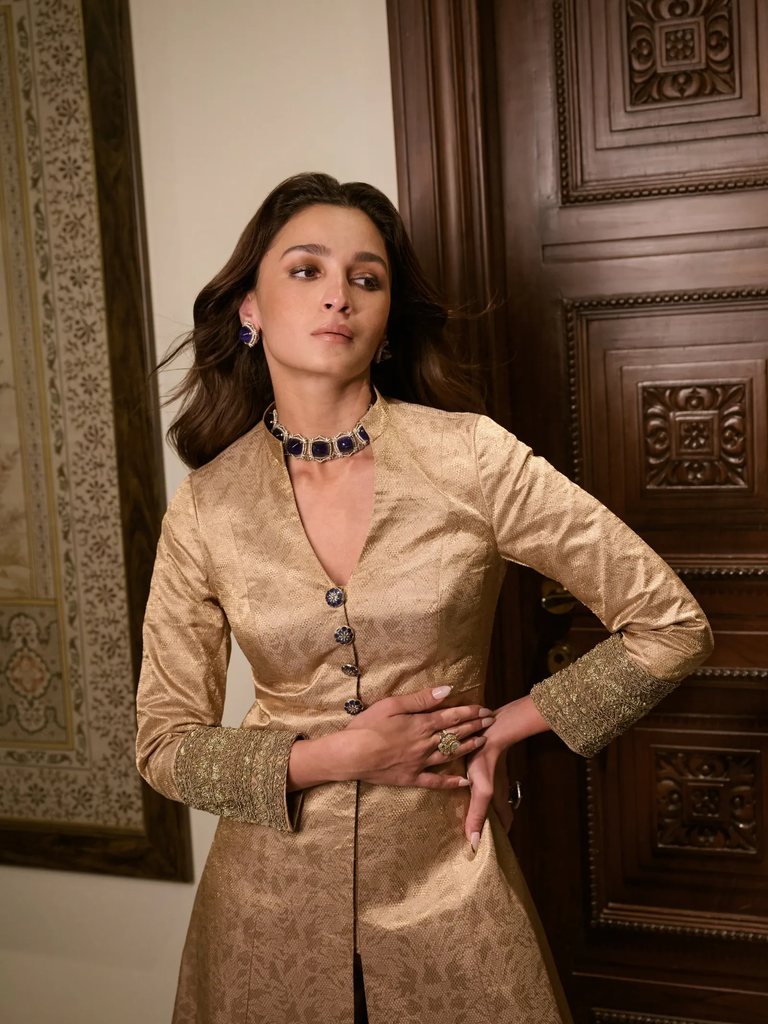
See Alia Bhatt’s contemporary Banarasi tissue look on Vogue India
This may be one of the most important current developments around Banarasi textiles.
The craft is no longer restricted to a six-yard saree.
Banarasi fabric can now appear in:
- jackets,
- kurtas,
- trousers,
- skirts,
- lehengas,
- structured tops,
- and coordinated sets.
What younger buyers can learn from this look
If you admire Banarasi craftsmanship but rarely wear sarees, you do not have to move away from the textile.
Choose a more contemporary silhouette made from authentic Banarasi fabric.
The garment can change while the textile tradition remains visible.
5. Khushi Kapoor: Banarasi Silk Reimagined as a Modern Skirt Set
Khushi Kapoor also recently demonstrated how far Banarasi silk can move beyond conventional occasion wear.
She wore a champagne-coloured Banarasi silk cropped jacket and mini skirt by Anita Dongre.
The outfit featured wildflower brocade motifs woven in light-gold zari.
According to Vogue India, the handwoven set took 45 days for artisans in Varanasi to create.
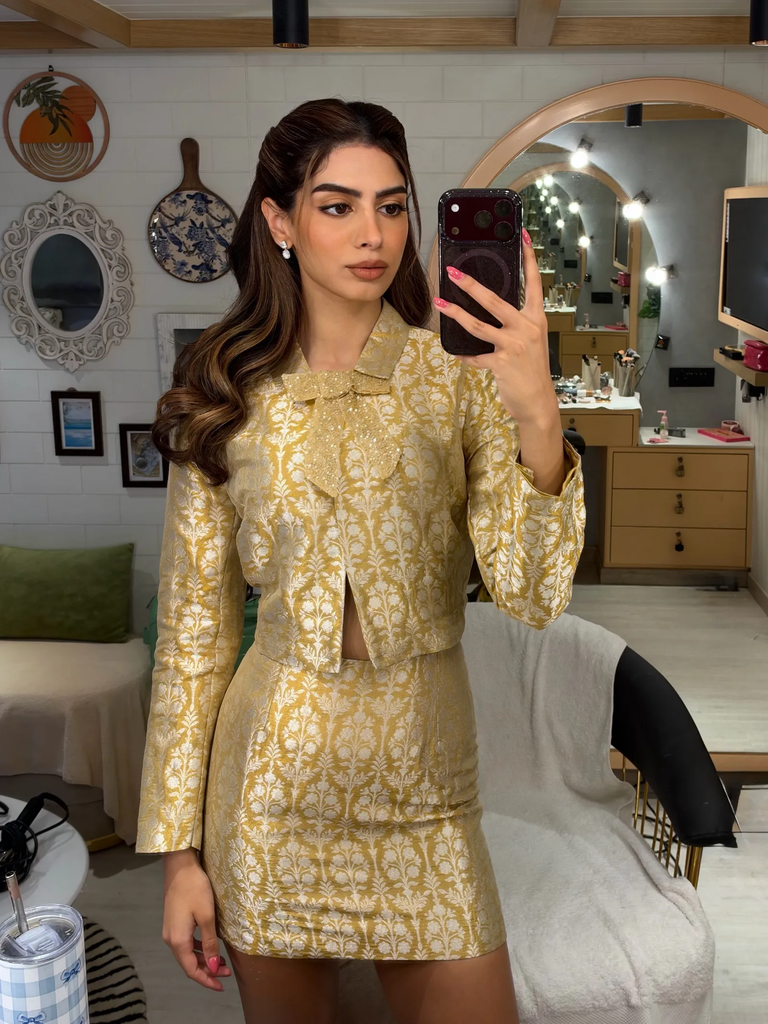
See Khushi Kapoor’s 45-day Banarasi silk outfit on Vogue India
What is interesting here is the contrast:
very traditional textile + very contemporary silhouette.
The weaving retains its craft identity even though the final garment looks completely different from a traditional saree.
What this means for wedding fashion
For functions such as:
- sangeet,
- cocktail,
- engagement,
- reception,
- or pre-wedding parties,
younger buyers can consider Banarasi fabric without necessarily wearing a conventional saree.
6. Dia Mirza: A Vintage Banarasi Saree From Her Mother’s Wardrobe
One of the most emotionally interesting examples comes from Dia Mirza, who has worn a vintage Banarasi saree belonging to her mother.
Vogue’s recent roundup of celebrity Banarasi looks highlighted the saree as part of the wider return to traditional woven textiles in contemporary celebrity wardrobes.
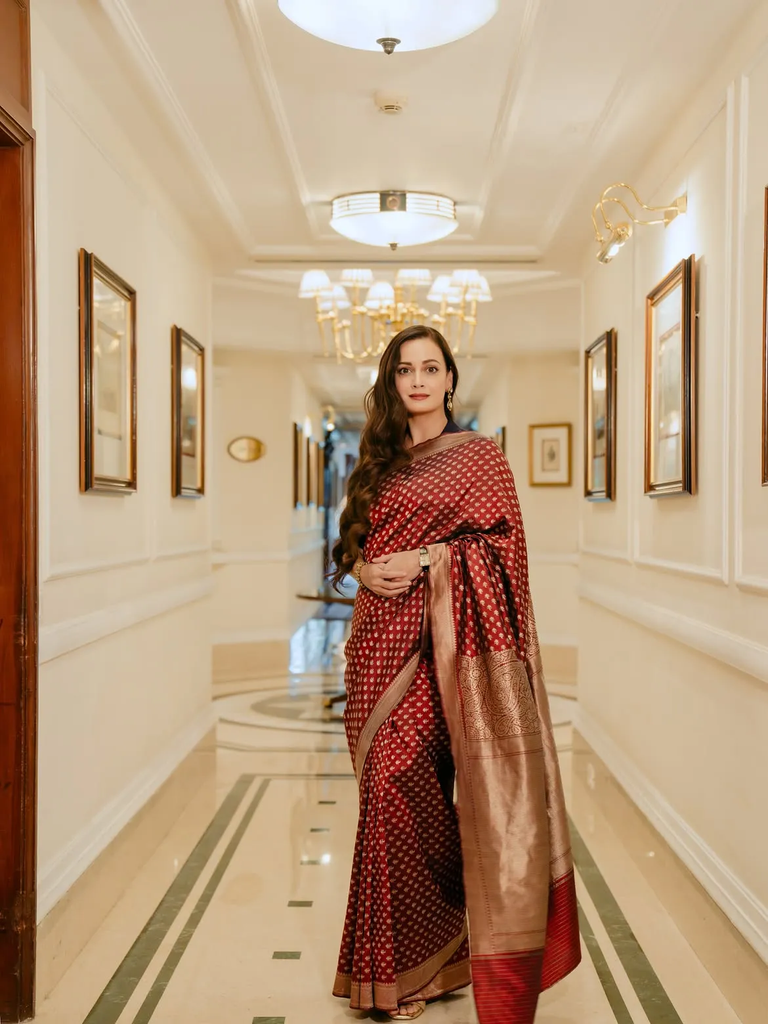
See Vogue India’s celebrity Banarasi saree roundup
This example is particularly relevant because it demonstrates something we often see with good Banarasi textiles:
an older saree does not necessarily look outdated.
The textile can survive changes in fashion if its design and weaving remain strong.
What you can learn from this look
Before purchasing something new for every wedding, look through your family wardrobe.
A mother’s or grandmother’s Banarasi saree can be transformed simply by changing:
- blouse,
- jewellery,
- hairstyle,
- makeup,
- and draping.
That can produce a much more individual look than copying a newly purchased trend.
7. Huma Qureshi: Banarasi Saree on an International Red Carpet
Huma Qureshi has also worn Banarasi weaving on an international stage.
Vogue’s recent Banarasi roundup highlighted her purple Banarasi saree worn at Cannes, showing how the textile can move beyond purely Indian ceremonial settings.
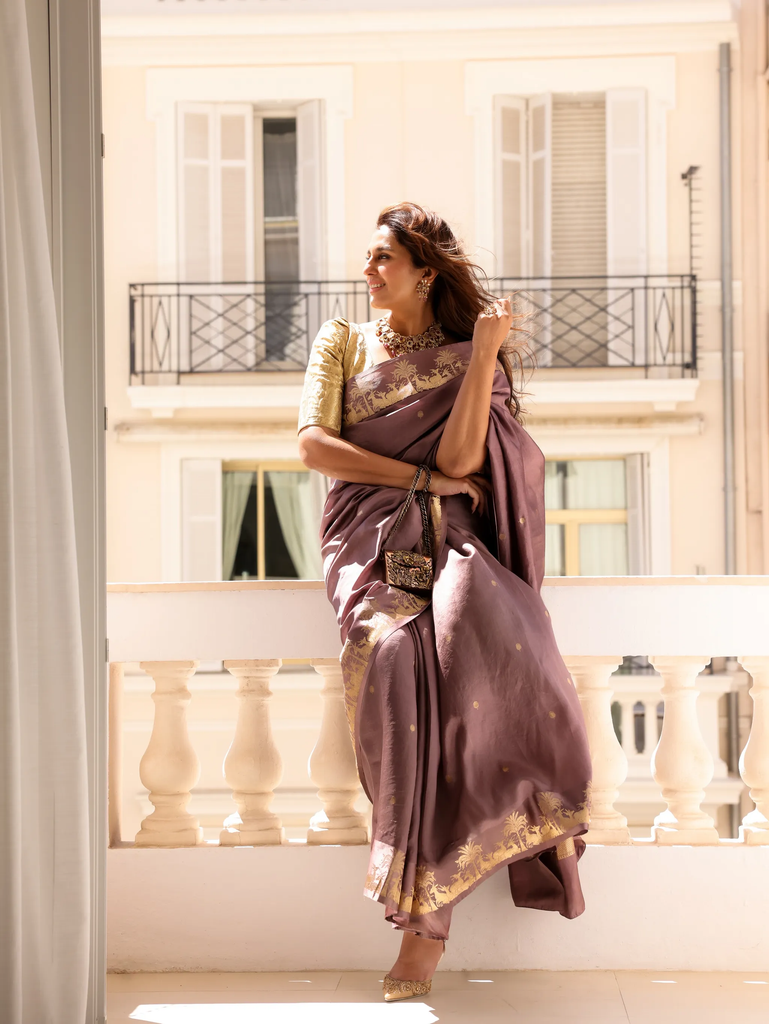
See Huma Qureshi and other celebrity Banarasi looks on Vogue India
This is useful because it demonstrates that Banarasi sarees do not need to rely only on tradition for relevance.
A strong weave, rich colour and carefully considered styling can allow the textile to work in very different fashion environments.
What this tells us
Banarasi sarees can be:
- ceremonial,
- bridal,
- formal,
- red-carpet appropriate,
- traditional,
- or contemporary.
The textile provides the foundation.
Styling determines the final personality.
8. Kareena Kapoor Khan: Turning Older Banarasi Sarees Into a New Silhouette
Kareena Kapoor Khan has appeared in a sari-gown concept by designer Amit Aggarwal created using pre-owned Banarasi sarees.
Vogue highlighted the look as an example of how existing Banarasi textiles can be restored, pleated and reinterpreted into a completely different silhouette.
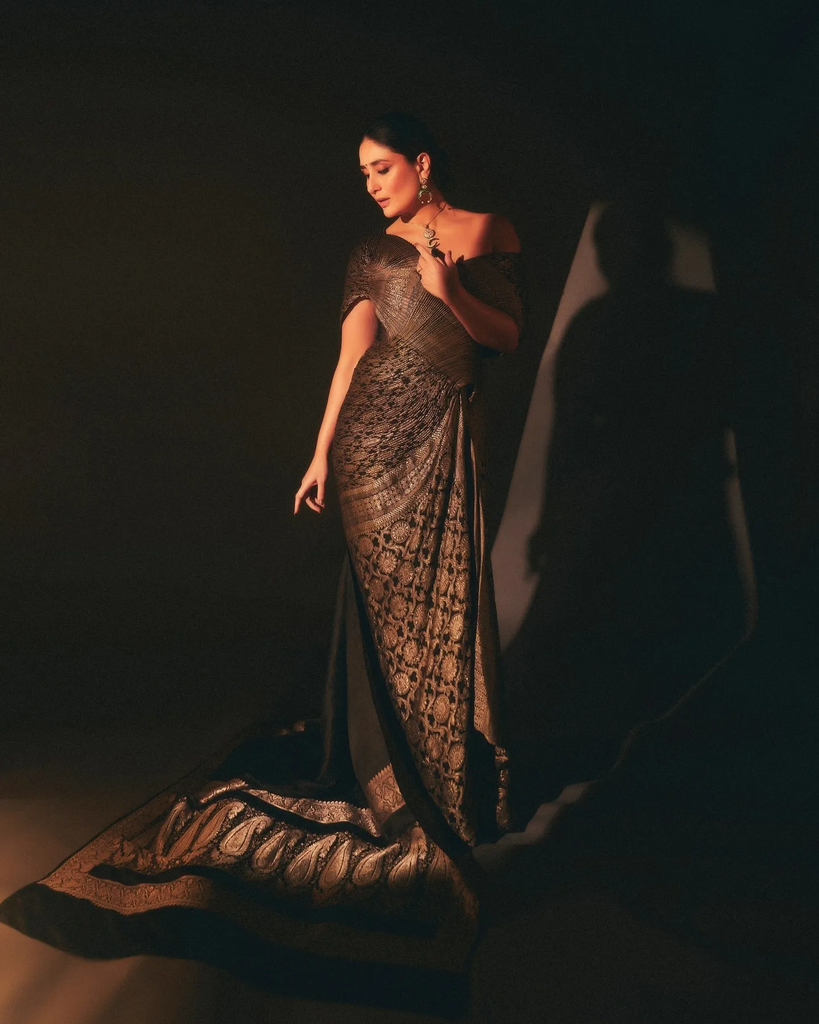
See Kareena Kapoor Khan’s Banarasi reinterpretation in Vogue India’s roundup
This raises an interesting question for modern Indian fashion:
Does preserving a traditional textile always mean wearing it exactly as it was originally intended?
Not necessarily.
There is room between completely preserving an old garment and discarding it.
Traditional textiles can sometimes be restyled, repurposed or adapted while keeping their visual identity alive.
9. Sonam Kapoor: Letting the Border Do the Talking
Sonam Kapoor recently wore a black Banarasi silk saree by Abu Jani Sandeep Khosla.
According to Vogue, the saree was handwoven using the Kadhwa technique and finished with gold zari and zardozi detailing.
The most interesting design decision was the contrast between a relatively restrained body and a much stronger border.
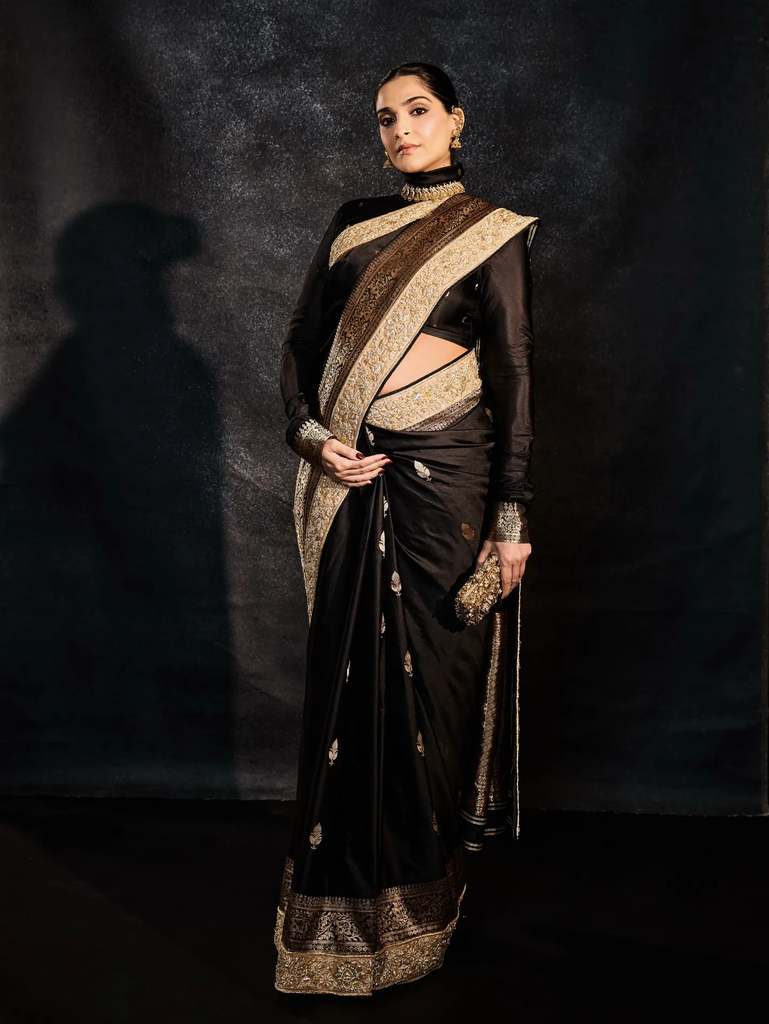
See Sonam Kapoor’s black Banarasi look on Vogue India
This is an excellent example for women who like Banarasi weaving but do not want an extremely dense all-over design.
What to learn from this look
Sometimes:
simple body + elaborate border + strong pallu
can look more sophisticated than covering the entire saree in heavy motifs.
What These Celebrity Banarasi Looks Tell Us About Wedding Fashion Right Now
The celebrity looks may be different, but several clear styling directions appear repeatedly.
1. The Weave Is Becoming the Main Decoration
Many of the strongest looks do not depend heavily on crystals, sequins or embroidery.
Instead, the visual richness comes from:
- silk,
- brocade,
- zari,
- motif construction,
- and border design.
That naturally benefits Banarasi textiles because their decorative character is built into the weave.
2. Jewel Tones Continue to Work Beautifully
Recent celebrity examples reinforce the strength of colours such as:
red, purple, fuchsia, gold, black and other rich tones.
For Indian wedding wardrobes, similar jewel tones work particularly well because gold zari creates strong contrast against them.
3. The Blouse Can Completely Change a Traditional Saree
A traditional Banarasi saree does not need to be altered to feel contemporary.
The blouse can do much of the work.
Current styling includes:
- open backs,
- structured blouses,
- high necks,
- sleeveless cuts,
- corset-inspired silhouettes,
- and restrained minimalist designs.
This gives buyers more freedom to invest in a traditional saree without worrying that the overall look will feel dated.
Banarasi Fashion Is Moving Beyond the Saree
Perhaps the biggest change is not happening to the Banarasi saree itself.
It is happening to Banarasi fabric.
Alia Bhatt’s gold tissue jacket-and-trouser look and Khushi Kapoor’s handwoven skirt set demonstrate how designers are using Banarasi weaving outside traditional formats.
That opens the textile to an entirely different audience.
Younger buyers who do not regularly wear sarees can still participate in the Banarasi tradition through:
- jackets,
- skirts,
- kurtas,
- lehengas,
- trousers,
- or coordinated sets.
For the weaving tradition, this kind of adaptation can be valuable because it creates new ways for the craft to remain visible.
Which Celebrity Banarasi Style Should You Take Inspiration From?
The goal should not be to copy a celebrity outfit exactly.
Instead, identify the styling direction that suits your own occasion.
For a Bride
Look at the textile-focused approach seen in the recent Nita Ambani and Malavika Mohanan looks.
Consider:
- Katan silk,
- detailed Kadwa weaving,
- rich traditional colours,
- meaningful motifs,
- and strong zari.
For the Mother of the Bride or Groom
The Madhuri Dixit approach offers good inspiration.
Deep purple, wine, maroon and green can create a rich formal appearance without looking excessively bridal.
For a Younger Wedding Guest
Look toward Alia Bhatt and Khushi Kapoor.
Banarasi fabric can be used in modern silhouettes while retaining the richness of the weave.
For Someone Who Loves Vintage Textiles
The Dia Mirza approach is particularly relevant.
Before purchasing another saree, consider whether a strong family piece can be restyled.
Why Banarasi Works So Well for Indian Weddings
A good wedding textile needs more than trend value.
It should look appropriate for an important occasion while still reflecting the personality of the wearer.
Banarasi weaving provides considerable flexibility.
A red Katan saree can feel bridal.
A purple brocade can feel regal.
A gold tissue can feel contemporary.
A vintage Banarasi can feel personal.
A Banarasi jacket can feel completely modern.
The common element is not the silhouette.
It is the textile.
Are Celebrities Really Bringing Banarasi Sarees Back?
Not exactly.
Banarasi sarees never disappeared from Indian wedding wardrobes.
What recent celebrity fashion is doing is giving the textile new visibility and new styling references.
Vogue India’s November 2026 roundup specifically highlighted multiple celebrity-approved ways of wearing Banarasi sarees, showing that the textile is currently receiving renewed fashion attention.
Read Vogue India’s recent celebrity Banarasi fashion roundup
So rather than saying Banarasi is suddenly “back”, a more accurate observation is:
Banarasi is being presented to a new generation in new ways.
What JDS Banaras Recommends Before You Copy a Celebrity Look
Celebrity fashion can be useful for inspiration.
But it should not be the only reason to buy a saree.
At JDS Banaras, our relationship with Banarasi textiles has continued across generations, with the business established in 1913.
When evaluating a Banarasi saree, we recommend looking beyond the photograph and understanding:
- the silk,
- weaving technique,
- handloom or powerloom construction,
- zari,
- motif construction,
- weight,
- finishing,
- and future usability.
Two sarees may look remarkably similar on a screen and still be completely different textiles when examined closely.
A celebrity image may help you decide:
“I like this colour.”
or:
“I like this kind of border.”
But the next question should always be:
“What exactly am I buying?”
Readers interested in the family’s long association with Banarasi textiles can explore the Heritage of JDS Banaras page.
For wedding-specific guidance, our article on traditional Banarasi sarees for Indian wedding ceremonies explains how different Banarasi textiles fit ceremonial wardrobes.
The Real Trend Is Not Celebrity Fashion—It Is Traditional Craft Being Styled Differently
Look beyond the names and one larger pattern becomes clear.
Traditional Indian textiles do not need to be frozen in one style to remain relevant.
A Banarasi textile can become:
- a bridal saree,
- a minimalist saree,
- an heirloom,
- a red-carpet look,
- a jacket,
- a skirt,
- or a contemporary wedding outfit.
The fashion changes.
The textile stays rooted in its weaving tradition.
And that adaptability may be one of the biggest reasons Banarasi continues to remain relevant to Indian wedding fashion generation after generation.