
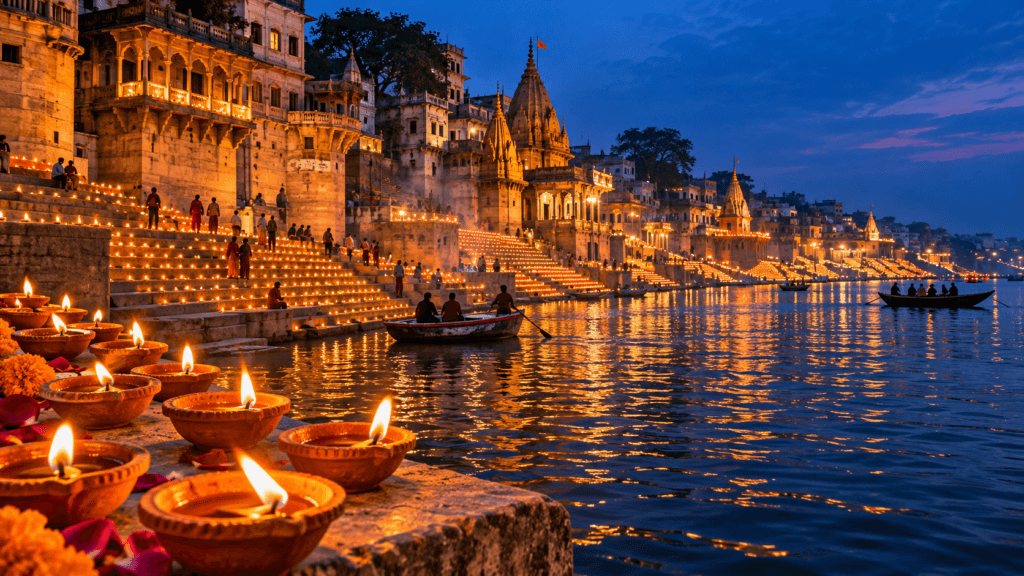
There are few sights in India as mesmerising as the ghats of Varanasi on the evening of Dev Deepawali. Countless earthen lamps illuminate the banks of the Ganga, temple bells echo through the ancient city, and golden reflections dance across the sacred river.
Every year, visitors from across India and around the world travel to Kashi to witness this extraordinary celebration of faith, light and tradition.
On 24 November 2026, Varanasi will once again celebrate its most spectacular festival — Dev Deepawali, also known as the Diwali of the Gods.
When Is Dev Diwali in Varanasi in 2026?
Dev Diwali will be celebrated on Tuesday, 24 November 2026, on the auspicious occasion of Kartik Purnima.
The celebrations will be preceded by Ganga Mahotsav, scheduled from 20 to 23 November 2026, showcasing the rich cultural and artistic traditions of Varanasi.
As evening approaches on Dev Deepawali, devotees will light earthen lamps along the ghats, transforming the riverfront into a breathtaking spectacle.
Why Is Dev Diwali Celebrated in Kashi?
According to Hindu tradition, Dev Deepawali commemorates Lord Shiva’s victory over the demon Tripurasura. It is believed that the gods celebrated this occasion by lighting lamps in celebration of his victory.
The festival is therefore also known as Tripurotsav.
For devotees, lighting a diya on Kartik Purnima represents devotion, gratitude and the triumph of light over darkness.
While Diwali is celebrated across India, Dev Deepawali holds a particularly special place in the spiritual identity of Kashi, the sacred city associated with Lord Shiva.
What Makes Dev Deepawali in Varanasi So Special?
The beauty of Dev Deepawali lies in the way the entire city comes together to celebrate its living heritage.
- Illuminated ghats: Thousands of earthen lamps decorate the historic steps along the Ganga.
- Maha Ganga Aarti: Elaborate rituals, devotional chants and traditional lamps create a powerful spiritual atmosphere.
- Boat rides on the Ganga: Visitors witness the illuminated riverfront from the water, offering an unforgettable perspective of the celebrations.
- Cultural performances: Classical music, dance and devotional performances reflect the artistic identity of Banaras.
- Deep Daan: Devotees offer lighted lamps as an expression of faith and devotion.
Dashashwamedh Ghat, Assi Ghat, Raj Ghat and Chet Singh Ghat are among the prominent locations associated with the celebrations.
Dev Deepawali 2026: What Is New This Year?
The 2026 edition of Dev Deepawali is expected to bring together centuries-old traditions and modern visual experiences.
According to recent reports, Varanasi’s first Dev Deepawali drone show, featuring 2,100 Made-in-India drones, is planned to illuminate the night sky above the Ganga on 24 November.
Alongside the traditional lighting of diyas, this new attraction is expected to add another dimension to the celebrations, offering visitors a distinctive experience of Kashi’s cultural and spiritual heritage.
Visitors should check the latest official announcements for final event schedules and arrangements.
The Timeless Connection Between Kashi and Banarasi Sarees
The cultural identity of Varanasi extends far beyond its temples and ghats.
For generations, the city has also been home to skilled weavers who have preserved the remarkable art of Banarasi silk weaving.
Much like the golden glow of Dev Deepawali, the intricate zari patterns of a traditional Banarasi saree reflect the richness and artistic character of the city.
Festivals, religious ceremonies and family celebrations continue to be occasions where women embrace traditional Banarasi silk sarees. From elaborate brocades to delicate floral motifs, these textiles remain an integral part of India’s cultural heritage.
What to Wear for Dev Diwali Celebrations
For those who wish to embrace traditional Indian attire during Dev Deepawali, a Banarasi saree can be a beautiful choice.
- Katan silk Banarasi sarees for traditional elegance.
- Banarasi tissue sarees for their luminous, festive appearance.
- Banarasi georgette sarees for a graceful and relatively lightweight drape.
- Banarasi silk dupattas for pairing with traditional suits and ethnic ensembles.
Rich shades of maroon, red, mustard, emerald green and gold complement the festive atmosphere of Kashi.
If you plan to spend the evening walking along the ghats, choose comfortable footwear and manageable attire.
Experience the Living Heritage of Banaras at JDS Banaras
A visit to Varanasi during Dev Deepawali also presents an opportunity to explore the city’s celebrated textile traditions.
Established in 1913, JDS Banaras is a fourth-generation, family-run heritage brand dedicated to preserving and presenting authentic Banarasi textiles.
For over a century, JDS Banaras has brought together traditional craftsmanship, intricate weaving techniques and the timeless beauty of Banarasi silk.
Visitors exploring the spiritual and cultural heritage of Kashi can also visit the JDS Banaras saree showroom in Varanasi to discover traditional handloom Banarasi sarees and experience the city’s remarkable textile legacy.
Things to Remember When Visiting Varanasi During Dev Deepawali
- Arrive at the ghats well before sunset.
- Book accommodation and boat rides in advance.
- Follow official traffic and crowd management advisories.
- Respect religious rituals and local traditions.
- Avoid overcrowded areas and keep the ghats clean.
- Set aside time to explore the historic lanes, temples and traditional handloom heritage of Banaras.
A Celebration Beyond the Festival of Lights
Dev Deepawali is more than an evening of illuminated ghats. It is a celebration of everything that makes Kashi extraordinary — its spirituality, faith, artistry and traditions passed down through generations.
From the glowing diyas along the Ganga to the intricate threads of Banarasi silk, the city continues to tell a story of heritage that transcends centuries.
This Dev Deepawali, experience the timeless beauty of Banaras and discover a city where tradition continues to live in every corner.
JDS Banaras wishes everyone a blessed and joyful Dev Deepawali 2026.