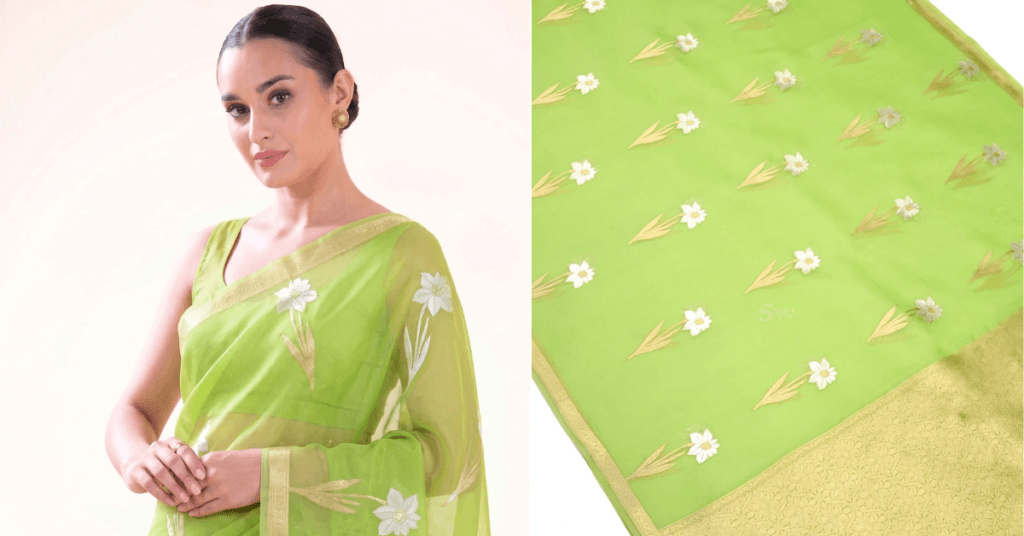
An organza saree can look deceptively simple: sheer, lightweight, crisp and luminous. But that same appearance can now be created using silk, polyester, nylon and blended fibres, making it difficult to judge purity from photographs—or even from touch alone.
So, how can you identify a pure organza saree?
The first thing to understand is that organza itself does not automatically mean silk. Traditional organza is a crisp, sheer plain-weave fabric associated with silk, but modern organza can also be manufactured from synthetic fibres.
When shoppers in India ask for a pure organza saree, they usually mean a pure silk organza saree.
To identify one, look at several clues together: the fibre declaration, Silk Mark where available, texture, natural lustre, translucency, weave, drape and, only when necessary, the behaviour of a loose thread when burned.
No single “home test” should be treated as absolute proof.
Quick Guide: Pure Silk Organza vs Synthetic Organza
| Check | Pure Silk Organza | Synthetic Organza |
| Fibre | Natural silk | Polyester, nylon or another manufactured fibre |
| Feel | Crisp, dry and lightly papery | May feel slick, plastic-like or excessively rigid |
| Lustre | Soft, changing natural sheen | Often brighter or more uniform |
| Appearance | Sheer with visual depth | Can appear glassier or highly reflective |
| Drape | Light but naturally structured | May be very stiff, springy or unnaturally flat |
| Burn behaviour* | Protein-fibre smell, brittle residue | Usually melts and may form a hard bead |
| Strongest buying evidence | Clear fibre disclosure + genuine Silk Mark | Product description declaring synthetic/blended fibre |
*A burn test should only be carried out on a separate loose yarn, never on the saree itself.
First, What Exactly Is a Pure Organza Saree?
Organza is known for three characteristics: sheerness, lightness and structure.
Unlike a fluid fabric such as georgette, organza does not simply collapse around the body. It has natural body, which gives a saree defined pleats and an airy silhouette.
Its characteristic appearance comes from its yarn and weave construction. Organza is generally produced as a fine plain-weave fabric using highly twisted yarns, creating a fabric that can be simultaneously lightweight, sheer and crisp.
Traditionally, that yarn was silk.
Today, however, you will find:
- pure silk organza,
- polyester organza,
- nylon organza,
- rayon-based variants, and
- silk-synthetic blends.
Therefore, “organza” and “pure silk organza” are not interchangeable terms.
That distinction should be the starting point whenever you are evaluating an organza saree.
Related Guide – Best Organza Sarees for Summer: Lightweight & Stylish
1. Check the Fibre Composition Before Performing Any Test
This is the most overlooked—and often the most useful—step.
If you are buying online, do not stop at a product title such as:
“Premium Organza Saree”
or
“Soft Organza Saree.”
Those phrases tell you very little about the actual fibre.
Look for a clear statement such as:
100% silk,
pure silk organza, or
pure kora organza silk.
If the description only says “organza,” ask the seller what fibre has been used in the warp and weft.
Terms such as organza feel, semi-organza, art silk organza or similar descriptions should not automatically be interpreted as pure natural silk.
A knowledgeable seller should be able to answer the fibre question directly.
2. Look for a Genuine Silk Mark
For an Indian buyer, this is considerably more dependable than trying to judge silk only with your fingers.
The Silk Mark Organisation of India, an initiative of the Central Silk Board under the Ministry of Textiles, states that Silk Mark labels are affixed to 100% pure silk products by authorised users. Genuine labels contain identifying security features including a unique number.
The organisation itself also makes an important point: identifying silk merely by appearance and touch can be difficult.
So if you are paying a premium specifically for pure silk organza, Silk Mark provides much stronger evidence than statements such as “it feels like silk.”
There is one important distinction, though.
What Silk Mark does—and does not—prove
Silk Mark confirms pure natural silk fibre.
It does not by itself certify:
- the purity of zari,
- whether a saree is handwoven,
- whether it is Banarasi, or
- the quality of every decorative element.
The Silk Mark Organisation specifically notes that its certification does not assure zari purity.
For a Banarasi organza saree, these are separate questions that should be evaluated separately.
3. Feel the Texture: Crisp, But Not Plastic-Like
One of the most recognisable qualities of silk organza is its hand-feel.
A pure silk organza saree normally feels crisp, light and slightly dry, often described as having a fine papery quality.
“Papery,” however, should not be confused with rough.
The fabric should still feel refined.
Synthetic organza can vary greatly, so there is no single synthetic texture. Some versions feel unusually slick and smooth, while others feel excessively stiff or plastic-like.
This is why touch works best as a comparison test, not a certification test.
If you have the opportunity to compare known pure silk organza and synthetic organza side by side, the difference becomes much easier to recognise.
4. Observe the Sheen in Natural Light
Silk naturally possesses lustre, but it does not usually look like a sheet of shiny plastic.
Take the saree near daylight and move it gently.
Pure silk organza often produces a subtle, changing glow as light interacts with the fibres and folds.
Synthetic organza may produce a stronger, flatter or more uniform reflection.
But be careful with simplistic rules such as:
“High shine means fake.”
Finishing treatments, dye, zari and photography can all change how a fabric appears.
The sheen test should therefore support other observations rather than decide the answer on its own.
5. Examine the Sheerness—But Don’t Expect Complete Transparency
Organza is a sheer fabric.
That does not mean a good silk organza saree should look like transparent plastic.
Hold a single layer against light.
You should be able to perceive light and objects through the cloth, while the fabric itself still retains visible body and texture.
This combination—sheerness with structure—is one of organza’s defining visual qualities.
The degree of transparency can change according to:
- yarn count,
- weaving density,
- colour,
- finishing,
- zari,
- motifs and
- whether you are looking through one or several layers.
For this reason, “transparent versus translucent” is not a reliable purity test by itself.
6. Look Closely at the Weave
A magnified look at the fabric often tells you more than simply looking at the overall saree.
Organza is fundamentally associated with a plain-weave construction. In plain weave, warp and weft alternate over and under one another.
A fine silk organza should reveal a light, open-looking construction while still feeling stable.
What should you avoid doing?
Do not assume that:
irregular = handwoven and pure
or
perfectly even = synthetic.
Modern weaving and finishing can produce extremely consistent natural-silk textiles, while poor construction can occur in any fibre.
The weave tells you about fabric quality and structure, but fibre purity still requires additional evidence.
7. Observe How the Saree Holds Its Shape
Organza’s appeal lies in what might be called lightweight structure.
Lift a portion of the saree and allow it to fall.
Pure silk organza generally maintains some body instead of collapsing like chiffon or georgette. When pleated, it should give the drape definition.
But this is where many online “bounce tests” become misleading.
Some guides claim pure organza should remain exactly where it is folded. Others say genuine organza should spring back. Even the references supplied for this article give opposite versions of the test.
The more accurate approach is not to look for one exact bounce response.
Instead ask:
Does the fabric feel naturally crisp and light, or artificially rigid and springy?
Different finishes and weaving densities can change the answer.
8. Listen for Silk “Scroop”—But Treat It Only as a Clue
When silk fibres rub against one another, they can sometimes produce a faint rustling or crunching sound often described as silk scroop.
Gently rub or scrunch a small section of the saree.
A silk organza may produce a delicate crisp rustle.
However, sound should never be your primary authentication method. Finishes, ageing, moisture and construction can influence how a fabric sounds.
Think of it as another clue that becomes useful when it agrees with the fibre label, texture and lustre.
9. The Burn Test: Useful, But Not the First Test to Perform
The burn test is frequently presented online as the ultimate way to identify pure organza.
It needs more context.
Silk is a protein fibre. The Silk Mark Organisation notes that when genuine silk thread burns, its smell resembles burnt hair.
A silk yarn generally burns differently from many synthetic yarns, which may melt and form a hard residue.
But the test has limitations.
It can indicate what type of fibre you may be dealing with; it does not establish every other claim about a saree. It cannot tell you whether a saree is Banarasi, handloom, or made with pure zari. Blends may also make the result harder to interpret.
Most importantly:
Never cut or burn the saree itself.
If testing is genuinely necessary, use only a loose yarn that is already separate from the saree.
For an expensive saree, documentation or professional fibre testing is preferable.
The Silk Mark Organisation states that consumers can have silk materials tested for purity at its silk-testing centres.
10. Don’t Use Price as Proof of Purity
Pure silk usually costs more than mass-produced synthetic fibre, so price can provide context.
But it cannot authenticate a saree.
An expensive synthetic saree can command a higher price because of:
- embroidery,
- branding,
- embellishment,
- design,
- finishing or
- retail positioning.
Likewise, pricing among pure silk organza sarees can vary considerably depending on workmanship, weaving, zari and design complexity.
The better question is not:
“Is it expensive enough to be pure?”
It is:
“What exactly am I paying for?”
A trustworthy product description should help answer that.
What Is Kora Organza in Banarasi Sarees?
For buyers of Banarasi sarees, another term frequently appears: Kora.
In the Banaras textile trade, Kora or Kora Organza is commonly used for the crisp, sheer organza silk base seen in many Banarasi sarees. JDS Banaras itself describes Kora/Organza silk as lightweight, crisp and slightly sheer.
On this transparent-looking base, Banarasi designs may be created using zari and coloured silk threads, including:
- butis,
- floral vines,
- jaal,
- meenakari,
- traditional borders and
- elaborate pallus.
This produces an interesting contrast: the ground remains light and airy while the woven motifs provide visual richness.
But even here, buyers should ask the same first question:
Is the Kora Organza made from pure silk?
The word Kora on its own should not replace a clear fibre declaration.
Related guide – Why Organza Sarees Are Trending in 2026
Pure Organza, Handloom and Banarasi Are Three Different Claims
This is particularly important when shopping for a premium Banarasi organza saree.
A seller may make three different claims:
1. Pure silk – what is the fibre?
2. Handloom – how was it woven?
3. Banarasi – where and within which textile tradition was it produced?
These should not be collapsed into one idea.
Silk Mark addresses the silk-fibre question.
Government handloom documentation states that Handloom Mark is intended to assure consumers that the product is genuinely handwoven.
And Banaras Brocades and Sarees is separately registered as a Geographical Indication.
This distinction is particularly useful when buying an expensive saree, because a saree can be made of real silk without necessarily proving every other claim made about it.
How to Identify a Pure Organza Saree When Buying Online
Online shopping removes your biggest advantage: touch.
So instead of trying to authenticate silk from a perfectly lit product photograph, evaluate the information around the saree.
Before purchasing, check:
- Is the fibre stated as 100% silk/pure silk organza?
- Does the seller mention whether it is handloom or power loom?
- Is Silk Mark provided when pure natural silk is claimed?
- Are close-up photographs of the weave available?
- Can you see the saree in natural movement through a video?
- Is zari composition disclosed separately?
- Does the seller clearly explain what “Kora,” “organza,” or “pure organza” means?
- Is there a proper invoice, return/exchange policy and business identity?
The Silk Mark Organisation also advises online buyers seeking pure silk to ensure the presence of a Silk Mark label and retain the original bill or receipt.
For a high-value saree, asking for a live video call can be useful. It allows you to see the saree’s translucency, movement, texture and zari far better than edited catalogue photographs.
Common Myths About Identifying Pure Organza
Myth 1: Every organza saree is silk
No. Organza can be made from natural or manufactured fibres.
Myth 2: If the saree is very stiff, it must be genuine organza
Not necessarily. Synthetic organza can also be extremely stiff.
Myth 3: A high price proves the saree is pure silk
Price alone proves nothing about fibre composition.
Myth 4: A burn test proves the saree is authentic Banarasi
No. A fibre burn test may help distinguish silk from certain synthetics. It does not establish geographical origin or weaving method.
Myth 5: Silk Mark certifies the zari as well
It does not. Silk Mark assures pure silk; the organisation specifically states that it does not certify zari purity.
Myth 6: Handloom irregularities prove that the fibre is silk
Handloom construction and fibre composition are separate characteristics.
How Should You Care for a Pure Silk Organza Saree?
Once you have invested in silk organza, its crisp structure deserves careful handling.
Avoid prolonged direct sunlight during storage because light can contribute to deterioration and fading in silk textiles. Textile-conservation guidance also recommends clean, dry storage and protecting silk with suitable cotton or muslin rather than leaving it exposed.
For a valuable Banarasi organza saree with zari, meenakari or elaborate weaving, follow the care instructions supplied by the seller rather than applying a generic home-washing method.
Also avoid keeping deep folds permanently in exactly the same place. Periodically changing the folds can reduce long-term stress on delicate silk.
The Most Reliable Way to Identify Pure Organza
If you remember only one thing from this guide, remember this:
Do not judge a pure organza saree from a single trick.
A soft sheen can be imitated. Synthetic fabric can feel crisp. Price can be manipulated. Photographs can make almost any organza look luxurious.
Instead, combine the evidence.
Start with the fibre declaration and Silk Mark where applicable. Then examine the fabric’s crisp hand-feel, subtle lustre, sheerness, weave and natural structure.
Use sensory tests as supporting evidence—not as substitutes for proper textile information.
And when you are making a substantial investment, buy from a seller who is comfortable explaining exactly what the saree is made from, how it was woven, where it was made and what type of zari it contains.
That level of transparency is often the clearest sign that you are buying the textile you were promised.
Frequently Asked Questions
First check whether the saree is explicitly described as 100% silk organza or pure silk organza. A genuine Silk Mark provides additional assurance of natural silk. Texture, sheen, translucency and drape can support your assessment but should not be used individually as proof.
Pure silk organza generally feels lightweight, crisp, dry and slightly papery rather than soft and fluid. It has structure without needing to feel heavy.
Technically, organza refers to a fabric construction and organza can now be manufactured from silk as well as synthetic fibres. In the Indian saree market, however, the phrase pure organza silk generally refers to organza woven from pure silk yarn.
Yes. Silk organza has a natural lustre, but it is usually more subtle and responsive to changing light than the strong, uniform shine often associated with some synthetic fabrics.
It can help distinguish silk protein fibre from many synthetic fibres, but it should only be performed on a loose separate thread. It does not prove that a saree is handloom, Banarasi or made with pure zari.
Within Banarasi saree terminology, Kora or Kora Organza commonly refers to a crisp, sheer organza-type silk ground used for lightweight Banarasi sarees. Terminology can vary between sellers, so always confirm the actual fibre composition.
No. Silk Mark verifies pure natural silk. Handloom authenticity is a separate claim.
Yes. Modern synthetic organza can imitate the sheerness, crispness and shine of silk surprisingly well. This is why the Silk Mark Organisation itself cautions that genuine silk can be difficult to identify by sight and touch alone.