India’s textile traditions have never existed entirely in isolation. Designs travel, weaving communities interpret them differently, and a motif associated with one region can acquire a new expression when it reaches another loom.
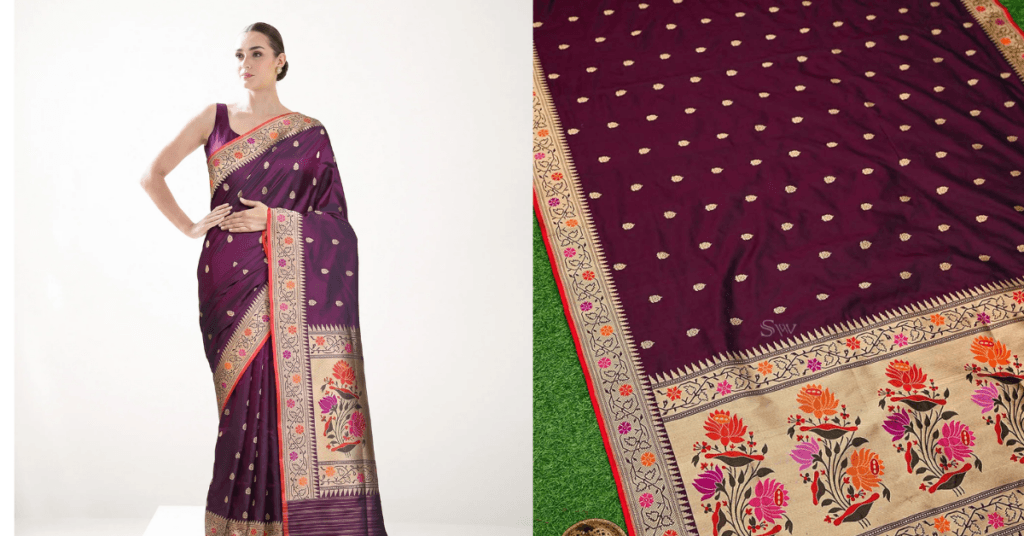
Banarasi Paithani sarees are an interesting example of this exchange. In the way the term is commonly used in the Banaras textile trade, it refers to sarees woven in the Banarasi tradition while drawing inspiration from the distinctive motifs, colours and decorative character associated with Maharashtra’s Paithani sarees.
This distinction is important.
A traditional Paithani belongs to Maharashtra’s celebrated weaving heritage and takes its name from Paithan in present-day Chhatrapati Sambhajinagar district. Paithani Sarees and Fabrics are also registered as a Geographical Indication for Maharashtra.
A Banarasi Paithani, on the other hand, brings elements of this Maharashtrian design vocabulary onto the looms of Banaras. The result can combine recognisable Paithani-inspired birds, florals and decorative pallus with the zari work, jaal, fabrics and weaving vocabulary for which Varanasi is known.
What Makes a Saree “Banarasi Paithani”?
There is no need to think of a Banarasi Paithani as one fixed design.
The term is better understood as a design interpretation within Banarasi weaving.
A weaver or designer in Varanasi may take visual elements associated with Paithani—such as peacocks, parrots, lotuses, floral vines, contrasting colours or an elaborate pallu—and reinterpret them through the structure and decorative techniques of a Banarasi saree.
This is where the character of the two traditions begins to meet.
Traditional Paithani is especially recognised for its richly ornamented border and pallu. Government references describe the peacock as one of its characteristic pallu motifs, alongside lotus, mango and other nature-derived designs. Parrots or munia, peacocks or mor, and lotus patterns are also documented among established Paithani design types.
Banaras brings a different vocabulary to the composition. Banarasi brocades are known for elaborate zari, floral and foliate forms, bel, jali or net-like patterns, meena work and sophisticated motif construction on the loom.
A thoughtfully designed Banarasi Paithani can therefore feel familiar to someone who loves Paithani while still carrying a distinct Banaras identity.
Related guide – Banarasi Shikargah Sarees: A Complete Guide to Their History, Motifs and Craftsmanship
How Are Banarasi Paithani Designs Made in Varanasi?
The process begins with design.
In Banaras, a saree design is not simply an image placed over a fabric. Motifs have to be translated into a form that can be woven through warp and weft.
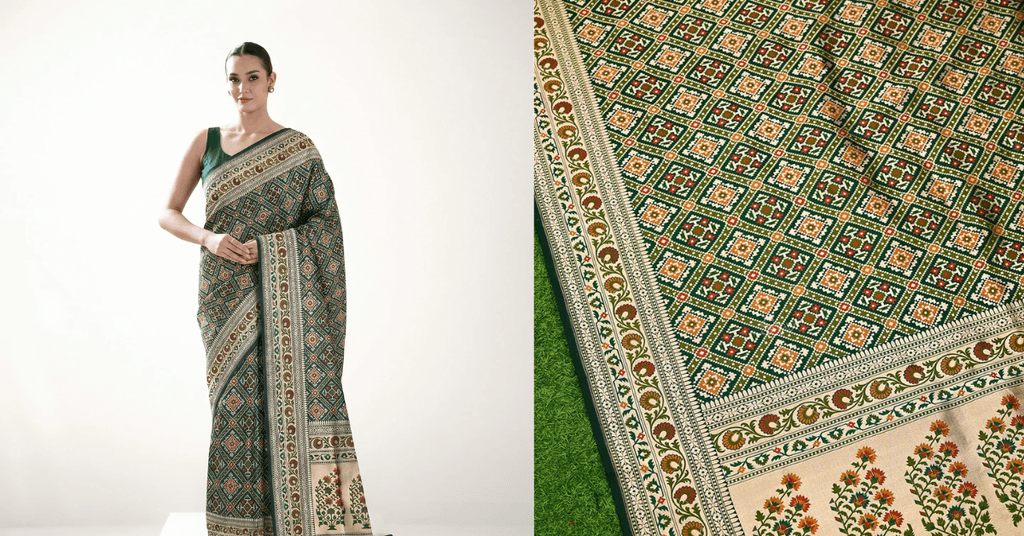
For a Paithani-inspired Banarasi design, the designer may begin with familiar visual elements such as a peacock, parrot, lotus, floral vine or ornamental pallu. These are then adapted according to the desired fabric, weave, scale, colour arrangement and zari treatment.
The final saree need not copy a Maharashtrian Paithani exactly. In fact, the more interesting examples often allow the Banaras vocabulary to remain visible.
A peacock may become part of a more elaborate Banarasi composition. A floral element may develop into a flowing jaal. Meenakari may introduce coloured details between metallic zari motifs. A Paithani-inspired pallu may be combined with a distinctly Banarasi border.
That interaction between design traditions is what gives the saree its individual identity.
The Role of Jaal in Banarasi Paithani Sarees
A jaal is an interconnected pattern that spreads across a substantial part—or sometimes almost the entire body—of a saree.
In Banarasi weaving, jali or net-like arrangements are an established part of the textile vocabulary.
When used in a Banarasi Paithani saree, a jaal can create a much richer surface than isolated motifs alone. Floral stems, leaves, birds and other elements can flow into one another, making the body of the saree feel continuous and highly detailed.
This is also where a Banarasi interpretation can differ visually from many traditional Paithani compositions, in which much of the decorative emphasis is often concentrated around the borders and pallu.
The density of the jaal, number of colours, zari content and intricacy of individual motifs can all influence how elaborate—and expensive—the finished saree becomes.
Shikargah and Paithani-Inspired Banarasi Design
Shikargah is another term that deserves careful distinction.
Shikargah belongs to the Banarasi design vocabulary rather than traditional Paithani design. It generally refers to elaborate compositions inspired by hunting scenes, flora, fauna, birds and animals.
Today, Banaras weavers work with Shikargah compositions across fabrics including georgette, and examples can feature an extensive Shikargah jaal woven in zari. Contemporary Varanasi textile houses also list Paithani and Shikargah as separate techniques or design categories within their Banarasi repertoire.
Where the two ideas are brought together, the result should therefore be understood as a Banarasi design interpretation rather than describing Shikargah itself as a traditional Paithani motif.
This distinction may sound small, but it matters when discussing Indian textiles accurately.
Banarasi Paithani Sarees in Silk and Georgette
One reason Banarasi Paithani designs can look very different from one saree to another is the choice of fabric.
Silk naturally lends itself to a more structured, rich and ceremonial appearance. When combined with substantial zari and an elaborate pallu, it can produce the kind of grandeur buyers often look for in wedding and heirloom sarees.
Georgette Banarasi Paithani sarees offer another expression.
Georgette has a softer, more fluid drape. This can make an intricate saree feel easier to carry while retaining the richness of woven motifs and zari. Banaras textile makers also work extensively with chiffon-georgette and pure khaddi georgette for detailed jaal and zari compositions.
The fabric therefore changes more than the feel of a saree—it affects its fall, visual weight, movement and the way an intricate design appears when draped.
What Is a Zari Banarasi Paithani Saree?
Zari plays an important role in both textile traditions, although the weaving structures and design treatment are not necessarily the same.
Traditional Paithani is renowned for its ornamental zari border and pallu, while intricate zari is equally fundamental to many Banarasi brocades.
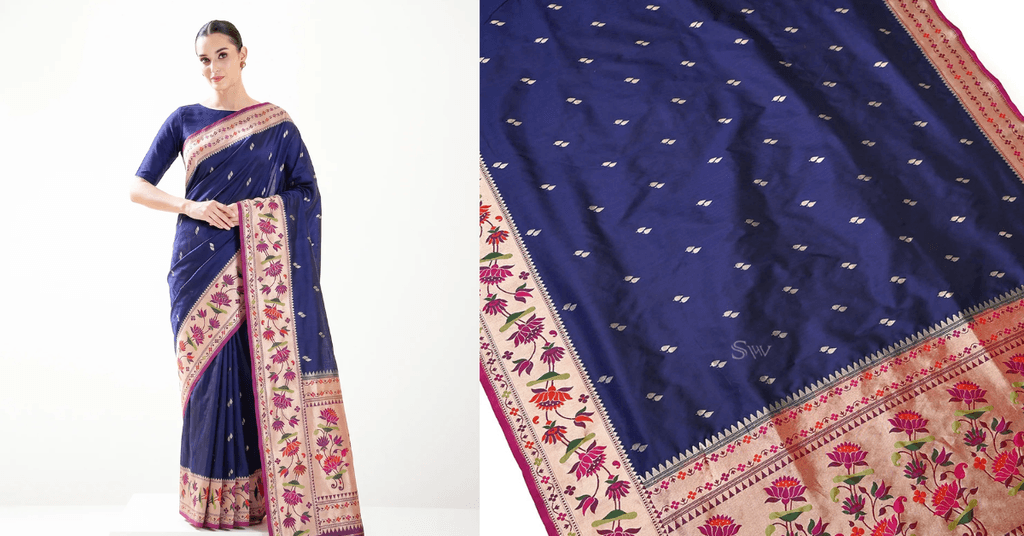
A Zari Banarasi Paithani saree may use metallic yarn to define birds, floral motifs, borders, jaal and the pallu. In more elaborate pieces, coloured meenakari details can be introduced alongside zari to give the motifs greater depth.
The type of zari should always be checked separately.
Not every saree sold under a Paithani or Banarasi Paithani description contains real zari. Contemporary sarees can use different grades and compositions of metallic yarn. If real zari is important to you, ask the seller specifically about the zari composition instead of judging authenticity only from its shine.
Real or higher-quality zari can also have a significant effect on the value of the saree.
Related guide – Bandhani (Bandhej) Banarasi Saree: A Simple Complete Guide
Are Paithani Sarees 9 Yards or 6 Yards?
This is an area where descriptions online can become confusing.
The Government of Maharashtra’s MSSIDC notes that the original Paithani was historically a nine-yard pure-silk saree known as the Navvari Paithani.
That historical association, however, does not mean every Paithani sold today must be nine yards.
Paithani has evolved with changing wearing habits, and contemporary sarees are also produced in the more commonly worn saree format. The important point is therefore not to use nine-yard length alone as a test of whether a Paithani is genuine.
For someone specifically looking for the traditional Maharashtrian nine-yard drape, the product length should be confirmed before buying.
Likewise, when purchasing a Banarasi Paithani saree, check the listed saree and blouse-piece measurements rather than assuming the length from the word “Paithani.”
Why Is Paithani So Closely Associated With Maharashtra?
Paithani is much more than a decorative silk saree in Maharashtra.
Its name comes from Paithan, and Paithani weaving has deep historical roots in the region. Maharashtra government sources describe it as an heirloom tradition, while official textile material also identifies the saree as a traditional part of a Maharashtrian bridal trousseau.
That explains why peacock-rich pallus, vivid colour combinations and Paithani-inspired designs continue to have particular emotional and ceremonial relevance for Maharashtrian buyers.
When such designs are woven in Banaras, the aesthetic may appeal to someone who loves this Maharashtrian visual language but also appreciates Banarasi fabrics, zari and weaving.
Banarasi Paithani Sarees for Weddings
A Banarasi Paithani saree for weddings works particularly well when the wearer wants a saree with a strong traditional presence but does not want a conventional Banarasi composition.
For brides, mothers of the bride or groom, and close family members, richer variations with an elaborate pallu, zari border and detailed body can work beautifully for wedding ceremonies.
Red, maroon, green, purple, magenta and jewel tones naturally complement the ceremonial character of these designs. More contemporary interpretations may use subtler tones or lighter fabrics such as georgette.
For Maharashtrian weddings in particular, Paithani-inspired motifs can create an immediate cultural connection, while the Banarasi weaving gives the saree a different textile expression.
The choice ultimately depends on how traditional you want the Paithani identity to remain.
Someone specifically seeking a traditional Maharashtrian Paithani should look for a genuine Paithani woven within that tradition. Someone drawn to the combination of Paithani motifs and Banaras craftsmanship may instead prefer a Banarasi Paithani.
Banarasi Paithani Sarees Price: Why Can They Be Expensive?
There is no meaningful single Banarasi Paithani sarees price because sarees sold under this name can differ enormously in material and workmanship.
A price should be understood through the saree itself.
The fabric used, handloom or other production method, quality and quantity of zari, complexity of the pallu, density of the jaal, number of colours, weaving technique, fineness of the design and time required to produce it can all affect cost.
This is especially important with intricate handwoven textiles. Government handloom documentation notes that Paithani production time can vary greatly according to the complexity of a design, and the quality of yarn and zari also influences the final cost.
The same buying logic applies to premium Banarasi work: two sarees that look similar in an online photograph can differ substantially in fibre, zari, weaving quality and labour.
So a higher price should be supported by identifiable textile value—not merely by the words “Banarasi,” “Paithani” or “bridal” in the product name.
Related guide – Banarasi Brocade Sarees: The Complete Guide From Varanasi
Is a Banarasi Paithani the Same as an Original Paithani Saree?
No, the terms should not automatically be treated as interchangeable.
For a buyer searching for a Paithani saree original, the geographical and weaving context matters.
“Paithani Saree & Fabrics” is registered as a GI for Maharashtra. Traditional Paithani is associated with Paithan and important weaving centres such as Yeola, and it has its own techniques, motifs and cultural history.
Banaras also has a separately recognised GI tradition: Banaras Brocades and Sarees, associated with Uttar Pradesh and the Varanasi weaving region.
A Banarasi Paithani woven in Varanasi should therefore be appreciated for what it is: a Banaras textile that draws inspiration from Paithani design, rather than being passed off as an original Maharashtra Paithani.
For collectors and serious saree buyers, that transparency adds value rather than taking anything away from the saree.
What to Check When Buying Banarasi Paithani Sarees Online
When looking at Banarasi Paithani sarees online, do not make the decision from the product title alone.
Read the fabric composition and saree measurements. Ask whether the piece is handloom woven and what weaving technique has been used. Check what type of zari it contains. Look closely at the pallu, border and body instead of judging the saree from one styled image.
Most importantly, understand what the seller means by “Paithani.”
Is it an original Paithani woven within Maharashtra’s Paithani tradition? Or is it a Banarasi saree using Paithani-inspired motifs and design?
A knowledgeable seller should be able to explain the difference clearly.
That clarity is particularly important when you are buying an expensive saree for a wedding, bridal trousseau or heirloom collection.
Two Traditions, One Interesting Design Conversation
The beauty of a Banarasi Paithani lies not in pretending that Banaras and Paithan are the same textile tradition, but in appreciating what happens when their visual languages meet.
Paithani contributes an unmistakable Maharashtrian heritage of peacocks, parrots, lotus forms, striking borders and ornate pallus. Banaras contributes its own centuries-old vocabulary of zari, jaal, meenakari, brocade, sophisticated motif development and diverse silk and georgette fabrics.
Together, they can create a saree that feels familiar yet distinctly different.
For someone who values Indian textiles, understanding that distinction makes the saree even more interesting: Paithani in inspiration, Banarasi in interpretation.
Frequently Asked Questions
A Banarasi Paithani generally refers to a saree woven in the Banaras textile tradition that incorporates design elements associated with Paithani, such as peacocks, parrots, lotus motifs, decorative borders or an elaborate pallu. It should be distinguished from a traditional Paithani woven in Maharashtra.
A Banarasi Paithani woven in Varanasi is not the same geographical textile as Maharashtra’s GI-registered Paithani Sarees and Fabrics. It is better understood as a Banarasi interpretation of Paithani-inspired design.
No. Historically, the original Navvari Paithani was a nine-yard saree, but Paithani is also made today in other saree lengths. Always check the actual product dimensions before purchasing.
The price can rise with better silk, real or higher-quality zari, intricate handloom weaving, dense jaal work, complex motifs, elaborate pallus and the amount of skilled labour involved.
Yes. Rich zari, elaborate borders and Paithani-inspired motifs make them particularly suitable for weddings, festive ceremonies and bridal-family wardrobes. Buyers wanting a specifically traditional Maharashtrian bridal Paithani, however, should distinguish it from the Banaras-woven interpretation.
Yes. Banaras weaving is practised on several fabrics, and georgette is used for intricate zari and jaal sarees. A georgette Banarasi Paithani can offer a softer, more fluid alternative to heavier silk versions.