
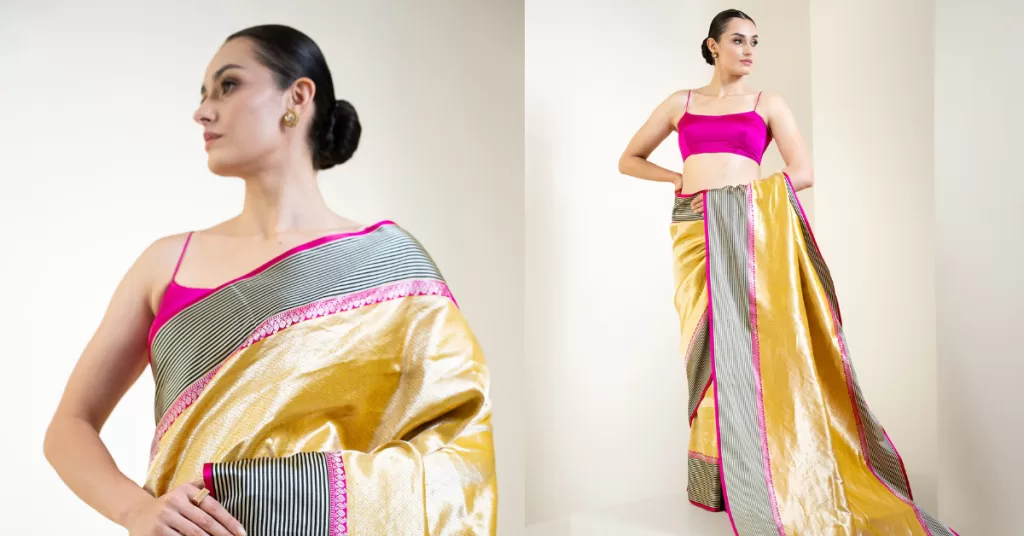
Banarasi brocade sarees are handwoven silk sarees from Varanasi in which gold and silver zari thread is woven directly into the fabric itself to create the design — not printed, not embroidered on afterward, but built into the cloth on the loom. This is what the word “brocade” specifically means in weaving: a raised, ornamental pattern created by an extra set of threads (called the supplementary weft) worked in alongside the base fabric. Banarasi brocade traces its major growth to the Mughal era, when Persian design sensibilities merged with existing Indian silk-weaving traditions in Varanasi, and it remains, centuries later, one of the most recognisable and most imitated silk weaves in India. A genuine handloom Banarasi brocade saree can take anywhere from 15 days to several months to complete, depending on the density and technique of the motifs.
What Does “Brocade” Actually Mean? Understanding the Weave, Not Just the Look
Before we go further, it’s worth pausing on a word that gets used constantly in saree shopping but rarely explained properly: brocade.
Every woven fabric starts with two sets of threads. The threads running the length of the fabric are fixed onto the loom before weaving begins — this is the warp. The threads running across the width, thrown by hand through the warp using a small wooden shuttle, are the weft. Together, warp and weft interlocking is what creates any woven cloth, from the simplest cotton to the finest silk.
A brocade weave adds a third element: a supplementary weft — usually zari thread, sometimes coloured silk — woven in alongside the base weft specifically to build a motif. Wherever the design calls for a flower, a paisley, or a vine, this extra thread is worked into the structure of the cloth itself. The motif isn’t sitting on top of the fabric. It’s part of it.
This is the single most important thing to understand about Banarasi brocade: it is defined by how it’s made, not by how it looks. Two sarees can look almost identical on a showroom shelf, and only one of them is genuine handloom brocade — the other might be a printed or embroidered imitation of the same visual style, made in a fraction of the time.
Expert Insight
We get asked constantly at JDS Banaras: “is this real brocade, or is it printed to look like brocade?” It’s a fair question, because from two feet away, a well-made print can genuinely fool the eye. The honest answer is that you have to feel it, not just look at it. Run your fingers over a motif — genuine woven brocade has a texture, a very slight raised quality where the supplementary thread sits. Printed brocade is flat. That single tactile check has saved more than a few of our customers from an expensive mistake elsewhere.
Related guide: Rangkat Banarasi Saree: The Complete Guide to Banaras’ Most Artistic Weave
The History of Banarasi Brocade: From Mughal Courts to Varanasi’s Looms
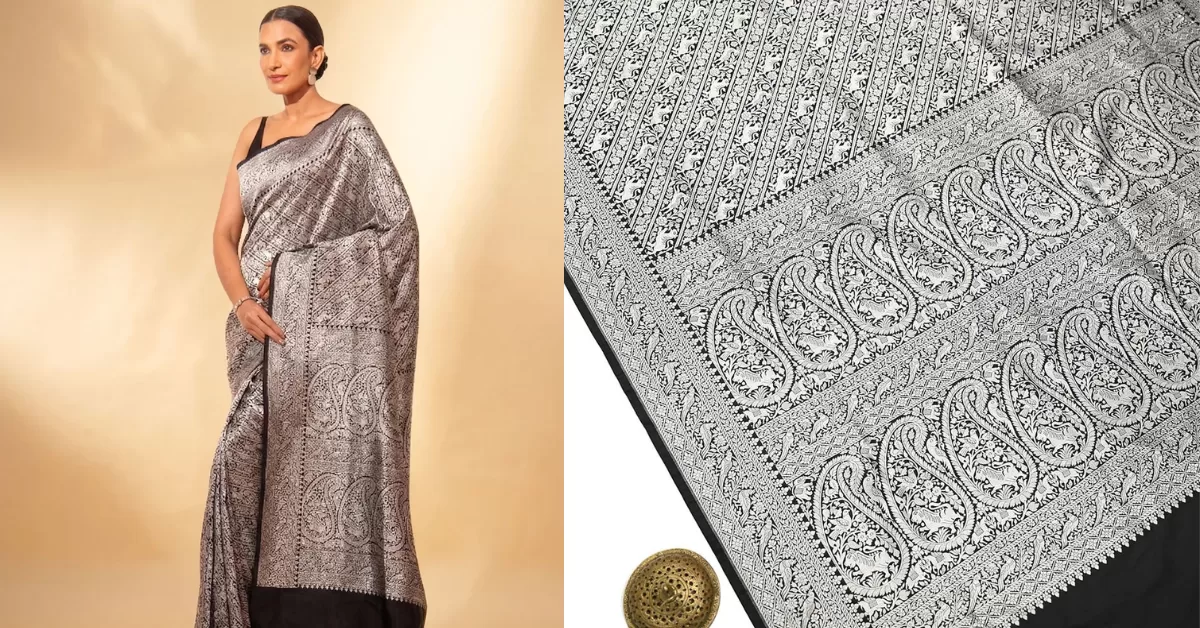
Varanasi’s silk-weaving tradition is old — old enough that some historical accounts trace threads of it back many centuries before the Mughal period. What’s more firmly documented, and what most directly shaped the Banarasi brocade we recognise today, is the transformation that happened under Mughal patronage between roughly the 14th and 17th centuries.
Persian weavers, textile artisans, and their design vocabulary arrived in India during this period, and in Varanasi specifically, that Persian aesthetic — floral vines, paisley forms (boteh), and formal garden motifs — merged with existing Indian silk-weaving skill. The result was something genuinely new: a design language that was neither purely Persian nor purely Indian, but a fusion that became the visual signature of Banarasi textiles.
Under emperors known for their patronage of the arts, brocade wasn’t just fabric — it was a status symbol, worn at court and gifted as an expression of wealth and taste. As Mughal court patronage eventually declined, the weaving communities didn’t disappear with it. They continued the craft in Varanasi, along the Ganga, passing the skill down through families — a transmission of technique that, in many weaving households, continues unbroken to this day.
This is not a static, museum-piece history. It is a living craft, practised today by descendants of the same weaving communities, using looms and techniques with a direct lineage to that Mughal-era transformation.
Related guide : What Is Kadhua Weave? The Complete Guide to Kadwa Weaving
How Banarasi Brocade Sarees Are Actually Woven
Every genuine Banarasi brocade saree begins as raw silk thread and ends, weeks or months later, as six yards of finished fabric. Here’s what actually happens between those two points.
- Preparing the Warp and Weft
The base silk threads are prepared and set onto the loom as the warp — thousands of fine threads running the full length of the saree, roughly 5.5 metres. This setup alone, for a dense or complex design, can take days before a single row is woven.
- Setting the Design
For patterned brocade, a jacquard mechanism sits atop the loom, controlling which warp threads lift at each pass to create the design’s structure. Traditionally, this was programmed using perforated cards — a system, incidentally, that is a direct historical ancestor of early computing punch-card logic.
- Weaving the Base Fabric and the Motifs
The weaver throws the base weft shuttle across the warp to build the plain fabric, then works in the supplementary zari or silk weft to build each motif. Depending on the specific technique — standard brocade, or the more labour-intensive Kadwa method where each motif is woven individually rather than thrown continuously — this stage is where the vast majority of the saree’s total weaving time is spent.
- Finishing
Once weaving is complete, the fabric is inspected, loose threads are trimmed, and the saree is prepared for the showroom floor. At this stage, the true richness and precision of the motif work becomes fully visible for the first time.
A relatively simple brocade design can be completed in 15 to 30 days. A dense, heavily worked design — particularly one using the individually-woven Kadwa technique — can take several months. This is the direct, verifiable reason genuine handloom Banarasi brocade commands the price it does: every additional day of weaving is a day of a skilled artisan’s labour, not a manufacturing cost that scales down with volume.
Types of Banarasi Brocade Sarees — A Complete Guide
“Banarasi brocade” is not one single fabric — it’s a family of related weaves, each built on a different base silk and each suited to a different kind of occasion. Understanding the differences will make you a genuinely confident buyer.
Katan Brocade
Katan refers to pure silk thread, tightly twisted in both warp and weft, that forms the classic bridal Banarasi base. Katan brocade is structured, substantial, and holds pleats beautifully — it is the fabric most people picture when they hear “Banarasi saree.” For a full breakdown of Katan silk specifically, see our detailed guide: What Is Katan Silk and Is It Pure?
Tissue Brocade
In Tissue brocade, the weft itself is largely zari — gold or silver metallic thread — woven against a silk warp, producing a shimmering, lightweight fabric with an almost molten-metal glow. It’s a favourite for evening receptions and blouses meant to catch the light. Read more in our dedicated guide: What Is Tissue Silk Saree?
Georgette Brocade
Georgette brocade combines the ornamental richness of brocade motifs with the soft, flowing drape of Georgette’s crinkle-weave base. This is the fabric of choice for anyone who wants Banarasi’s visual richness without a heavy, structured drape.
Organza (Kora) Brocade
Sheer, crisp, and semi-transparent, Organza brocade sees the motifs almost float against the fabric’s transparent base. It’s especially striking for summer weddings, where structure and visual richness are wanted without added weight.
Jangla Brocade
Named for its dense, jungle-like coverage, Jangla brocade features continuous floral and vine motifs running across the entire body of the saree — often with little to no visible ground fabric showing through. It is one of the oldest and most opulent Banarasi design categories, and among the most labour-intensive to weave.
Butidar Brocade
Where Jangla is dense and continuous, Butidar is scattered — small, individual motifs (butis) repeated evenly across the body, typically with generous spacing between them. When both gold and silver zari are used together in the same motif, this style is often called Ganga-Jamuna, after the meeting of the two rivers.
Shikargah Brocade
Shikargah translates roughly to “hunting ground,” and this brocade style depicts exactly that: elephants, tigers, deer, and hunters woven into narrative scenes across the fabric. It is one of the most artistically ambitious Banarasi motifs, directly inspired by Mughal court art depicting royal hunts.
Tanchoi Brocade
Tanchoi uses a satin base and typically favours richly coloured silk threads over heavy zari, producing a smooth, jewel-toned fabric with a distinctive jamawar-like appearance. It’s the choice for buyers who want Banarasi’s craftsmanship in a more understated, colour-forward finish.
Cutwork Brocade
A faster, more accessible weaving technique where the supplementary weft floats behind the fabric between motifs and is trimmed after weaving, rather than turned and woven closed at each motif’s edge. Cutwork brocade offers real handloom character at a more approachable price point than dense Kadwa work.
Related guide: Meenakari Banarasi Saree: The Complete Guide to Banaras’ Finest Colourful Weaving Art
How to Identify a Genuine Handloom Banarasi Brocade Saree
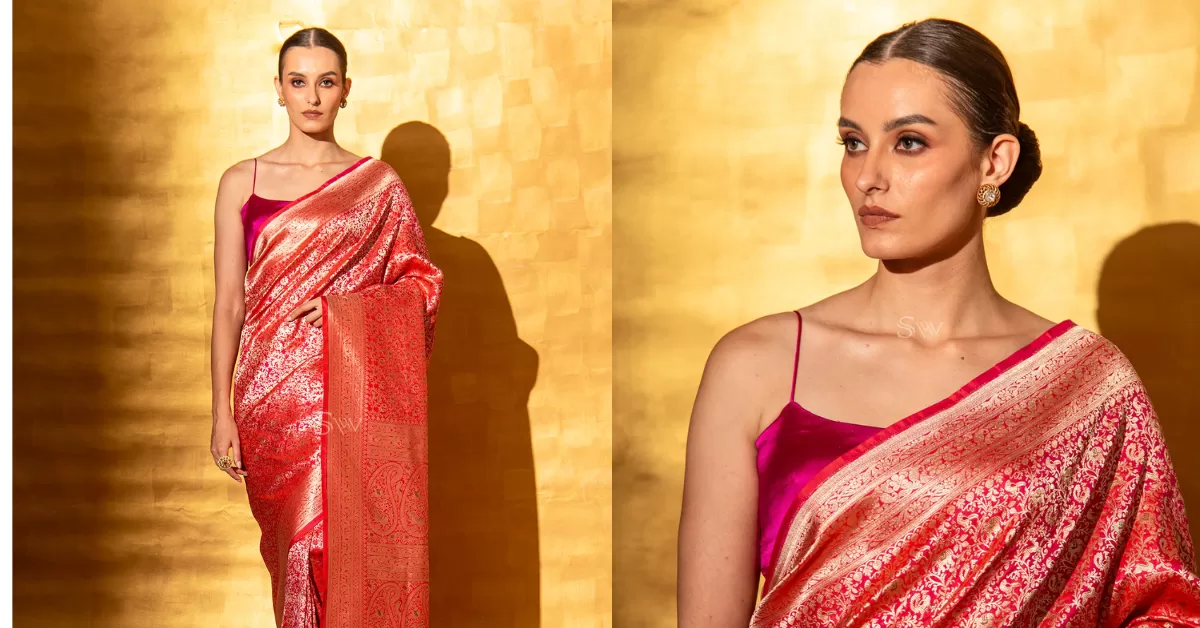
With Banarasi’s popularity comes an unfortunate reality: the market is full of power-loom and printed imitations sold under the same name. Here’s what to actually check.
- Feel the motif, don’t just look at it. Genuine woven brocade has a subtle raised texture where the supplementary thread sits. Printed imitations are flat to the touch.
- Check the reverse side. Turn the saree over. Handwoven brocade typically shows some thread structure on the back — in standard brocade, floating threads behind the motifs; in Kadwa weaving, a cleaner, closed finish with no floats at all. A power-loom or printed imitation shows neither — just a flat, uniform reverse.
- Look for a loom mark. Genuine handloom sarees often carry a small pin or loom mark near the pallu, a natural byproduct of the weaving process.
- Scratch-test the zari. Real zari is silver wire, gold-plated, wrapped around a silk core — scratching it reveals silver beneath the gold. Synthetic zari flakes or shows plastic underneath.
- Ask for Silk Mark certification. Issued by the Silk Mark Organisation of India under the Central Silk Board, Government of India, this tag independently verifies pure silk content.
- Check for GI tag documentation. Banarasi silk holds Geographical Indication protection, legally restricting the name to sarees genuinely woven within Varanasi’s designated production zone.
For the complete step-by-step test — including the burn test and how to interpret each result — see our detailed guide: Real Silk Versus the Fake: How to Identify.
Expert Insight
If a seller discourages you from turning the saree over or doing the scratch test, treat that as information in itself. At JDS Banaras, we actively encourage every one of these checks before a customer buys — a genuine handloom brocade saree has nothing to hide, and honestly, watching a first-time buyer learn to spot the difference for themselves is one of the most satisfying parts of this work.
When Is Banarasi Brocade Worn? Occasions and Cultural Significance
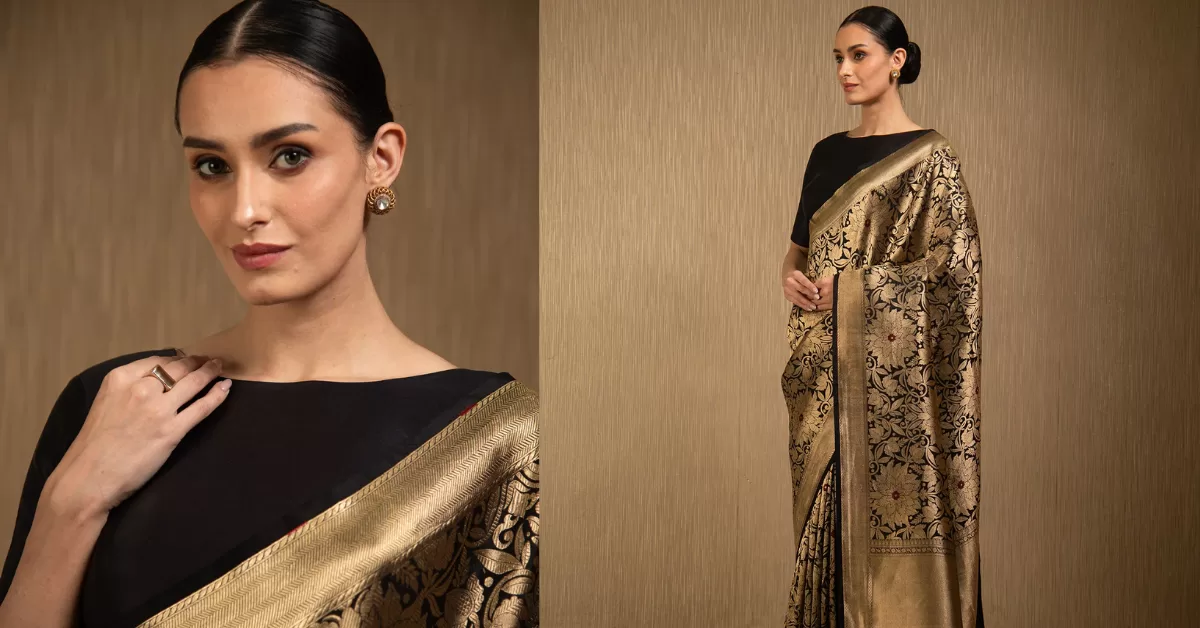
Banarasi brocade occupies a central place in North Indian cultural life, well beyond simply being an expensive fabric.
Weddings remain its most significant occasion — a red or maroon Banarasi brocade saree is the traditional choice for Hindu brides across Uttar Pradesh and Bihar in particular, and heavy Jangla or Kadwa Katan pieces are frequently chosen specifically for the main wedding ceremony.
Festivals such as Diwali, Durga Puja, and Karva Chauth regularly see Banarasi brocade worn as a form of festive, celebratory dressing — the fabric’s natural shimmer suits evening lamplight and celebration alike.
Religious ceremonies also feature Banarasi brocade prominently — pieces are sometimes offered to deities in temples, and the fabric’s association with purity and tradition makes it a natural fit for pujas and rituals.
Heirloom gifting is perhaps the most emotionally significant occasion of all. A Banarasi brocade saree is very often purchased not just to be worn once, but to be preserved and passed from a mother to a daughter, carrying family history in six yards of silk.
Real-world proof of Banarasi brocade’s enduring prestige at the very highest level continues into the present day. In 2026, Nita Ambani wore a handwoven Kadwa Banarasi brocade saree — a labour-intensive brocade variant where each motif is woven individually — to the Venice Biennale, a piece that took two master artisans five months to complete. Read the full story here: Nita Ambani’s Banarasi Saree Splendor.
Common Myths About Banarasi Brocade Sarees
Myth 1: All Banarasi Sarees Are Brocade
Reality: Not every Banarasi saree uses brocade weaving. Some Banarasi weaves, like certain Tanchoi and plain Katan pieces, use little to no zari brocade work at all. “Banarasi” refers to the region of origin and its weaving traditions broadly — brocade is one major technique within that tradition, not a synonym for it.
Myth 2: Heavier Always Means More Authentic
Reality: Weight reflects the base silk and zari density used, not necessarily authenticity. A lightweight Organza brocade with delicate, precisely woven motifs can be just as genuinely handwoven — and just as technically demanding — as a heavy Jangla piece.
Myth 3: Brocade and Embroidery Are the Same Thing
Reality: They are fundamentally different processes. Brocade motifs are woven into the fabric’s structure during weaving itself, using a supplementary weft thread. Embroidery is applied to an already-finished fabric using a needle after weaving is complete. A trained eye — and a simple touch test — can usually tell the two apart.
Myth 4: Machine-Made Brocade Looks Identical to Handloom
Reality: Power-loom brocade can approximate the visual pattern of handloom brocade, but it typically lacks the subtle irregularity, raised texture, and reverse-side structure that genuine handweaving produces. Side by side, the difference is usually clear once you know what to look for.
The JDS Banaras Perspective on Banarasi Brocade
As a Banarasi saree manufacturer working directly with Varanasi’s weaving families since 1913, brocade weaving is not a category we simply stock — it is the craft our family has spent four generations helping to preserve. We source directly from weaving families across Varanasi, which means every brocade saree at JDS Banaras comes with a documented, honest account of how it was actually made.
Every pure silk saree at JDS Banaras comes with a certificate of authenticity specifying the fabric type, the weaving technique, and the zari grade used. Learn more about our work as a Banarasi saree manufacturer in Varanasi, or read about our showroom experience here: Experience the Authentic Banarasi Saree Shop in Varanasi.
Visit JDS Banaras — See Genuine Brocade Weaving Up Close
No article fully replaces holding a genuine handwoven Banarasi brocade saree in your own hands — feeling the texture of the motifs, seeing the reverse side, understanding the weight and drape for yourself. At JDS Banaras, our team can walk you through every type of brocade described in this guide, motif by motif.
JDS Banaras — Jagdish Das & Company
D-58/1, Rathyatra Kamachha Road, Rathyatra Crossing, Varanasi 221010
Phone: +91 7269 055 695
Hours: Monday to Saturday, 10:30am to 8:30pm
Get in touch via our contact page, or learn more about JDS Banaras.
Frequently Asked Questions