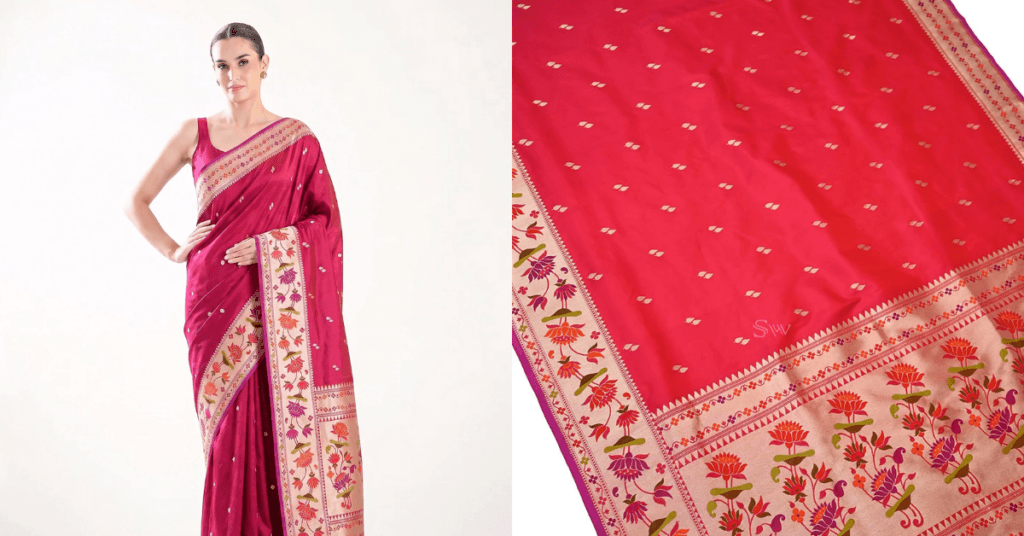
A Paithani saree may be recognised at first glance by its lustrous silk, contrasting border and elaborate pallu filled with peacocks, parrots, lotuses or flowering vines.
But those visual elements alone do not prove that a saree is an authentic Paithani.
Today, Paithani-inspired motifs can be printed, embroidered or machine woven on different fabrics. Some sarees use pure silk; others use blends or synthetic fibres. There are also Banarasi and other regional sarees that intentionally reinterpret the Paithani design language.
So, how do you identify an original Paithani silk saree?
The most reliable approach is to examine several things together: where it was made, how the motifs are woven, what the reverse side looks like, the silk used, the pallu and border construction, zari quality and the information provided by the seller.
No single touch test, price tag or peacock motif can establish authenticity on its own.
Quick Check: What Does an Authentic Paithani Look Like?
| What to Check | What to Look For |
| Origin | Maharashtra; ask where the saree was woven |
| Technique | Woven motifs rather than printed or surface-applied designs |
| Reverse side | Traditional tapestry work can look remarkably similar on both sides |
| Silk | Natural silk with characteristic lustre and drape |
| Pallu | Elaborately woven and integral to the saree |
| Border | Woven into the saree, often with geometric or traditional forms |
| Motifs | Mor, Bangadi Mor, Popat, Kamal, Asawali, Kuyri and related designs |
| Colour | Rich colours; some Paithanis show a characteristic two-tone dhoop-chaav effect |
| Zari | Quality varies; ask exactly what type has been used |
| Documentation | GI/authenticity information, Silk Mark where applicable, clear seller disclosure |
First Understand What “Original Paithani” Means
Paithani is not simply a saree with a peacock on its pallu.
It is a historic textile tradition of Maharashtra, named after Paithan in present-day Chhatrapati Sambhajinagar district.
The Government of Maharashtra describes Paithani as a handwoven silk tradition associated with Paithan and known particularly for its ornamental zari borders and pallus.
More importantly, “Paithani Saree & Fabrics” is a registered Geographical Indication, and the official Indian GI registry lists its geographical area as Maharashtra.
That means the question of authenticity involves more than appearance.
You need to distinguish between:
a traditional Paithani,
a pure silk saree with Paithani-style motifs, and
a Paithani-inspired saree woven in another textile tradition.
They may all be beautiful, but they are not necessarily the same textile.
Related guide – What Are Banarasi Paithani Sarees? A Guide to Their Design, Weaving & Heritage
1. Ask Where the Saree Was Woven
This should come before all the popular “home tests.”
Ask the seller:
Where was this Paithani woven?
Paithan is the historic home of the craft, while Yeola is another important contemporary centre of Paithani production.
But one of the references supplied for this article claims that only a saree woven in Yeola can legally be called Paithani. That is too narrow.
The official GI registration for Paithani Saree & Fabrics identifies Maharashtra as the geographical area, not Yeola alone.
Therefore, ask for clear information about provenance rather than relying on claims such as:
“Yeola means real”
or
“Paithan means real.”
A knowledgeable seller should be able to explain where the saree comes from and what type of Paithani it is.
2. Turn the Saree Over and Examine the Reverse Side
This is one of the most useful physical checks.
Traditional Paithani uses a tapestry-style weaving approach in which coloured weft threads are worked into specific sections of a motif rather than merely printed onto the finished cloth.
Government handloom documentation notes a distinctive characteristic of Paithani: the textile can appear remarkably similar from either side because of its traditional tapestry technique.
Look particularly at the decorative pallu.
A traditionally woven motif should form part of the fabric itself.
If a peacock appears beautifully on the front but the back reveals:
- obvious embroidery backing,
- pasted decoration,
- printed colour,
- large messy thread floats, or
- attached motifs,
you are likely not looking at traditional Paithani tapestry work.
But don’t demand literal perfection
“Both sides should be completely identical” is an oversimplification.
Different motifs, contemporary loom arrangements, zari constructions and finishing techniques may affect the reverse.
What you are looking for is woven structural integrity, not photographic front-to-back duplication.
Related guide – How to Identify a Pure Organza Saree? A Practical Guide to Real Silk Organza
3. Check Whether the Motifs Are Woven, Printed or Embroidered
A traditional Paithani motif is created during weaving.
Run your fingers gently across a peacock, lotus or floral design.
You should be able to perceive the structure of woven threads rather than a layer of colour sitting flat on top of the fabric.
The National Handloom Development material describes Paithani designs as being produced using additional weft yarns and multiple small bobbins or tillis for intricate motifs.
Printed imitations are easier to recognise:
the motif has little or no woven texture and behaves like part of the printed surface.
Embroidery can also imitate Paithani imagery beautifully, but embroidery and traditional Paithani weaving are two different techniques.
The distinction is not about whether one looks attractive.
It is about knowing what you are actually buying.
4. Learn the Traditional Paithani Motifs
Paithani has a recognisable visual vocabulary.
Common traditional motifs documented in government textile material include:
Mor – peacock
Bangadi Mor – peacock within a bangle-like composition
Popat or Tota-Maina – parrot
Kamal – lotus
Asawali – flowering vine
Kuyri – mango/paisley
Narli – coconut
Hans – swan
Tara – star
Pankha – fan
Many of these motifs reflect nature, while some Paithani imagery has also been associated with the artistic influence of the nearby Ajanta caves.
The peacock pallu is perhaps the most immediately recognisable Paithani feature, but remember:
a peacock does not make a saree Paithani.
Peacock motifs occur across Indian textile traditions.
Look at the weaving technique, provenance and overall construction along with the motif.
5. Examine the Pallu Carefully
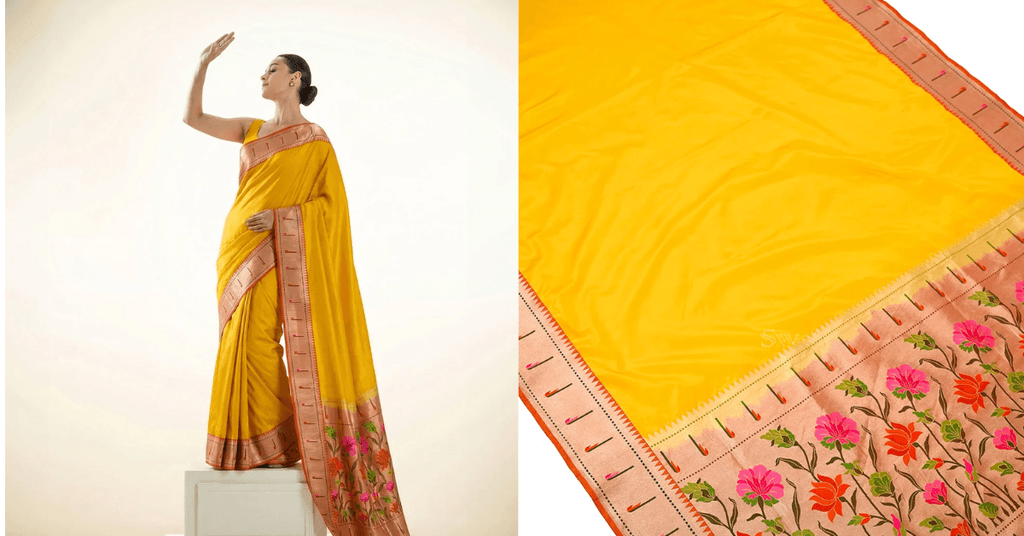
If you want to understand a Paithani, spend time looking at its pallu.
Historically, Paithani was often characterised by a relatively plain body combined with an elaborate zari border and richly ornamented pallu.
The pallu may contain peacocks, parrots, lotus flowers, vines and geometrical arrangements, sometimes involving hundreds of individual thread movements during weaving.
Look closely at where the body transitions into the pallu.
In a well-made Paithani, the pallu should feel like an integral part of the weaving rather than a decorative piece sewn onto the saree later.
If you find:
visible joining seams,
glue marks,
appliqué-style motif placement, or
a completely unrelated fabric attached as the pallu,
ask the seller for clarification.
6. Look at the Border
Paithani borders have their own character.
The Maharashtra government describes one recognisable traditional feature as an oblique-square border, alongside richly ornamented pallus.
Different Paithanis may use different border arrangements, however, so one geometry should not become a rigid authentication test.
The more useful question is:
Has the border been woven as part of the textile, or merely attached or printed later?
On an expensive traditional Paithani, look at how cleanly the border integrates with the body and pallu.
7. Look for the Dhoop-Chaav Colour Effect
One particularly beautiful characteristic found in Paithani is known as dhoop-chaav, literally suggesting the changing effect of light and shade.
It can be created by using one colour in the warp and another in the weft. As the saree moves, the interaction of the two colours creates a changing or shot-colour effect.
The Maharashtra government specifically documents this characteristic of Paithani.
You might see combinations such as:
blue with green,
red with green,
black with red,
pink variations, or
other contrasting shades.
This colour play can be particularly striking in natural light.
But again, it is a characteristic, not a mandatory authenticity test. Not every genuine Paithani needs to have a dramatic two-tone body.
8. Check Whether the Silk Is Actually Silk
This sounds obvious, but two different questions often get mixed together:
Is this saree Paithani?
and
Is this saree pure silk?
They are not the same question.
A saree can contain pure silk and still not be an authentic Paithani. Conversely, Paithani-style products may be sold in different fibre compositions.
When purchasing a Paithani silk saree, ask specifically about the fibre.
Pure silk generally has natural lustre, good drape and a different hand-feel from polyester or art silk.
But the Silk Mark Organisation of India cautions that silk is difficult to identify conclusively merely by sight and touch.
For that reason, documentation is more useful than guessing from softness.
Look for Silk Mark when pure silk is claimed
Where applicable, a genuine Silk Mark can provide assurance that the product contains natural silk.
This helps verify the fibre.
It does not, by itself, prove that the saree is Paithani, handloom or made with real zari.
Those are separate questions.
9. Use the Burn Test Only on a Loose Thread
Your references repeatedly mention the burn test as a method of checking the silk.
There is a sound basis for the fibre test, but it should be used carefully.
According to the Silk Mark Organisation of India, silk:
- burns relatively slowly,
- smells similar to burnt hair, and
- leaves residue that can be crushed.
Polyester and nylon generally melt and form harder plastic-like beads.
But never burn the actual saree.
If testing is truly necessary, use only a loose, separate thread whose origin you are certain about.
And remember what the test can tell you:
It may help identify the fibre.
It cannot tell you whether the saree was woven in Maharashtra, whether the weave is Paithani, or whether the zari is genuine.
Related guide – How Can I Check the Quality of Zari Work to Verify If a Banarasi Saree Is Authentic?
10. Don’t Assume Every Original Paithani Must Use Pure Gold Zari
This is another area where internet guides frequently go too far.
One of your supplied references says that authentic Paithani necessarily uses “pure silver zari dipped in gold.”
Historically, very fine Paithani did indeed use precious-metal zari. Government documentation notes that older Paithanis used zari drawn from pure gold.
But it also explains that silver later substituted for gold to make Paithani more affordable, and contemporary Paithani production uses different qualities of zari that influence the saree’s lustre, strength, price and quality.
Therefore, ask:
What type of zari does this particular saree contain?
Possible answers may vary according to the saree and price point.
What matters is transparency.
A seller should not describe tested or imitation zari as real precious-metal zari.
11. Don’t Treat Small Irregularities as Proof of Handloom
Handwoven textiles can naturally contain small variations in yarn tension, motif placement or weaving.
Your reference material also suggests checking for minor irregularities when distinguishing handloom from power loom.
That is useful—but should not become:
“If it is imperfect, it is genuine.”
A skilled handloom saree may be remarkably precise.
At the same time, modern machine weaving can sometimes imitate irregular-looking details.
Look at handloom characteristics together:
- motif construction,
- reverse side,
- weaving depth,
- provenance,
- documentation, and
- seller explanation.
If the seller specifically claims handloom, ask whether relevant handloom documentation or certification is available.
12. Price Is a Clue, Never Proof
Traditional Paithani can be expensive because elaborate examples require substantial skilled labour, high-quality silk, complex motifs and significant zari.
Government handloom documentation notes that Paithani production time can range from around 10 days to as long as one or two years, depending on design complexity.
That explains why exceptionally detailed sarees can command high prices.
But avoid rules such as:
“Anything under ₹15,000 is fake.”
Prices vary with:
- silk quality,
- zari composition,
- motif complexity,
- pallu density,
- workmanship,
- weaving time,
- retailer margins and
- the specific type of Paithani.
An expensive saree can still be mislabelled.
A surprisingly inexpensive saree deserves extra questions—but price alone cannot authenticate it.
Original Paithani vs Banarasi Paithani: Know the Difference
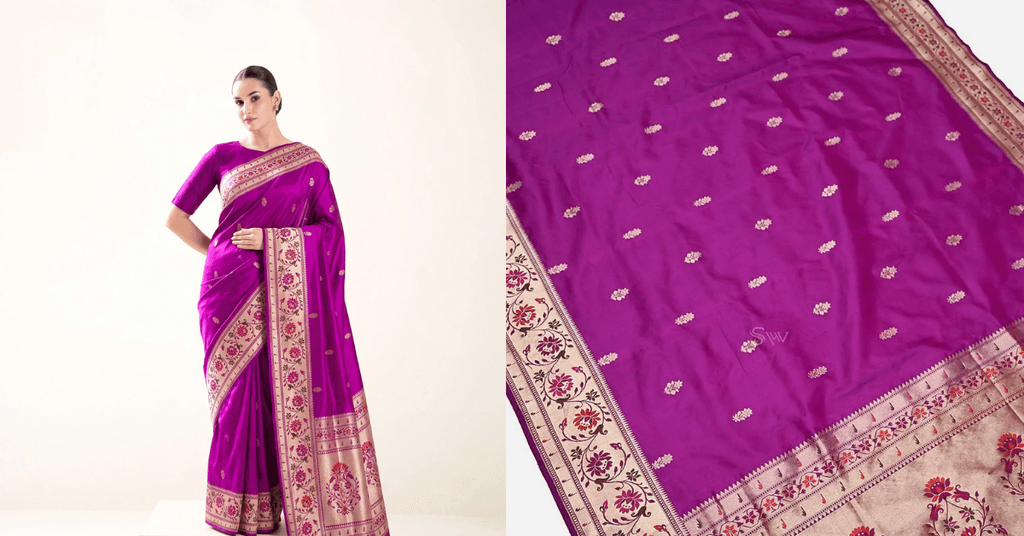
This distinction is particularly important because similar motifs now appear across weaving traditions.
At JDS Banaras, for example, Paithani-inspired designs may be interpreted through Banarasi weaving—using Banaras textile vocabulary alongside motifs associated with Maharashtra.
JDS Banaras makes an important distinction in its own textile guidance: a Banarasi Paithani woven in Varanasi should not be presented as the same thing as an original Maharashtra Paithani.
That is exactly the type of transparency buyers should expect.
An original/traditional Paithani belongs to Maharashtra’s Paithani textile tradition.
A Banarasi Paithani is better understood as a Banarasi saree that draws inspiration from Paithani design—perhaps through peacocks, parrots, lotus forms, colourful pallus or related motifs.
Neither description needs to diminish the other.
They represent different weaving identities.
For a serious saree buyer, knowing the difference makes the purchase more meaningful.
How to Identify a Paithani Saree When Buying Online
Buying online means you cannot examine the weave with your own hands, so seller transparency becomes even more important.
Before placing the order, ask for the following:
1. Exact fibre composition
Is it pure silk, semi-silk, cotton-silk or synthetic?
Do not rely solely on the word “Paithani.”
2. Weaving origin
Ask where in Maharashtra the saree was made.
3. Front and reverse-side photographs
Request clear photographs of:
- body,
- pallu,
- border,
- motifs, and
- reverse side.
4. Close-up video
Movement reveals far more than heavily edited product photographs.
Ask the seller to show the saree in daylight if possible.
5. Zari composition
Is it real precious-metal zari, tested zari or another metallic yarn?
6. Silk documentation
If pure silk is being claimed, ask whether Silk Mark or equivalent documentation accompanies the saree.
7. GI/provenance information
For a saree sold specifically as an authentic Paithani, ask how the seller establishes its Maharashtra origin.
8. Proper invoice and return policy
For a high-value textile, always retain the bill and description under which the saree was sold.
Common Paithani Buying Myths
Myth: A peacock pallu proves it is Paithani
Reality: Peacock motifs occur in many Indian weaving traditions. Technique and origin matter.
Myth: Only Yeola Paithani is genuine
Reality: Yeola is an important Paithani centre, but the registered GI geographical area for Paithani Saree & Fabrics is Maharashtra.
Myth: Both sides must look absolutely identical
Reality: Traditional tapestry Paithani has a characteristic similar appearance on both sides, but finishing, weave type and design can affect the reverse. Judge the structural weaving rather than demanding photographic duplication.
Myth: Real Paithani must use pure gold zari
Reality: Precious-metal zari has an important historic place in Paithani, but contemporary Paithani uses different zari qualities. Ask for the exact composition.
Myth: Pure silk means original Paithani
Reality: Fibre authenticity and textile provenance are separate questions.
Myth: An expensive Paithani must be authentic
Reality: Price is not certification.
A Better Way to Judge Paithani Authenticity
The best question is not:
“What is the one trick for identifying Paithani?”
There isn’t one.
Instead, think like a textile buyer and build a chain of evidence.
Ask where it was woven.
Inspect both sides.
Understand whether the motifs are woven rather than printed.
Look carefully at the pallu and border.
Verify the silk separately.
Ask what zari has been used.
And finally, buy from a seller willing to explain these details clearly rather than relying on vague claims such as “100% original.”
A genuine heritage textile should withstand knowledgeable questions.
That applies whether you are buying a traditional Maharashtra Paithani or exploring a Paithani-inspired Banarasi saree from a heritage textile house such as JDS Banaras.
Understanding what you are buying is part of appreciating the craft itself.
Frequently Asked Questions
Check several characteristics together: Maharashtra origin, woven rather than printed motifs, the reverse side of the pallu, traditional motif construction, silk composition, border and pallu integration, and seller documentation. No single test proves authenticity.
Traditional tapestry-style Paithani weaving is known for producing designs that can appear remarkably similar on both sides. The reverse should show woven structure rather than a printed surface or messy embroidery backing.
Traditional motifs include peacock (mor), Bangadi Mor, parrot (popat), lotus (kamal), flowering vine (asawali), mango (kuyri), swan, coconut, fan and star motifs.
Paithani exists in different material and market variations. If you are specifically buying a Paithani silk saree, check the actual fibre composition rather than assuming purity from the name.
Look for clear fibre disclosure and Silk Mark where applicable. A burn test on a separate loose thread can distinguish silk from many synthetics, but sight and touch alone are not conclusive.
Yeola is an important centre of Paithani weaving. However, the official GI registration for Paithani Saree & Fabrics lists Maharashtra as the geographical area, so authenticity should not be reduced to Yeola alone.
No. A Banarasi Paithani is a Banaras-woven interpretation using Paithani-inspired design elements. Traditional Paithani belongs to Maharashtra’s Paithani weaving heritage. JDS Banaras makes this distinction explicitly in its educational content.
Price can reflect silk quality, zari, motif complexity and the amount of skilled weaving involved. Government handloom documentation notes that intricate Paithani production can take from days to many months—and in exceptional cases considerably longer.
No. Peacock is one of the best-known Paithani motifs, but traditional designs also include lotus, parrots, flowering vines, mango, coconut, swans, stars and other forms.