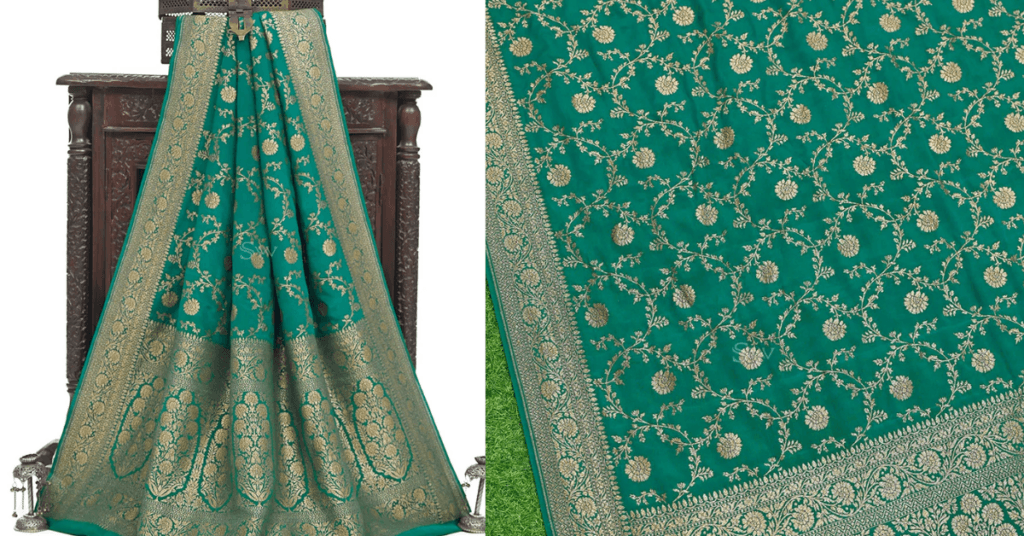
When buying a Banarasi saree, zari is often one of the first things people notice. The metallic motifs, borders and pallu are what give a Banarasi saree much of its distinctive richness and visual character.
But there is an important distinction every buyer should understand:
Good-quality zari does not, by itself, prove that a saree is an authentic Banarasi.
Zari can tell you a great deal about the quality of the weaving, finishing and craftsmanship. However, the authenticity of a Banarasi saree needs to be assessed through a combination of factors, including its weave, motifs, fabric, construction, applicable certification or identification marks, and the credibility of the seller.
This is particularly important because Banaras Brocades and Sarees are a recognised GI product, and the Government of Uttar Pradesh describes them as finely woven silk textiles decorated with intricate zari designs, including floral and foliate motifs, kalga, bel, jali and meena work. The products are traditionally associated with Banaras handlooms and specialised attachments used for creating motifs.
So, if you are standing in a showroom—or looking at a saree online—how can you actually examine the zari?
Let’s go step by step.
What Does High-Quality Zari Work Look Like on a Banarasi Saree?
Before checking whether the zari is “real”, first understand what good zari work looks like.
Quality zari work is not simply about how bright or expensive the metallic thread appears. On a well-made Banarasi saree, the zari should look like an integral part of the textile.
Look for:
- Clean and well-defined motifs
- Consistent zari coverage
- Neat borders and pallu
- Controlled edges around motifs
- A refined metallic appearance
- Proper integration of zari with the silk ground
- A reverse side that corresponds with the claimed weaving technique
- Good overall finishing
The Government of Uttar Pradesh specifically identifies compact weaving, detailed figures, metallic visual effects, jali, meena work and intricate floral and foliate designs among the characteristics associated with Banaras Brocades and Sarees.
This gives us a useful starting point:
Don’t look at the zari as an isolated thread. Look at how the zari has been used within the entire weave.
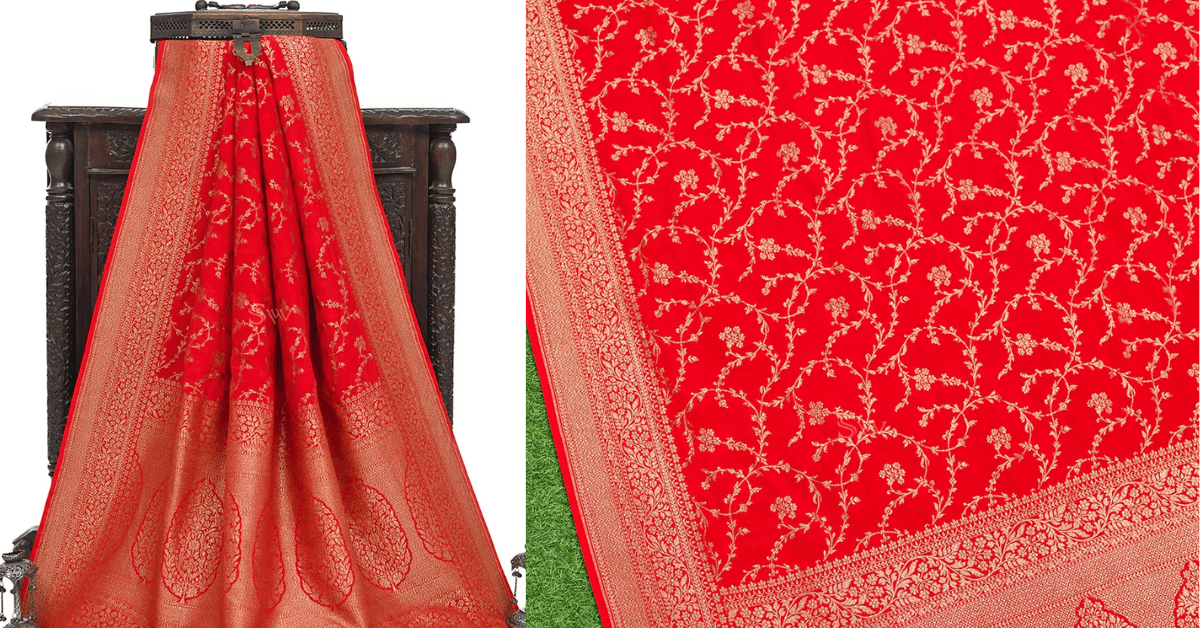
7 Things to Check When Inspecting Zari Work on a Banarasi Saree
- Look at the Zari’s Sheen
The first thing you’ll notice is the appearance of the zari.
Good-quality zari generally has a refined metallic sheen rather than looking like an extremely bright, plastic or painted gold surface.
However, this is only a visual clue.
Different zari materials and finishes can produce different appearances, and modern Banarasi weaving uses more than one type of zari. Therefore, you should never conclude that a saree is authentic simply because its zari looks rich or golden.
Similarly, don’t assume that a slightly subdued metallic appearance means poor quality.
The more important question is:
Does the zari look naturally integrated with the silk and the overall design?
Look at the saree under natural light if possible. Move it slightly and observe how the zari responds as the fabric changes angle.
A well-made saree should have a depth and consistency to its metallic appearance rather than looking like a flat decorative coating.
- Examine the Definition of the Zari Motifs
Next, look closely at the motifs.
Take a buta, floral motif, bel, kalga or another zari element and examine its edges.
Are the motifs:
- Clearly defined?
- Consistent?
- Properly aligned?
- Neatly woven?
- Appropriate to the overall design?
Traditional Banarasi textiles are known for intricate motifs and detailed ornamentation. The Varanasi district’s official description specifically mentions Mughal-inspired floral and foliate elements, including kalga and bel, along with detailed figures and metallic effects.
The motif should not appear as though it has simply been placed on top of the fabric.
Instead, examine how the zari interacts with the silk ground.
This is particularly important when distinguishing woven zari work from surface-applied decoration or embroidery.
A saree can imitate the visual appearance of a Banarasi design without reproducing the same woven construction.
- Inspect the Border Carefully
The border is one of the easiest places to inspect the quality of zari work because it usually contains a relatively continuous pattern.
Run your eyes along the entire length of the border.
Look for:
- Consistent pattern repetition
- Clean motif edges
- Even zari coverage
- Proper alignment
- No obvious breaks caused by poor finishing
- A pattern that appears integrated into the fabric
Don’t judge a saree from one small section alone.
A high-quality handwoven saree can naturally contain minor variations because it is made by a skilled artisan rather than produced as an identical industrial repeat.
The important distinction is between natural variation and poor workmanship.
Small variations in an intricate handwoven motif aren’t automatically a defect.
- Examine the Pallu
The pallu often contains some of the most elaborate zari work on a Banarasi saree, making it another useful area for inspection.
Spread the pallu fully and look at the relationship between:
motif → zari → silk ground → border → overall pattern
Ask yourself:
- Is the pattern clearly defined?
- Is the zari evenly woven?
- Are the transitions clean?
- Does the design feel structurally integrated?
- Does the finishing remain consistent across the pallu?
A heavily worked pallu also allows you to compare the front and reverse sides of the same design.
That comparison can reveal much more than simply looking at the metallic surface.
- Turn the Saree Over and Inspect the Reverse Side
This is one of the most useful practical checks—but also one of the most misunderstood.
Turn the saree over and inspect the back of a heavily zari-worked section.
You may see floating supplementary threads or other structural features associated with the particular weaving technique.
But here’s the important part:
There is no single reverse-side appearance that every authentic Banarasi saree must have.
The construction can vary according to the weaving technique.
For example, Kadwa/Kadhwa weaving is constructed differently from techniques where supplementary threads are carried differently across the fabric. Therefore, judging every Banarasi saree using the same “loose threads = real, clean back = fake” rule can be misleading.
This is precisely why an experienced textile seller should be able to explain what weaving technique has been used rather than relying on a generic authenticity test.
The Government of Uttar Pradesh notes that traditional Banaras handlooms use attachments including jala, pagia and naka for creating motifs, demonstrating how specialised weaving structures are part of the craft. (Varanasi District)
What should make you cautious?
Be more careful if:
- The seller claims the saree is handwoven but cannot explain its construction.
- The motif appears to be surface embroidery rather than woven ornamentation.
- The reverse shows obvious machine-applied decoration.
- The finishing is inconsistent with the claimed weaving technique.
But don’t reject a saree simply because its reverse side doesn’t match a photograph you’ve seen online.
The technique matters.
- Check Whether the Zari Is Actually Woven Into the Fabric
This is perhaps more useful than simply asking whether the zari is “real”.
Look closely at a zari motif from different angles.
A Banarasi brocade is a woven textile. The zari ornamentation forms part of the fabric’s construction rather than functioning simply as decoration applied afterward.
This distinction is particularly important when you’re comparing a genuine woven Banarasi with products that reproduce Banarasi-style motifs using other production methods.
The official Varanasi description identifies Banaras Brocades and Sarees as handloom textiles with intricate zari ornamentation and compact weaving.
So instead of asking only:
“Is the zari real?”
also ask:
“How has this zari been incorporated into the saree?”
That is a much more useful question.
- Look at the Zari in Relation to the Silk
Finally, step back and look at the saree as a whole.
Zari should complement the fabric rather than overwhelm it through an artificial-looking surface.
Look at:
- The silk’s drape
- The relationship between silk and zari
- The density of the motifs
- The border-to-body proportion
- The pallu construction
- Overall finishing
Remember that zari quality and silk quality are separate questions.
A saree may have excellent zari work but use a different fabric than you expected.
Likewise, a pure silk saree can still have imitation or tested zari.
This is why you should never use one characteristic as the sole test of authenticity.
Can You Tell If Zari Is Real or Synthetic Just by Looking at It?
Not reliably.
This is where many online “Banarasi authenticity tests” oversimplify the subject.
You may hear advice such as:
- Real zari must look a particular shade of gold.
- Real zari must feel heavy.
- Scratch the zari to see what is underneath.
- If the zari is bright, it must be fake.
These are not reliable universal rules for identifying a Banarasi saree.
The material composition of zari and the authenticity of the Banarasi weave are two different questions.
If your primary concern is whether the zari itself is real, tested or synthetic, we’ve covered that subject separately in our detailed guide:
Is Zari in Banarasi Sarees Real or Fake? How to Tell the Difference.
For an expensive saree, we would also advise against scratching or damaging the zari simply to perform an informal test.
Instead, ask the seller what type of zari has been used and request the relevant product information.
Real Zari Does Not Automatically Mean an Authentic Banarasi Saree
This deserves its own section because it is one of the biggest misconceptions buyers encounter.
Imagine two sarees.
Saree A
- Has metallic zari
- Has beautiful floral motifs
- Looks luxurious
But it isn’t necessarily woven as a Banarasi textile.
Saree B
- Is an authentic Banarasi textile
- Uses a different type of zari
- Has excellent handwoven construction
Calling Saree A “more authentic” simply because its zari is more expensive would be incorrect.
Zari authenticity and Banarasi authenticity are not the same thing.
Banaras Brocades and Sarees have a registered GI identity, and the official Varanasi description associates them with distinctive weaving, silk, zari ornamentation and traditional motifs.
Therefore, when buying a Banarasi saree, think in terms of the complete textile rather than one material.
How to Verify a Banarasi Saree Beyond the Zari
Once you’ve inspected the zari, move to the rest of the saree.
Check the Fabric
If the saree is being sold as pure silk, don’t rely solely on touch.
Silk Mark Organisation of India itself states that it is difficult to identify silk purely by look and feel. Its Silk Mark label is used on eligible 100% pure silk products sold by authorised users. (Silk Mark India)
So if a seller claims a saree is pure silk, ask for appropriate documentation or Silk Mark assurance where applicable.
Importantly:
Silk Mark verifies silk—not the authenticity or quality of zari.
Silk Mark Organisation of India explicitly states that Silk Mark does not assure the purity or quality of zari. (Silk Mark India)
Check the GI Identity
Banaras Brocades and Sarees is a registered Geographical Indication.
The official IP India record lists the GI as registered, with certificate date 4 September 2009. (Intellectual Property India)
GI should therefore be understood as part of the product’s geographical and traditional identity—not as a substitute for examining the actual quality of the saree.
If a seller makes a GI-related claim, ask what documentation or product identification accompanies it.
Check Handloom Identification Where Applicable
If the saree is specifically being sold as handloom, ask the seller how that claim is supported.
The Government of Uttar Pradesh categorises Banaras Brocades and Sarees as a Handicraft Handloom GI product.
But the important thing for a buyer is to understand what they are actually purchasing:
Handloom? Powerloom? Which weaving technique? Which fabric? Which zari?
These specifications affect both authenticity and price.
A Simple 5-Minute Zari & Banarasi Authenticity Checklist
Before purchasing an expensive Banarasi saree, use this quick checklist:
Zari
- Does the zari have a refined metallic appearance?
- Are the motifs clean and well defined?
- Is the zari consistently woven?
- Does the border have good pattern continuity?
- Is the pallu finished properly?
Weave
- Does the zari appear integrated into the fabric?
- Does the reverse side correspond with the claimed weaving technique?
- Can the seller explain the technique used?
Fabric
- What fabric is being used?
- If it is claimed to be pure silk, is there appropriate Silk Mark assurance or documentation where applicable?
Authenticity
- Is the saree being sold as a Banarasi/GI product?
- Can the seller explain its origin and construction?
- Is the seller transparent about handloom vs powerloom?
Seller
- Can the seller answer technical questions confidently?
- Are product specifications clearly disclosed?
- Is there a physical business/showroom or established textile presence?
- If you cannot get clear answers to basic questions about an expensive saree, pause before purchasing.
Common Myths About Zari and Banarasi Sarees
Myth 1: “The brighter the zari, the better the saree.”
Not necessarily.
Zari appearance depends on its material, finish and construction. A very bright metallic appearance isn’t automatically a sign of superior quality.
Myth 2: “Real zari means the saree is authentic Banarasi.”
No.
Zari material and Banarasi authenticity are separate considerations.
Myth 3: “A perfectly clean reverse side means it is fake.”
Not necessarily.
Different weaving techniques produce different reverse-side characteristics. The claimed technique needs to be considered.
Myth 4: “Loose threads on the back prove that a saree is handloom.”
Again, not by themselves.
The construction depends on the weaving technique. Loose threads alone cannot establish authenticity.
Myth 5: “Silk Mark proves everything about the saree.”
No.
Silk Mark is about 100% pure silk assurance. Silk Mark Organisation of India explicitly says it does not certify zari purity or quality. (Silk Mark India)
Why Buying from an Experienced Banarasi Textile House Matters
Learning how to inspect zari is useful, but there is another important factor that buyers sometimes overlook:
Who is selling you the saree?
A knowledgeable Banarasi textile house should be able to tell you what you are actually buying.
For example:
- What fabric is used?
- Is it handloom or powerloom?
- Which weaving technique has been used?
- What type of zari is used?
- How complex is the motif?
- Is the saree suitable for repeat production?
- What certifications or product documentation apply?
These questions become particularly important when buying an expensive handwoven saree.
Why JDS Banaras
JDS Banaras has been part of the Banarasi textile tradition since 1913, with four generations of family experience in Banarasi textiles.
Its role extends beyond selling sarees. JDS’s experience across manufacturing, wholesale and retail gives customers access to people who understand the fabric, weaving techniques, zari work and craftsmanship behind the product.
For a buyer visiting Varanasi, this experience can be particularly valuable because you can examine the saree physically, compare different weaving techniques, ask questions about its construction and understand what you are actually purchasing.
You can also learn more about the family’s journey and textile heritage through the Heritage of JDS Banaras page.
If you’re planning a Varanasi shopping trip, our guide on How to Avoid Getting Cheated When Buying Banarasi Sarees on Your Varanasi Trip covers the broader precautions buyers should take when comparing sarees and sellers.
And if you’re looking for an established place to explore authentic Banarasi collections in Varanasi, you can visit the Best Banarasi Saree Shop in Varanasi.
Final Takeaway: Can Zari Verify a Banarasi Saree?
Zari can help you evaluate the quality and construction of a Banarasi saree, but it should never be treated as a standalone authenticity test.
Start with the zari:
Look → Inspect → Turn it over → Understand the weave → Check the fabric → Verify applicable marks/documentation → Evaluate the seller.
The most important lesson is to look at the entire textile.
A genuine Banarasi saree is not defined by one shiny thread. Its identity comes from the combination of weaving, fabric, motifs, craftsmanship, construction and geographical tradition.
And when you’re buying an expensive saree, the ability of the seller to explain those details can be just as important as the saree itself.

Pingback: What Types of Banarasi Sarees Are Considered Most Auspicious and Traditional for Indian Wedding Ceremonies? - Jagdish Das and Company - JDS Varanasi