
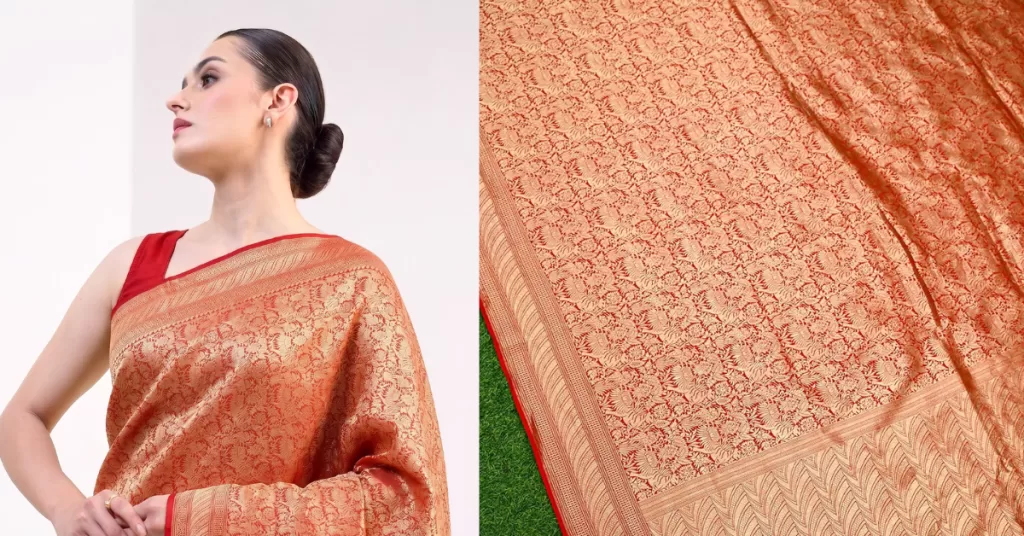
A Banarasi saree is known for its rich silk, detailed weaving and timeless connection with Indian celebrations. Among the many traditional Banarasi designs, Banarasi Shikargah sarees have a distinctive place because they turn the saree into a visual story. Instead of relying only on floral butis or geometric patterns, Shikargah designs traditionally depict hunting scenes, animals, birds, riders, vegetation and other elements inspired by historical artistic traditions.
The word Shikargah is associated with a hunting ground, and the design vocabulary reflects scenes connected with royal hunts. Elephants, deer, tigers, peacocks, horses, hunters and foliage may appear together in carefully arranged compositions. What makes these sarees especially remarkable is not simply the presence of these motifs but the precision with which they are woven across the fabric.
Shikargah is also often misunderstood as a separate weaving technique. It is more accurate to describe Shikargah as a group or style of motifs depicting hunting scenes, which can be created using traditional Banarasi weaving techniques. Reference material on the craft notes that Shikargah Banarasi sarees are generally created using supplementary-weft weaving, while authentic Kadhwa Shikargah sarees can require several months of highly skilled work.
For women looking for a saree that feels traditional, artistic and distinctive, a Shikargah Banarasi can be an especially meaningful choice for weddings, receptions and other important family occasions.
What Is a Banarasi Shikargah Saree?
A Banarasi Shikargah saree is a Banarasi saree featuring elaborate motifs inspired by hunting scenes and natural surroundings. The design may show animals, birds, riders, human figures, trees, vines and floral elements arranged together to create a detailed visual composition.
One important point to understand is that Shikargah is not itself a weaving technique. The term primarily describes the design vocabulary. The actual saree may be woven using traditional Banarasi methods, including supplementary-weft techniques. Kadhwa weaving, for example, can be used to create highly detailed patterns where individual motifs require considerable time and skill.
The beauty of a Shikargah saree comes from the balance between the motifs and the spaces around them. The reference material describes this as a careful relationship between positive and negative space. The result is a rich brocade appearance without making the overall design look randomly crowded.
This balance is one of the reasons Shikargah sarees can look particularly impressive when draped. The motifs continue across the fabric, while the border and pallu often receive special attention, allowing the intricate craftsmanship to remain visible even when the saree is worn.
Related guide – Banarasi Brocade Sarees: The Complete Guide From Varanasi
History of Shikargah Sarees
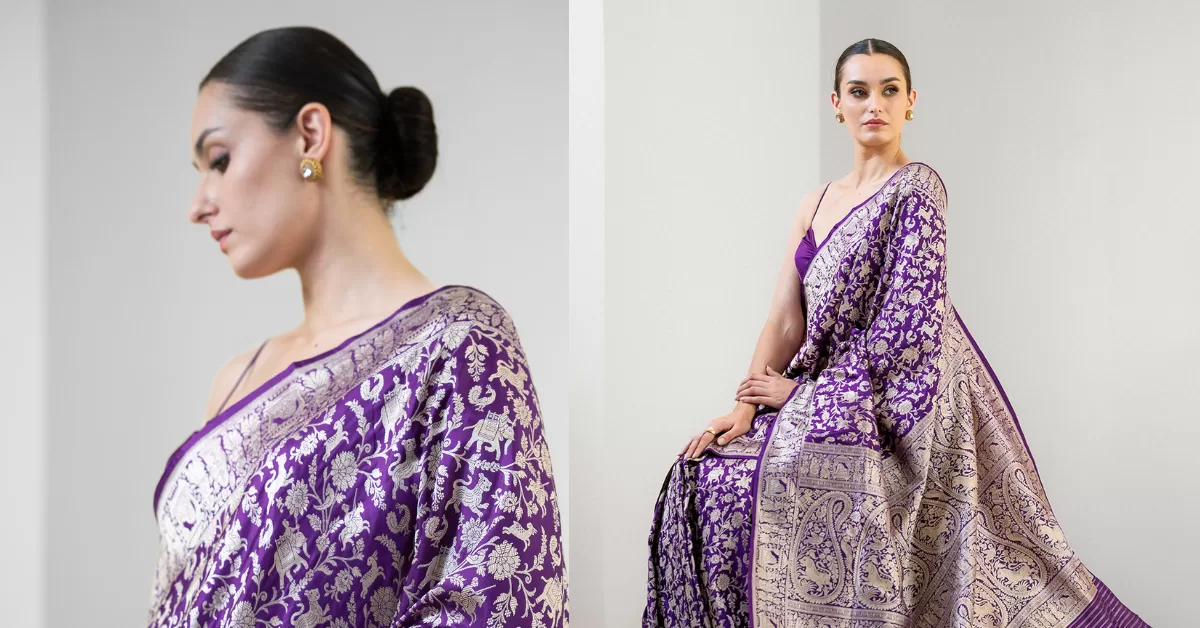
The exact beginning of Shikargah designs on Banarasi sarees is difficult to establish. Available references suggest that hunting-inspired artwork existed in Indian art and crafts during and before the Sultanate and Mughal periods, while some experts associate aspects of the Shikargah design vocabulary with Persian artistic traditions.
This means it would be too simplistic to assign a single date or culture as the sole origin of Shikargah. Over centuries, different artistic influences travelled and evolved, and Banaras became an important centre where these influences were adapted into sophisticated textile designs.
Hunting scenes were associated with royalty and aristocratic life in historical art. Similar visual themes appeared in paintings, carpets, metalwork, ceramics and other decorative arts. When such ideas were translated into textiles, the saree became a surface on which an entire scene could be created through weaving.
The reference material also notes that some Shikargah designs may have evolved through influences from Persian, Chinese and Ottoman brocade traditions. However, the exact historical journey is complex, and the available material does not establish one definitive origin.
What is clear is that Shikargah eventually became closely associated with the artistic vocabulary of Banarasi textiles, where skilled weavers adapted detailed animal, floral and natural motifs to the structure of the saree.
Related guide – The History of Shikargah Saree
What Makes Banarasi Shikargah Sarees Different?
The first thing you notice about a Shikargah saree is the storytelling quality of its design. A conventional floral Banarasi may use repeating motifs, but a Shikargah saree can create a much more elaborate visual scene.
The hunting-inspired motifs may be combined with vines, flowers, leaves and other natural elements. The composition is carefully distributed so that the saree maintains a rich appearance while retaining visual balance.
Another important feature is the richness of the brocade. Traditional Shikargah designs can create a dense, luxurious surface, particularly when woven on fine silk with zari or additional patterning threads.
The colour palette is often festive. Deep red, pink, purple, green, blue and other rich shades can be used with contrasting or metallic-looking motifs. Modern interpretations may also experiment with colour combinations while retaining the traditional character of the Shikargah design.
Popular Motifs Found in Shikargah Sarees
The motifs in a Shikargah saree are not simply decorative. Each element contributes to the visual story and can carry traditional symbolic associations.
Elephants
Elephants are among the most recognisable motifs used in Shikargah compositions. When shown with riders or within royal scenes, they can represent strength, grandeur, royalty and wisdom. Their large form also gives the weaver an opportunity to create detailed decorative elements within the body of the saree.
Tigers
The tiger adds a sense of strength, courage and movement to the design. In hunting-inspired compositions, it can create a dramatic contrast with floral and natural motifs surrounding it.
Deer
Deer introduce a softer and more graceful element into Shikargah designs. Their slender form works beautifully with vines, foliage and other natural motifs and can create a sense of movement across the saree.
Peacocks and Birds
Peacocks are frequently appreciated for their beauty and detailed feathers. They can appear in the border, pallu or body of the saree and add a graceful, decorative quality to the overall composition.
Other birds may also be incorporated into the design, depending on the particular pattern created by the weaver.
Riders and Hunting Figures
Figures riding horses or elephants connect the design directly with the historical idea of royal hunts. These motifs can be particularly intricate because the weaver has to create recognizable human and animal forms while maintaining the scale and rhythm of the overall saree design.
Related guide – Meenakari Banarasi Saree: The Complete Guide to Banaras’ Finest Colourful Weaving Art
How Are Banarasi Shikargah Sarees Woven?
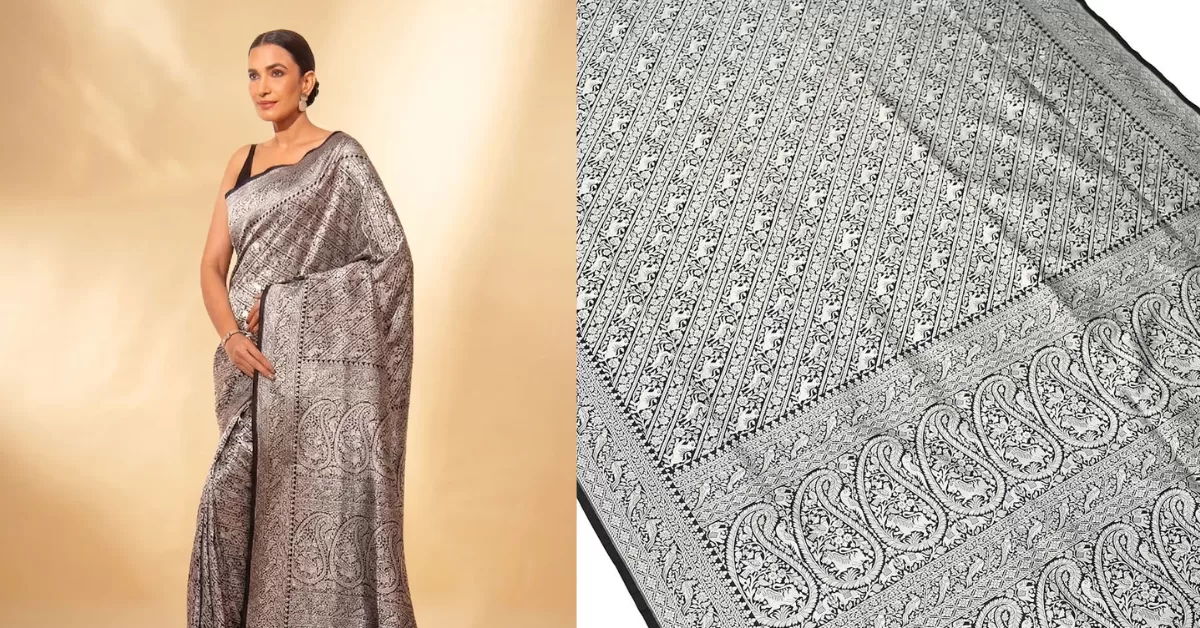
Creating a detailed Shikargah saree requires considerably more planning and skill than producing a simple repeating motif. The weaver has to translate a complex design into the structure of the textile while maintaining correct proportions, spacing and continuity.
Traditional Shikargah Banarasi sarees are generally associated with supplementary-weft weaving. In highly detailed Kadhwa Shikargah work, individual motifs require careful handling of additional threads. This makes the process slow and labour-intensive.
According to the reference material, an authentic Kadhwa Shikargah saree can take around two to four months to weave, depending on its complexity. The exact time can vary according to the design, weaving method, material and level of detail.
This long weaving process is one reason a finely crafted Shikargah saree should be appreciated as a piece of textile craftsmanship rather than simply another occasion-wear garment.
The Role of Skilled Weavers in Shikargah Craft
The survival of Shikargah weaving depends heavily on highly skilled artisans. Creating recognizable animals, people and hunting scenes within the structure of a saree requires experience that cannot be gained quickly.
The reference material points out that the number of highly skilled weavers capable of producing authentic Shikargah work has declined over time. The craft is also more demanding than faster power-loom production because of the time and labour required for intricate traditional designs.
There are also cultural considerations within the weaving community. Some weavers may choose not to create animal or human figures because of their religious beliefs. This is one of the factors that has contributed to the limited number of artisans working on highly detailed Shikargah designs.
For this reason, purchasing a genuinely handwoven Shikargah saree from a credible source can do more than add a beautiful saree to your wardrobe. It can also support the artisans and specialised skills that keep this textile tradition alive.
Shikargah Sarees for Weddings and Bridal Wear
A wedding saree needs to feel special, and Shikargah has the visual richness to make a strong impression. The detailed motifs, silk texture and elaborate borders can give the saree a grand appearance without depending entirely on heavy embellishment.
For a bride, a traditional red Shikargah Banarasi saree can create a classic bridal look. Women who prefer something less conventional can explore jewel tones such as deep pink, purple, green or blue, depending on the wedding function and personal style.
Shikargah can also work beautifully for mothers of the bride or groom, sisters, close family members and women attending traditional wedding ceremonies. Since the design itself is detailed, jewellery and blouse styling can be kept balanced rather than overly complicated.
For a wedding purchase, it is particularly important to examine the quality of the silk, weaving, zari, motif definition, border, pallu and overall finishing instead of selecting a saree only because its pattern looks attractive in photographs.
Related guide – Which Is Best Bridal Saree? An Honest Weaver’s Guide
How to Choose a Banarasi Shikargah Saree
When buying a Shikargah saree, look beyond the overall shine and colour. A high-quality saree should show careful detailing, clean motif formation and a balanced distribution of patterns.
Consider these factors before making your purchase:
- Look at the motifs closely: Animal, bird and human figures should appear well-defined rather than blurred or poorly formed.
- Check the weaving: Ask whether the saree is handloom and understand which weaving technique has been used.
- Examine the silk: The quality and feel of the silk should suit the type of saree you are buying.
- Inspect the zari: If the saree has zari work, ask about the material and quality rather than judging it only by shine.
- Study the pallu and border: These areas often contain some of the most detailed work and can reveal the quality of craftsmanship.
- Ask about the weaver and origin: A reliable seller should be able to explain where and how the saree was made.
- Consider the occasion: Heavier Shikargah designs are particularly suitable for weddings and formal celebrations, while more balanced designs can be easier to wear at smaller functions.
- Check the saree in natural light: Rich silk and zari can appear different under showroom or artificial lighting.
A trusted Banarasi saree seller should be comfortable explaining these details instead of simply describing the saree as “premium” or “pure.”
Why Buy Shikargah Sarees from Varanasi?
Varanasi, traditionally known as Banaras, remains closely connected with the production and trade of Banarasi textiles. Buying from a knowledgeable local saree house can give customers an opportunity to understand the weave, fabric, motifs and craftsmanship more closely.
This is especially useful when buying an intricate saree such as Shikargah because the visual appearance alone does not always tell you how the saree was produced.
If you are visiting Varanasi for wedding shopping, look for a store that has a long association with Banarasi textiles and can explain the difference between handloom and power-loom production, different silk varieties, weaving techniques and zari options.
For brides and families searching for the best banarasi saree shop in Varanasi, JDS Banaras is one option worth considering. The reference material describes JDS Banaras as a Banarasi saree house with more than a century of experience and mentions specialised weavers working on Shikargah craftsmanship. It also states that its Shikargah Banarasi sarees are handloom and involve extensive hours of detailed weaving.
How to Style a Banarasi Shikargah Saree
Because Shikargah sarees already contain detailed visual elements, styling works best when it allows the saree to remain the focus.
For a bridal look, you can pair a rich red or deep-toned Shikargah saree with traditional gold jewellery, a classic blouse and a neatly arranged pallu. For a reception or engagement, a jewel-toned Shikargah saree can be styled with statement earrings and a more contemporary blouse.
If the saree has an especially elaborate pallu and border, avoid adding too many competing patterns through the blouse. A solid blouse in a complementary shade can make the woven motifs stand out more clearly.
For jewellery, traditional pieces such as jhumkas, necklaces, bangles and a kamarbandh can complement the heritage character of the saree. The final styling should depend on the density of the zari and motifs rather than following a fixed formula.
Related guide – Bandhani (Bandhej) Banarasi Saree: A Simple Complete Guide
How to Care for a Banarasi Shikargah Saree
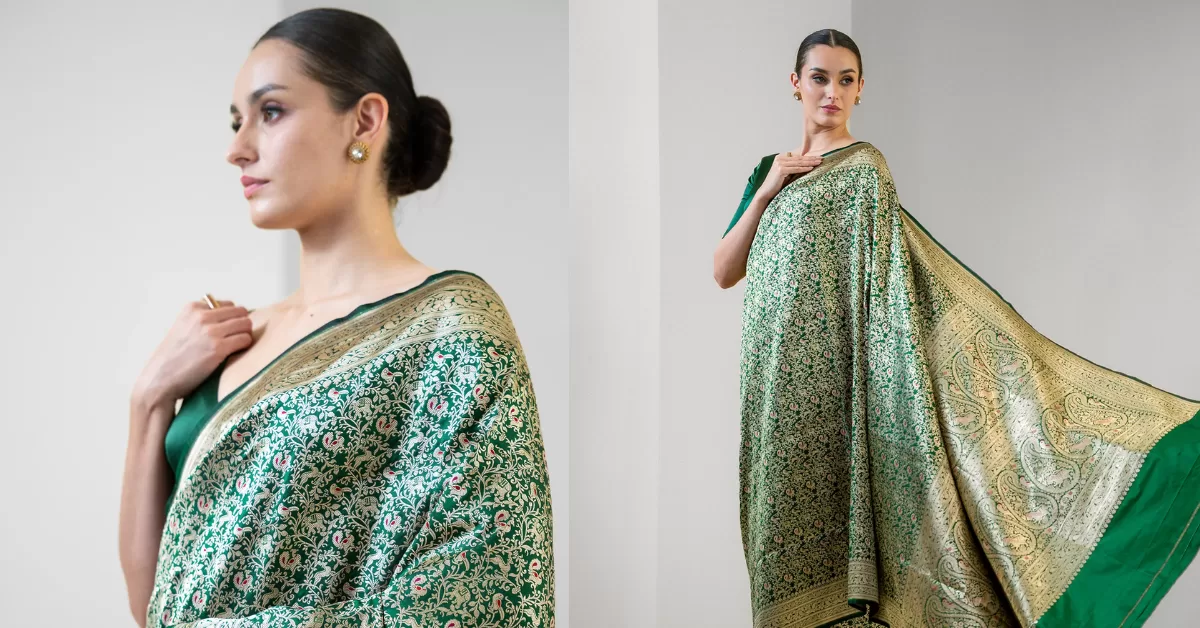
A detailed handwoven Banarasi Shikargah saree deserves careful storage and handling. Since the saree may contain fine silk, zari and intricate woven motifs, rough handling or unsuitable storage can affect its appearance over time.
After wearing the saree, allow it to air naturally before storing it. Avoid keeping it in direct sunlight for long periods, and do not store it in a damp place. Folding it differently from time to time can also help prevent permanent creases along the same fold lines.
For cleaning, professional dry cleaning is generally the safer option for valuable silk Banarasi sarees, particularly those with zari. Avoid experimenting with home washing methods unless the seller or manufacturer specifically recommends them.
When storing the saree for a long period, use clean, breathable fabric rather than trapping it in unsuitable plastic packaging. Handle the saree gently when refolding it so that the woven motifs and zari are not unnecessarily stressed.
Why Shikargah Sarees Remain Relevant Today
Traditional textiles survive when craftsmanship and contemporary taste can exist together. Shikargah is a good example of this balance. While the core idea remains connected with historical hunting scenes, designers and weavers have experimented with the scale, placement and interpretation of these motifs to make them relevant to modern women.
The reference material notes that contemporary design interventions have given hunting motifs a more modern appeal while retaining their traditional character. The renewed interest in handloom textiles has also created greater demand for Shikargah sarees.
This makes Shikargah especially appealing to women who want a saree that feels rooted in Indian textile history but does not look like an ordinary repetitive floral Banarasi.
Final Thoughts
A Banarasi Shikargah saree is much more than a richly decorated silk saree. It represents a specialised design tradition in which animals, birds, riders, foliage and hunting scenes are transformed into detailed woven compositions.
Its real beauty becomes easier to appreciate when you understand the skill behind it. The intricate motifs require careful planning, the weaving can take months, and the number of artisans with the expertise to produce highly detailed Shikargah work is limited.
For a wedding, a Shikargah saree can become a memorable choice because it combines the grandeur expected from Banarasi silk with a design that tells a story. Whether chosen as bridal wear, a family heirloom or a special occasion saree, it carries the visual character of India’s long textile tradition.
When buying one, focus on craftsmanship, fabric, weaving method, zari quality, motif clarity and the credibility of the seller. A genuine, well-made Shikargah saree is not simply something to wear for one celebration; it can become a piece of textile heritage that remains meaningful for years.
Frequently Asked Questions About Banarasi Shikargah Sarees