
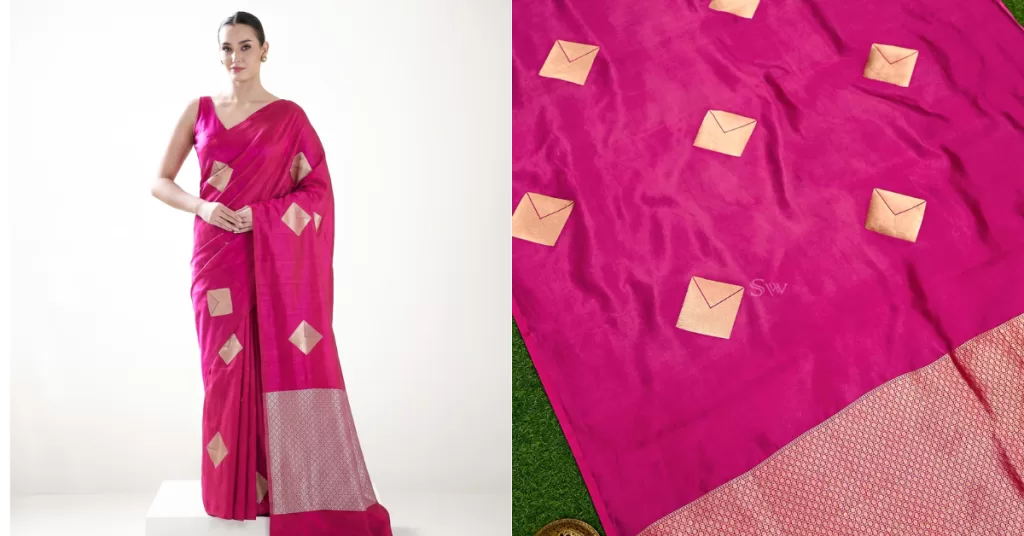
Kadhua weave (also spelled Kadwa or Kadhwa) is a hand-weaving technique from Varanasi in which every individual motif on a Banarasi saree — every buti, every flower, every paisley — is woven separately by hand, rather than created by throwing a single shuttle continuously across the fabric. The weaver stops at the edge of each motif, turns the thread back on itself, and begins the next line of that same motif — which is why Kadhua is sometimes called the “turning weave.” Because no thread floats loosely on the reverse side, a genuine Kadhua saree has an almost identical, clean finish on both the front and the back. This technique can take 20 days to several months for a single saree, depending on design density, which is the primary reason Kadhua sarees command a significant price premium over other Banarasi weaves.
What Is Kadhua Weave? Understanding Banaras’s Most Painstaking Technique
If you’ve shopped for a Banarasi saree — online or in a physical showroom in Varanasi — you have almost certainly heard the word Kadhua, sometimes written as Kadwa or Kadhwa, spoken with a certain reverence by the seller. It usually comes with an implied promise: this one is special, this one costs more, this one is the “real” thing.
That instinct isn’t wrong. But very few buyers — and, frankly, very few sellers — can actually explain why Kadhua commands that premium in mechanical, verifiable terms. At JDS Banaras, where our family has manufactured Banarasi textiles since 1913, we believe that explanation matters. A saree bought with genuine understanding is worn with more pride than one bought on faith alone.
So let’s build that understanding from the ground up — starting with the weave that comes before Kadhua, because you cannot understand Kadhua without first understanding brocade.
Related guide – Famous Weaving Techniques and Patterns of Banarasi Sarees
Kadhua Weave vs Brocade: What’s the Relationship?
Kadhua is not a separate fabric or an independent weaving system — it is a specific, more demanding variant of brocade weaving, and it can only be executed on a handloom. To understand what makes it special, you first need to understand what an ordinary brocade weave actually is.
Every woven fabric is built from two sets of threads. The first runs the length of the fabric and is fixed onto the loom before weaving begins — this is called the warp (in Hindi, taani). The second runs across the width and is wound onto a small wooden shuttle that the weaver throws by hand through gaps in the warp — this is the weft (baana). For a standard six-yard Banarasi saree roughly 44 inches wide, the warp runs the full 5.5 metres and the weft threads run 44 inches, over and over, thousands of times, to build the fabric.
In a brocade weave specifically, a third element is introduced: a supplementary weft, usually zari thread, which is woven in to create the motifs — a buti, a jaal, a paisley, whatever the design calls for. This supplementary weft is what gives brocade its characteristic raised, ornamental surface.
The question that separates Kadhua from ordinary brocade is simple: how is that supplementary weft actually inserted to build each motif?
Kadhua Weave vs Fekuan (Standard Brocade): The Real Mechanical Difference
In standard brocade — sometimes called Fekuan weaving in Varanasi’s weaving community, from the Hindi word for “throwing” — the zari shuttle carrying the supplementary weft is thrown continuously across the entire width of the fabric, the same way the base weft is. Wherever the design calls for a motif, the zari appears; wherever it doesn’t, the thread simply floats loosely behind the fabric until it’s needed again. This is fast, and it’s why standard brocade sarees are more affordable.
In Kadhua weaving, this continuous throw is abandoned entirely. Instead, the weaver picks up the zari (or coloured silk) thread only at the exact point where a motif begins, weaves that single motif to completion, and then turns the thread back on itself at the motif’s edge — reversing direction to weave the next line of the same motif, rather than continuing across the width to the next one. This manual turning motion, repeated at the edge of every single motif in every single row, is why Kadhua is known in some weaving circles as the “turning weave.”
The practical consequence: on a genuine Kadhua fabric, there are no floating threads running behind the motifs. Turn the saree over, and the back looks almost as clean and finished as the front — a direct, physical signature of how the fabric was actually made.
Expert Insight
I’ve watched our master weavers execute this motion thousands of times, and it never stops being remarkable to see up close. In a standard brocade throw, the weaver’s hand movement is continuous and rhythmic — throw, beat, throw, beat. In Kadhua, that rhythm breaks constantly. The weaver throws, stops precisely at the motif’s edge, reverses, throws again in the opposite direction, stops again. It is a fundamentally different kind of concentration — closer to embroidery in its precision than to conventional weaving in its rhythm, even though it’s happening entirely on a loom.
Related guide- Rangkat Banarasi Saree: The Complete Guide to Banaras’ Most Artistic Weave
Why Is Kadhua Weave So Expensive? The Real Math Behind the Price
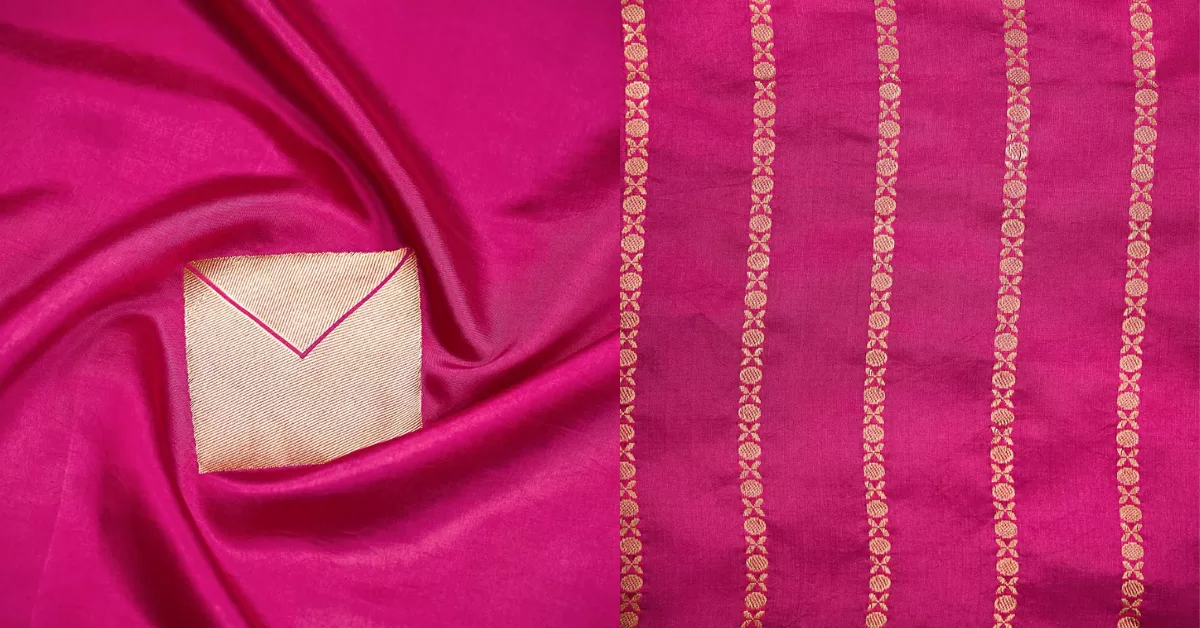
This is the question every buyer eventually asks, and the honest answer is arithmetic, not marketing. Every single pass of the weft shuttle across the fabric is called a pick. The density of a fabric — how fine and tightly woven it feels — is measured partly by its pick count, the number of these passes packed into every inch of length.
Consider a saree with a design featuring 8 zari butis repeated across every row, plus zari borders on both edges. In a standard Fekuan brocade, weaving one full row requires exactly one throw of the base silk shuttle, plus roughly one or two continuous zari throws to cover the borders and the entire row of butis in a single sweep.
In Kadhua weaving, that same row requires: one throw for the base silk, two separate movements for the two zari borders, and then eight individual turning movements — one for each buti — because the zari thread only appears exactly where that specific motif sits, and must be manually turned at each one. If a motif combines two colours of zari (gold and silver, for instance, which is common), the movement count for that single motif effectively doubles again.
Now scale that up. A saree with a pick count of 100 picks per inch requires roughly 4,000 weft rows in a single metre of fabric. Across a full 5.5-metre saree, that is well over 2,00,000 individual shuttle movements — and in Kadhua weaving, a significant share of those movements are the slow, precise turning motions described above, compared to the much faster continuous throws of a standard brocade. This is not an exaggeration for effect; it is the literal, countable mechanics of the craft. It is also why a dense Kadhua saree can take anywhere from 20 days to several months to complete, depending on motif density and colour complexity — while a comparable standard brocade piece might be finished in a week or two.
Key Takeaway
Kadhua’s price premium isn’t an arbitrary “luxury tax.” It is the direct, calculable cost of an enormous number of additional manual movements that a standard brocade weave simply does not require. When you pay more for a Kadhua saree, you are paying for hours of turning motions that happened one motif at a time.
Related guide – Why Customers Trust JDS Banaras: The Heritage, Craftsmanship & Expertise Behind Every Banarasi Saree
How Design Type Changes Kadhua Weaving Difficulty
Not every Kadhua saree takes the same amount of time, even at a similar size and price point. The single biggest variable is how the motifs are arranged.
When there are visible gaps between motifs — both across the width and down the length of the saree — the weaver has natural pauses built into the design, and the overall motif count (and therefore total working time) comes down. This is the more common and more affordable way to execute Kadhua.
But in a dense jaal design — where the pattern runs continuously across the entire body of the saree with no gaps — Kadhua weaving becomes significantly more demanding. Every single inch is motif, meaning every single inch requires individual turning work. A Kadhua jaal saree, particularly one using multiple zari or silk colours across its width, sits at the very top of the Banarasi price hierarchy for exactly this reason — it represents the maximum possible expression of the technique with none of the natural breaks that make simpler designs faster to execute.
This is also why many premium Banarasi sarees use a hybrid approach: the fine connecting vines and borders are woven using the faster Cutwork technique (explained below), while the focal motifs — the flowers, the paisleys, the elements meant to draw the eye — are woven using true Kadhua. This blend delivers Kadhua’s visual sharpness exactly where it matters most, while keeping the overall weaving time, and therefore the price, more reasonable.
Related guide – Best Banarasi Saree Store in Varanasi for Wedding Shopping
Kadhua Weave vs Cutwork: Which Should You Choose?
Cutwork is the other major technique you’ll encounter while shopping for Banarasi sarees, and it’s frequently confused with Kadhua because both produce clean-looking motifs with real zari or silk detailing. The distinction matters enormously for both price and how the saree will feel and last.
In Cutwork weaving, the supplementary weft thread is allowed to float behind the fabric between motifs — similar to standard Fekuan brocade — but after weaving is complete, these floating threads are carefully trimmed and cut close to the fabric surface, rather than being tucked away by turning. This is considerably faster than Kadhua because the weaver never has to stop and reverse direction at every motif edge; the design is thrown continuously and cleaned up afterward.
| Feature | Kadhua (Kadwa) Weave | Cutwork Weave | Fekuan (Standard Brocade) |
|---|---|---|---|
| How motifs are made | Woven individually; thread turned at each motif’s edge | Thread floats between motifs, then trimmed after weaving | Thread thrown continuously across the full width |
| Reverse side appearance | Clean, almost identical to the front — no floats | Small trimmed thread-ends visible at motif edges | Visible floating threads running behind the design |
| Weaving time (full saree) | 20 days to several months, design-dependent | 5–15 days typically | 1–2 weeks typically |
| Durability | Highest — motifs are structurally anchored individually | Good, but trimmed thread-ends can loosen with heavy wear over decades | Good for the price point; floats are more prone to snagging |
| Weight and feel | Denser, more structured — a felt sense of “richness” | Noticeably lighter, especially on Organza or Tissue base | Moderate — depends on zari density |
| Best suited for | Bridal wear, heirloom pieces, main wedding ceremony | Receptions, summer functions, contemporary festive wear | Everyday festive wear, budget-conscious premium buyers |
| Price tier | Highest | Mid-range | Entry to mid |
There is no universally “better” choice here — only the right choice for your occasion, your budget, and how long you need the saree to last. A bride choosing her main ceremony saree, something meant to become a family heirloom, has good reason to choose Kadhua. Someone dressing for a reception or a summer function, where a lighter, more fluid drape matters more than maximum structural richness, is well served by Cutwork — and shouldn’t feel that it’s a lesser choice, simply a different one suited to a different moment.
Related guide – Best Banarasi Saree Manufacturer in Varanasi
Why Is It Called Kadhua or Kadwa? The Meaning Behind the Name
The name itself carries a story that connects directly to the technique. Kadwa is the Hindi word for “bitter” — and within Varanasi’s weaving community, this name is widely understood to be a reference not to any bitterness in the finished fabric, but to the sheer difficulty, patience, and slow, exacting labour the technique demands of the weaver. It is worth noting that, like many oral craft traditions, this etymology is passed down through weaving families and textile historians rather than documented in a single formal source — but it is the explanation consistently given by Varanasi’s own weaving community, and it fits the technique perfectly: something genuinely difficult to make, transformed into something genuinely beautiful to wear.
The alternate spelling Kadhua (कढ़ुआँ) is simply a phonetic variant of the same word, and both spellings — along with Kadhwa — refer to the exact same weaving technique. If you see any of these four spellings used by a seller, they are describing the identical craft.
How to Identify a Genuine Kadhua Saree — The Reverse-Side Test
Fortunately, verifying Kadhua weaving does not require any special equipment — just the willingness to turn the saree over and look closely at what’s behind the motifs.
Genuine Kadhua: The reverse side of each motif shows no floating threads at all. Because the thread was turned and re-woven at each motif’s edge rather than thrown across the gaps, the back of the fabric looks structured and almost as finished as the front — you can trace the same motif shape on the reverse.
Cutwork imitation: The reverse side shows small trimmed thread-ends at the edges of each motif — neat, but visibly cut, not woven closed.
Standard Fekuan brocade: The reverse side shows continuous floating threads running behind and between the motifs, visible as loose strands across the fabric’s back.
One honest caveat worth knowing before you rely on this test alone: there are legitimate exceptions. Some fabrics use a small number of intentional cuts even within genuine Kadhua work for specific design reasons, and in fabrics where motifs sit extremely close together with almost no gap, a clean-backed cutless saree can sometimes be achieved without full Kadhua technique. The reverse-side test is the single best indicator available to a buyer, but it is a strong signal, not an infallible one — buying from a manufacturer who can speak plainly and specifically about their own weaving process remains the most reliable safeguard of all.
For the same principle applied to verifying real versus synthetic zari specifically — since the two checks are often needed together — see our detailed guide: Is Zari in Banarasi Sarees Real or Fake? How to Tell the Difference.
Expert Insight
The single most useful habit we try to teach every customer at JDS Banaras: before you even ask the price, turn the saree over. The back of the fabric will tell you more honestly what you’re buying than any sales pitch. This one habit, practised consistently, will make you a genuinely confident Banarasi buyer within a handful of showroom visits.
Related guide – Banarasi Saree Wholesaler in Varanasi Since 1913
Kadhua Weave on the World Stage: A Real Example
The clearest recent illustration of what Kadhua weaving actually demands came not from a showroom but from one of the most closely watched cultural events of 2026. At the Venice Biennale dinner hosted by the Nita Mukesh Ambani Cultural Centre, Nita Ambani wore an ivory-beige Banarasi brocade Kadwa saree, handwoven over five months by two master artisans working together. That five-month timeline is not an exaggeration or a marketing flourish — it is a direct, real-world confirmation of the turning-weave mechanics described earlier in this guide, executed at the highest level the craft allows.
For the complete story of that piece, and how the Kadwa technique specifically drives Banarasi silk to the top of India’s price hierarchy for heritage textiles, read our guide: Which Silk Saree Is Most Expensive? India’s Heritage Silks Ranked.
Common Myths About Kadhua and Kadwa Weaving
Myth 1: “Kadhua” and “Kadwa” Are Different Weaves
Reality: They are the same technique. Kadhua, Kadwa, and Kadhwa are three spellings of one Hindi word, all describing the identical motif-by-motif, thread-turning weaving method.
Myth 2: Any Saree Without Floating Threads on the Back Is Kadhua
Reality: Not necessarily. Some cutless finishes are achieved through very tightly spaced motifs without true Kadhua technique, and it’s possible for a small number of intentional cuts to appear even in genuine Kadhua work. The reverse-side test is a strong signal, but a knowledgeable, transparent seller remains the best confirmation.
Myth 3: Kadhua Can Be Done on a Power Loom to Cut Costs
Reality: Kadhua weaving, by its nature, can currently only be executed on a handloom — the turning motion at each motif’s edge requires a human weaver’s judgement and manual control that mechanised looms cannot replicate. Any saree marketed as “machine-made Kadhua” is describing something else, most likely a printed or embroidered imitation of the visual style.
Myth 4: Cutwork Is a “Fake” or Lesser Version of Kadhua
Reality: Cutwork is a genuine, distinct handloom technique in its own right — not a counterfeit of Kadhua. It simply prioritises speed and a lighter finished fabric over Kadhua’s maximum structural density. Both are authentic expressions of Varanasi’s weaving tradition, suited to different occasions and budgets.
Myth 5: A Higher Price Always Means Genuine Kadhua
Reality: Price alone is not proof. The reverse-side test, a transparent conversation with the seller about weaving technique, and — for pure silk claims — Silk Mark certification together offer a far more reliable confirmation than price point alone.
Which Fabrics Is Kadhua Weave Used On?
Kadhua is a weaving technique, not a fabric itself, which means it can be applied across several of Varanasi’s traditional Banarasi base fabrics, each producing a different final character:
- Katan Silk: The most traditional and most common pairing — pure silk warp and weft with Kadhua motifs woven in, producing the classic structured bridal Banarasi saree
- Organza: Kadhua on a lighter, semi-transparent base creates a striking contrast between the crisp, sheer fabric and the raised, structured motifs
- Georgette: A softer, more fluid base fabric carrying Kadhua work for a saree that balances structured motifs with a lighter overall drape
- Tissue Silk: Kadhua combined with a metallic tissue base produces an especially luminous, formal finish favoured for grand occasions
To explore how Kadhua-woven Katan silk fits into the wider Banarasi silk category, see our complete guide: Is Banarasi Silk Saree Soft or Hard? The Honest Fabric Guide by Weave Type.
The JDS Banaras Perspective on Kadhua Weaving
As a Banarasi saree manufacturer working directly with Varanasi’s weaving families since 1913, Kadhua represents the outer edge of what our craft can achieve — and also the outer edge of what we can honestly ask a customer to pay for. We carry Kadhua alongside Cutwork and standard brocade specifically so that every customer, regardless of budget or occasion, can choose the technique that genuinely fits their need rather than being sold the most expensive option by default.
Every pure silk saree at JDS Banaras comes with a certificate of authenticity specifying the exact weaving technique used — Kadhua, Cutwork, or standard brocade — alongside the fabric type and zari grade. Explore the complete collection on our JDS Banarasi Saree page.
Visit JDS Banaras — See the Difference Between Kadhua and Cutwork in Person
No article, including this one, fully replaces holding a Kadhua saree and a Cutwork saree side by side and feeling the weight, structure, and reverse-side finish for yourself. At JDS Banaras at Rathyatra Crossing, our staff can walk you through exactly what to look for, motif by motif, before you buy.
To read what over 8,000 customers have said about their experience with JDS Banaras, visit our customer reviews page.
JDS Banaras — Jagdish Das & Company
D-58/1, Rathyatra Kamachha Road, Rathyatra Crossing, Varanasi 221010
Phone: +91 7269 055 695
Hours: Monday to Saturday, 10:30am to 8:30pm
Online: sacredweaves.com — JDS Banaras’s official online store
Frequently Asked Questions