
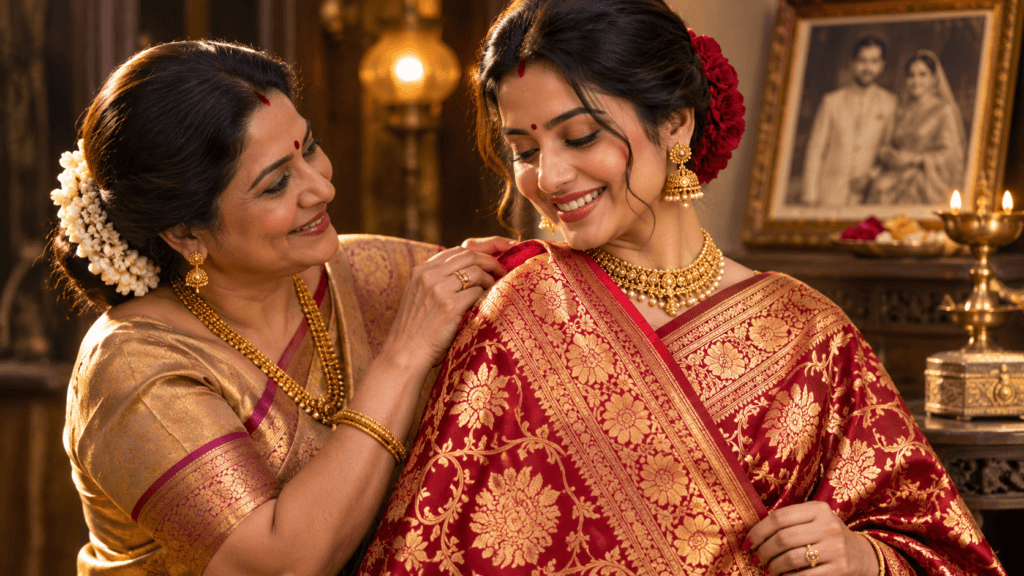
Some sarees are bought for an occasion.
Others become part of a family story.
A Banarasi saree often belongs to the second category.
For generations, families have preserved wedding sarees long after the ceremony is over—carefully folding them away, bringing them out for important occasions, restyling them years later, and sometimes passing them from mother to daughter.
But what actually makes a Banarasi saree worthy of becoming an heirloom?
It is not simply the price.
A genuine heirloom saree usually brings together quality silk, skilled weaving, well-executed zari, timeless design, emotional value and proper care.
That combination is what allows a Banarasi saree to remain meaningful long after changing fashion trends have disappeared.
Why Banarasi Sarees Naturally Become Wedding Heirlooms
Banarasi sarees are closely associated with ceremonial and wedding dressing because of their rich silk, intricate weaving and metallic zari work.
The Government of India recognises Banaras Brocades and Sarees as a registered Geographical Indication. The official Varanasi district description notes their finely woven silk, intricate zari decoration, compact weaving, floral and foliate motifs such as kalga and bel, jali patterns and meena work.
These qualities give a well-made Banarasi saree something that many trend-driven garments do not have:
longevity of design.
A traditional jaal, butidar pattern or woven border can remain relevant for decades because the design is not dependent entirely on one season’s fashion.
That is one reason a Banarasi saree worn at a wedding today can still feel appropriate when brought out years later.
An Heirloom Saree Is More Than an Expensive Saree
A high price alone does not make a saree an heirloom.
An heirloom piece usually earns that position because several things come together:
- quality of fabric,
- quality of weaving,
- durability,
- design that does not quickly look dated,
- craftsmanship,
- emotional association,
- and the way the saree is preserved.
A relatively understated Banarasi saree can become more meaningful to a family than an extremely expensive piece if it is connected to an important wedding or family event.
Similarly, an expensive saree that is poorly stored or selected only because it followed a temporary trend may never become something future generations want to wear.
The Role of Katan Silk in an Heirloom Banarasi Saree
For many traditional wedding Banarasi sarees, Katan silk is an important choice.
Katan is valued for its smooth texture, structure and ability to support detailed brocade and zari work.
This makes it particularly suitable for wedding sarees that are expected to look formal, photograph well and remain part of the wardrobe for years.
A good Katan Banarasi saree can carry:
- small woven butis,
- floral jaal,
- elaborate borders,
- richly woven pallus,
- meenakari detailing,
- and traditional zari work.
For an heirloom purchase, the objective should not simply be to find the heaviest saree.
It should be to find a saree where the silk, weaving and design work together well.
Why Zari Matters
Zari is one of the most recognisable features of a traditional Banarasi saree.
It adds depth, contrast and the metallic richness associated with ceremonial dressing.
The official GI description of Banaras brocades and sarees specifically identifies zari, metallic visual effects, gold work and fine woven detailing among their characteristic features.
For an heirloom saree, zari quality matters because it influences both appearance and long-term value.
Real Zari
Traditional real zari uses precious-metal elements and is usually associated with higher-value pieces.
When combined with quality silk and skilled weaving, it can contribute to the long-term desirability of the saree.
Tested or Imitation Zari
Many beautiful Banarasi sarees also use tested or imitation zari.
These can still make excellent wedding sarees.
The important thing is transparency.
A customer should know whether she is purchasing:
real zari, tested zari or another metallic yarn.
An heirloom purchase should be based on understanding what the saree actually contains rather than assuming that every gold-looking woven surface is the same.
Why Handloom Craftsmanship Adds Character
Banarasi weaving is not simply about the final design visible on the saree.
The structure of the weave, placement of motifs and handling of supplementary yarns are all part of the textile.
The Varanasi district’s official description notes that traditional Banaras brocade sarees are woven on conventional Banaras handlooms using jacquard systems, sometimes with traditional attachments used to create motifs.
That craftsmanship can give a saree a distinct character.
Small irregularities in a handmade textile should not automatically be treated as defects. In many cases, they are part of the weaving process itself.
This is also why two Banarasi sarees that look similar from a distance may differ significantly in:
- weaving complexity,
- time required,
- silk quality,
- zari quality,
- finishing,
- and price.
Why Wedding Sarees Carry Emotional Value
The emotional value of an heirloom cannot be measured in fabric alone.
A wedding saree becomes associated with:
- the bride’s wedding day,
- family photographs,
- rituals,
- relatives,
- jewellery,
- and memories of the occasion.
Years later, the saree may be remembered not merely as clothing, but as:
“the saree my mother wore at her wedding.”
That changes the way the textile is valued.
A daughter wearing her mother’s Banarasi saree does not simply reuse an old garment.
She brings a piece of family history into a new occasion.
This emotional continuity is one of the strongest reasons Banarasi wedding sarees often become heirlooms.
Why Traditional Designs Age Better
Fashion trends change quickly.
One year, very pale pastels may dominate weddings.
Another year, metallic tissue, bright reds or jewel tones may become popular.
Traditional Banarasi motifs tend to survive these changes better because their identity comes from the weaving tradition itself.
Common Banarasi design vocabulary includes:
kalga, bel, floral forms, jaal, buti and meenakari details.
These elements are also documented among the characteristic design features of Banaras brocades and sarees.
A saree built around these established design traditions often feels less tied to a single fashion cycle.
That can make it easier for another generation to restyle and wear it later.
Does Heavy Zari Automatically Make a Saree More Heirloom-Worthy?
No.
This is a common misconception.
A very heavy saree may look grand, but heaviness alone is not a measure of quality.
An elegant Banarasi saree with balanced zari, fine silk and good weaving can be more desirable over time than a saree overloaded with metallic work.
For an heirloom piece, look at the saree as a whole:
fabric + weave + zari + design + finishing.
Not just weight.
Which Banarasi Sarees Are Most Suitable for an Heirloom Wedding Wardrobe?
There is no single answer, but some styles naturally work well.
Red Katan Banarasi Saree
A classic bridal choice.
Red with gold zari has remained part of Indian wedding dressing for generations and can be especially meaningful for families that value traditional bridal colours.
Maroon Banarasi Saree
Maroon offers similar richness but often feels more understated.
It can also be easier to rewear for future weddings and formal family occasions.
Rani Pink Banarasi Saree
Rani pink combines festive energy with strong traditional appeal.
It is particularly suited to women who want something bright but less conventional than bridal red.
Traditional Jaal Banarasi Saree
A richly woven jaal can give the saree a distinctly ceremonial appearance.
When the design is well balanced, it can continue to look elegant for many years.
Butidar Banarasi Saree
A saree with evenly distributed butis and a traditional border can be extremely versatile.
It may be easier to rewear than an extremely heavy bridal saree.
Real-Zari Banarasi Saree
For buyers specifically looking for a long-term high-value textile, genuine zari can be worth considering.
However, authenticity should always be verified rather than assumed.
Can Your Mother’s Wedding Banarasi Saree Be Worn Today?
Yes.
In many cases, an older Banarasi saree can be styled in a way that feels completely contemporary.
The saree does not necessarily need alteration.
Instead, change the styling around it.
You can pair it with:
- a modern blouse,
- a contrasting blouse,
- minimal jewellery,
- a statement necklace,
- a different drape,
- contemporary makeup,
- or a cleaner hairstyle.
This keeps the textile intact while changing the overall visual language.
An heirloom saree often becomes more interesting when the next generation does not try to reproduce the original styling exactly.
Should an Old Banarasi Saree Be Restored?
Sometimes.
If the saree is structurally sound but has minor issues, professional restoration or careful repair may help.
However, restoration should be approached cautiously.
Old zari, silk and woven borders can be delicate.
Aggressive washing, ironing, chemical treatment or unskilled repair can cause more damage than the original problem.
If the saree has genuine family value, it is better to consult someone experienced with Banarasi textiles before attempting significant restoration.
How to Store an Heirloom Banarasi Saree
Proper storage is essential if you want the saree to survive for decades.
Some basic practices include:
Do Not Leave It on a Hanger for Long Periods
Heavy silk and zari can place stress on the fabric.
Folded storage is generally safer.
Change the Folds Periodically
Leaving the saree folded in exactly the same place for years can create permanent creases.
Refold it occasionally.
Avoid Plastic for Long-Term Storage
Breathable cotton or muslin is usually preferable.
Keep It Away From Moisture
Humidity can damage both silk and zari.
Store the saree in a dry, clean place.
Avoid Direct Perfume Contact
Perfumes and chemicals can affect delicate textiles.
Air It Periodically
Occasionally taking the saree out and airing it in a shaded, dry environment can help with long-term preservation.
The objective is to preserve the textile without exposing it unnecessarily to heat, moisture or harsh chemicals.
Can an Heirloom Banarasi Saree Be Worn Again and Again?
Yes—and it should be.
An heirloom does not have to remain permanently locked away.
A quality saree can continue to be worn for:
- weddings,
- receptions,
- anniversaries,
- Diwali,
- family pujas,
- engagements,
- and important celebrations.
Each time it is worn, another memory becomes connected to the textile.
That is what makes an heirloom different from a museum object.
What Should You Look for When Buying an Heirloom Banarasi Saree?
If you are purchasing specifically with long-term use in mind, ask more questions than you would for an ordinary occasion saree.
Try to understand:
- what silk has been used,
- whether the saree is handloom,
- what type of zari has been used,
- how the motifs are woven,
- how heavy the saree is,
- whether the design is versatile,
- how it should be stored,
- and how easily it can be worn again.
Do not buy simply because someone describes a saree as “heritage” or “heirloom.”
Those words should be supported by the textile itself.
Why Authenticity Matters More for an Heirloom Purchase
If you plan to preserve a saree for years, knowing what you are actually buying becomes especially important.
Banaras Brocades and Sarees are protected as a registered Geographical Indication in India, with the official GI registration covering the recognised product category.
For buyers, this reinforces an important point:
A Banarasi saree should not be judged only by whether it visually resembles Banarasi design.
Its origin, textile construction, weaving and materials matter.
This becomes even more important when purchasing a wedding saree intended to stay in the family.
An Heirloom Is Built Over Time
No shop can truly guarantee that a saree will become a family heirloom.
That happens over time.
A saree becomes an heirloom because people preserve it, remember it, wear it again and attach family history to it.
The textile provides the foundation.
The family creates the meaning.
The JDS Banaras Perspective
At JDS Banaras, our relationship with Banarasi textiles has continued across generations, with the business established in 1913.
Working with wedding sarees over many decades makes one thing very clear:
Customers often remember the sarees connected to their most important family events much longer than they remember ordinary purchases.
That is why we believe a wedding Banarasi saree should not be chosen only by asking:
“What looks grand today?”
It is equally important to ask:
“Will I still value this saree years from now?”
A well-chosen Banarasi saree can become part of a wedding, then part of a wardrobe, and eventually part of a family’s story.
You can read more about the heritage of JDS Banaras and our long relationship with Banarasi textiles.
For readers choosing a saree specifically for a wedding, our guide to traditional and auspicious Banarasi sarees for Indian wedding ceremonies provides additional guidance.
A Saree Worth Keeping
The value of an heirloom Banarasi saree lies in more than silk and zari.
It lies in the combination of:
craftsmanship, authenticity, timeless design and memory.
A wedding saree may begin as something chosen for one important day.
But when it is made well, cared for properly and connected to a family’s history, it can continue far beyond that occasion.
That is when a Banarasi saree becomes more than wedding attire.
It becomes something worth keeping.
Frequently Asked Questions
Banarasi sarees can become heirlooms because quality silk, skilled weaving, traditional designs and zari can give them long-term value, while weddings and family occasions add emotional significance.
Katan silk Banarasi sarees with well-executed traditional weaving and good-quality zari are strong choices. Design versatility and authenticity are more important than simply choosing the heaviest saree.
Not necessarily. Real zari can add value, but a saree can still become an heirloom because of its craftsmanship, design and family significance. Buyers should simply know what type of zari they are purchasing.
Yes. An older Banarasi wedding saree can often be restyled with a modern blouse, different jewellery and contemporary draping while keeping the original textile intact.
Store it folded in a breathable cloth such as muslin or cotton, keep it away from moisture and direct chemicals, and change the folds periodically.
No. Weight alone does not determine quality. Fabric, weaving, zari, design and finishing are more useful indicators.
No. Price can reflect materials and craftsmanship, but emotional value, timeless design, authenticity and long-term care are what ultimately make a saree an heirloom.