
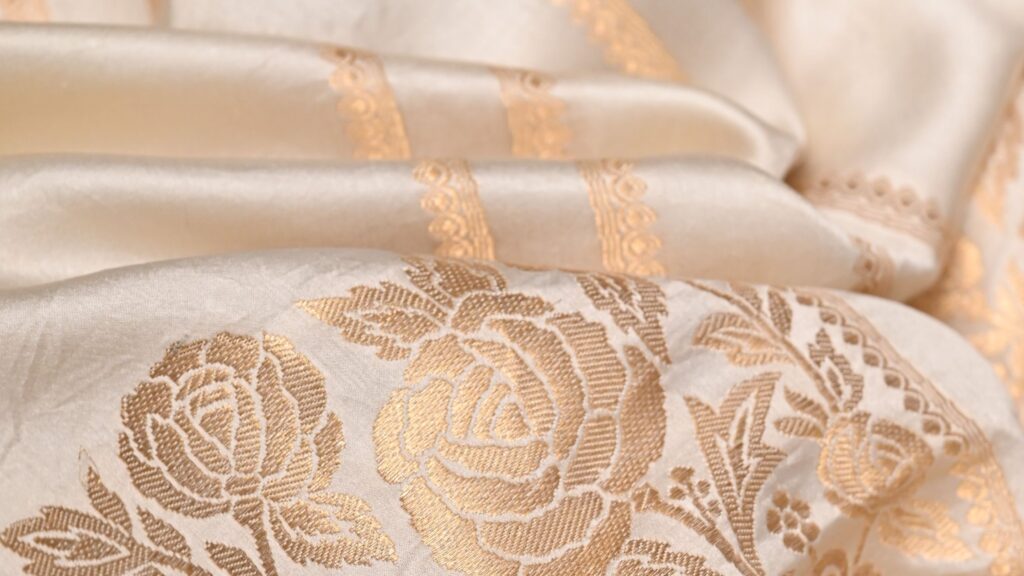
The silk route has earned a name and a continuity in the contemporary times for a reason and we need to refer to the importance of this fabric.
There was a time when silk was the reason behind the Asian merchants stored gold in their assets as the fine fabric with a pearl-like shimmer was an asset that only the rich and the royalty could possess.
The farmers who invested in sericulture and weavers who spun these handlooms, knew they were spinning gold. Silk has a long history of it being associated with heritage and culture.
It is a natural fiber which makes it an obvious choice for cultural celebrations, such as weddings, while cotton would be the preferred everyday choice.
Also read – Must-Know Checklist Before Buying a Pure Banarasi Saree: HSN Code 5007, Silk Mark & Authenticity Guide
The people who come from long lines of traditions and cultures have a keen eye to spot the authenticity of a weave, a certain eye for the finesse of the patterns woven in, and the width or structure of elements as simple as maybe just a border.
You couldn’t understand the reference, could you?
For instance, if you are somewhat well-versed with the world of Benarasi silk weaving, you will know that a Tanchoi weave looks different from a Butidar weave.
But distinguishing the original from the fake in a technologically age and time is also a challenge.
Here, are a few measures you can adopt to find real silk vs fake silk
Touch Test:
There are people who would simply touch Silk and the softness of the real fabric, even in the true katan weave or the handwoven eri silk weave will feel very smooth. Silk is a very fine and soft fabric, so if it is real silk, the fabric has a soft sheen and smooth butter like texture with a very soft flow.

Whereas, the fake silk has a coarser texture and your hand will immediately feel that slight harshness to it. The contrast is especially stark for people who might even have one or more heirloom pieces where the embroidery or zari was done using real metal threads and the weight would be of the metal threads than of the silk itself. On a similar note, the handwoven silk will be soft but can be uneven, whereas an art or fake silk will be smoother, yet unpleasant to the touch.
Rub Test:
The experienced hands may know it just by touch, but some even use the rub test. Take a part of the fabric in your hand and rub it between two palms and let the fabric go.
What does it do? Or how does it prove the authenticity?
Silk, like cotton, is a natural fiber and the natural fibers either have zero, negligible, or short-term static electricity. So, when you do a static electricity test, you’ll be pleased to see your Silk, if real, being a safe choice for attire.
Ring Test:
The ring has played a role for centuries in identifying the fineness of the silk. If the silk is authentic, it will pass through a finger ring of whatever diameter without much ado. But even the slightest addition of unnatural fabric or even cotton, the cloth will either clog or clot around the ring and not pass smoothly through and through.
Burn Test
This really is the first expression when you read the word fire, and silk is definitely very expensive, so one has to have that heart of stone to use the fire test.
What does this test however helps prove within no time is the fake or real or even how much of fake?
Even if you do not wish to burn the fabric, you can just move a lighter under the fabric and see the real silk immediately start losing its sheen and become thinner. Whereas, a fake silk will start clotting like plastic does. And if the zari is originally gold or silver, the thread will burn to ashes, just like real silk fabric which also turns into ash.
There are a few points that you need to keep in mind.
Your skin will tell you over time if the saree you are wearing if you is silk or not. For sensitive skin types, silk and cotton are the advised choices. If you have a sensitive skin and are hypoallergenic, your skin will also announce the difference from the real to the fake. Although this test will be an overtime test where your skin announces it to you, but silk and cotton are breathable and especially suitable for hypoallergenic skin.
Also, the luster and shine of silk is very pearl-like with a soft sheen. The colors in pure silk will have varied sheen and tint under different light settings. You might also notice the same metallic thread on a silk saree behaves in different metallic tones. Whereas, there is a coarse gaudy shine to fake silk with no tint or tone variation and has a flat color texture.
The real silk is also quite expensive and even the simplest saree will cost very less in comparison. A real handwoven silk is really an heirloom and hence, the work, the unfinished threads in the reverse side of the saree, the unfinished edges are all evident.
Where can you find a real silk?
Situated near the Rathyatra Crossings of the old as civilization holy city of Banaras, JDS Banaras is a century-old name that pledges serving you with a smile. What you receive is authentic pure handloom Benarasi silk sarees, suits, dupattas, Lehengas, fabrics and more. The olden golden promise of assisting you find the purest silk for your cherished wardrobe.
However, if visiting a store is not a possibility or you love shopping online, Sacred Weaves, the sister concern of JDS can be your wish fulfillment. With unmatched and assured quality, you will find designs vowing and wooing you in real silk made with traditional weaving skills. Sacred Weaves, the sister concern of JDS is also fulfilling the pledge to the new age audience.
A final address:
The real silk has an age-old regality of its own and thus, the more you delve into the world of silken threads, the easier it will be for you to spot the real.
How to Identify Pure Banarasi Silk Saree Before Buying
Buying a genuine Banarasi silk saree requires more than simply looking at the design. Authentic Banarasi sarees are handcrafted by skilled artisans who spend days or even weeks weaving intricate motifs using pure silk yarns and fine zari. Before making a purchase, keep the following points in mind:
Check the Weaving
A handwoven Banarasi saree will usually have slight irregularities on the reverse side because every motif is woven manually. Machine-made sarees generally have a perfectly uniform backside.
Observe the Zari Work
Original Banarasi sarees use premium quality zari that blends naturally into the weave. Cheap imitation sarees often use metallic polyester threads that appear overly shiny.
Feel the Weight
Pure silk has a rich drape and graceful fall. While lightweight, it never feels flimsy. The weight distribution remains balanced throughout the saree.
Examine the Border and Pallu
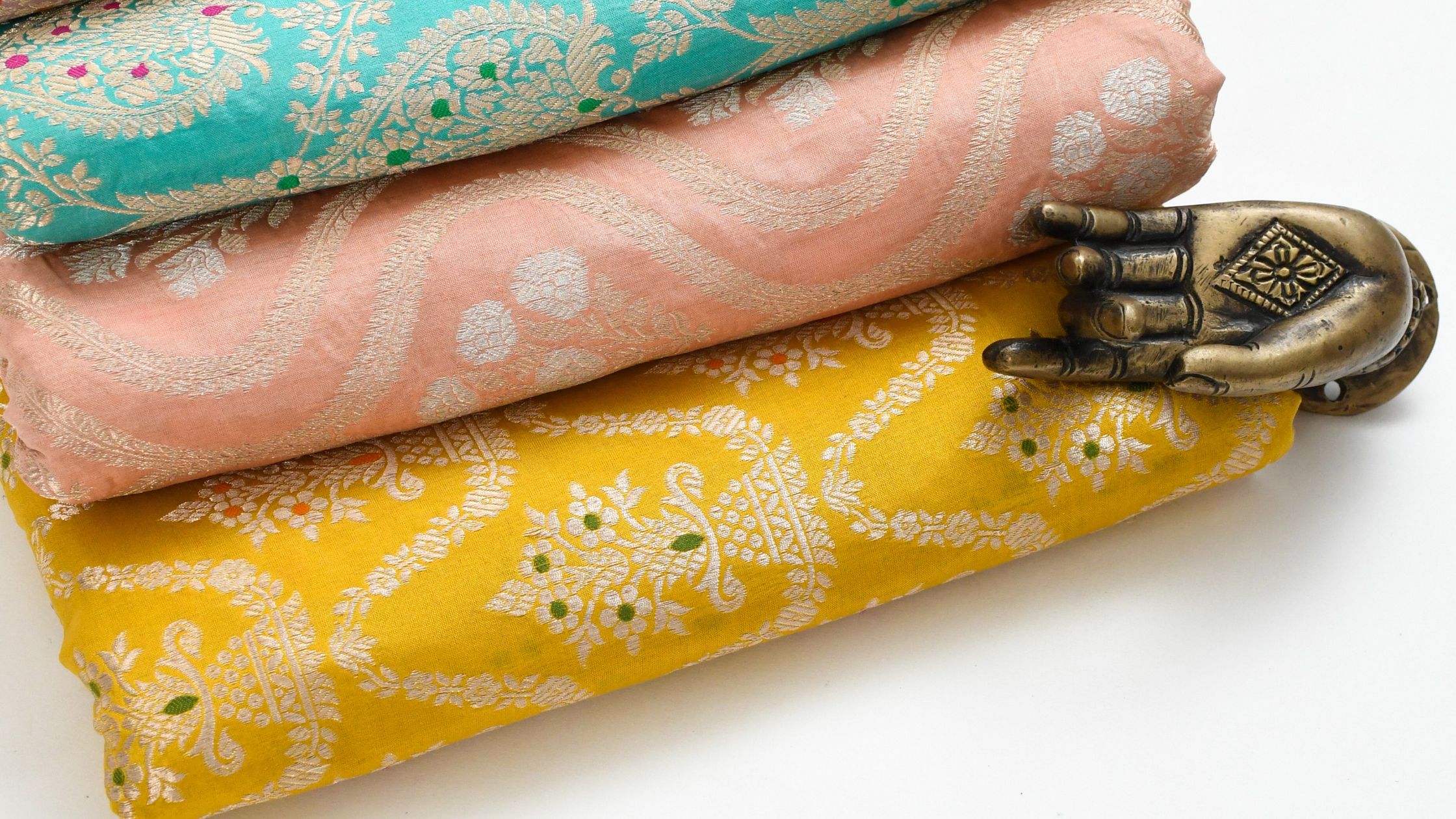
Traditional Banarasi sarees are known for their detailed borders, elaborate pallu designs, floral jaal patterns, kalga, bel, buta and paisley motifs. Sharp detailing usually indicates superior craftsmanship.
Ask About Silk Authenticity
Reputable sellers openly explain the silk quality, weaving technique, and origin of the saree. Genuine Banarasi silk retailers value transparency and craftsmanship.
Why Authentic Banarasi Silk Costs More
Many first-time buyers wonder why genuine Banarasi silk sarees are significantly more expensive than imitation alternatives.
Several factors contribute to the price:
- Pure natural silk yarn
- Skilled handloom weaving
- Traditional craftsmanship passed through generations
- Time-intensive production process
- Premium zari work
- Limited handcrafted production
Unlike machine-made fabrics, an authentic Banarasi silk saree is often considered an heirloom that can be preserved and passed down through generations.
Common Types of Fake Silk Available in the Market
Consumers often encounter several types of imitation silk marketed as genuine silk.
Some common examples include:
- Artificial Silk (Art Silk)
- Polyester Silk
- Nylon Blend Silk
- Viscose Silk
- Satin Fabric Sold as Silk
- Powerloom Banarasi Sarees
While these fabrics may resemble silk visually, they differ significantly in texture, durability, breathability, and overall elegance.
Difference Between Pure Silk and Artificial Silk
| Feature | Pure Silk | Artificial Silk |
|---|---|---|
| Origin | Natural silk fibre | Synthetic fibre |
| Texture | Soft, smooth, luxurious | Slightly coarse or slippery |
| Shine | Soft pearl-like lustre | Bright artificial shine |
| Breathability | Excellent | Limited |
| Durability | Very high with proper care | Moderate |
| Heat Resistance | Burns into ash | Melts like plastic |
| Value | Premium | Budget-friendly |
How to Care for a Pure Banarasi Silk Saree
Proper maintenance helps preserve the beauty of a silk saree for decades.
Some useful care tips include:
- Always dry clean pure silk.
- Store the saree wrapped in soft cotton or muslin cloth.
- Avoid direct sunlight during storage.
- Refold the saree every few months to prevent permanent creases.
- Keep perfumes and deodorants away from the fabric.
- Never spray water directly onto silk.
- Store in a cool, dry place away from moisture.
Why Handwoven Banarasi Silk is Different
Banaras has been the centre of silk weaving for centuries. Every authentic handwoven Banarasi saree represents the artistry of experienced weavers who combine traditional techniques with intricate design knowledge.
Unlike mass-produced machine-made sarees, handwoven Banarasi silk carries subtle variations that reflect genuine craftsmanship. These small imperfections are often regarded as a hallmark of authenticity rather than defects.
Owning a handwoven Banarasi silk saree means preserving a living tradition that has been celebrated across generations.