
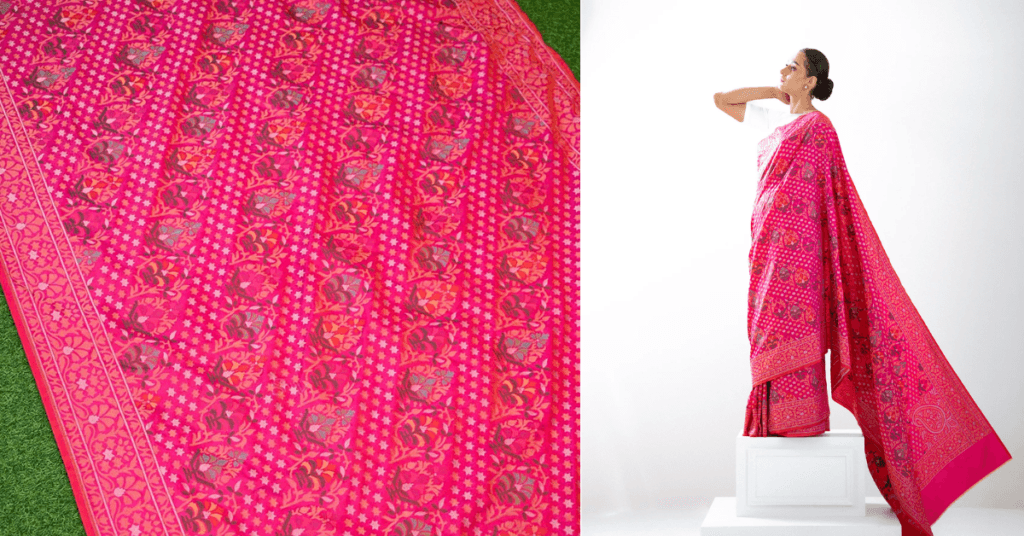
The best saree for Dussehra is the one that matches your actual day, not just the festival itself. If your Vijayadashami involves a temple visit, Ayudha Puja at home, and a family meal that stretches into the evening, a single saree may need to carry you through very different moods and hours. A rich Banarasi Katan silk saree, with its zari work and traditional motifs, feels wonderfully festive for pujas and family gatherings. A lighter Banarasi Georgette or Organza suits a longer day of travelling between temple, relatives, and celebrations. In this guide, I’ll walk you through how to choose, what colours actually work, and why Dussehra sarees so often become the ones families hold onto for years.
What Dussehra Actually Celebrates, and Why the Saree Matters
Dussehra, also called Vijayadashami, marks the end of Navratri and celebrates the victory of good over evil — a theme that runs through Indian festivals in different forms, but always carries the same sense of renewal. It’s a day people genuinely look forward to, and dressing well for it is part of how that feeling gets expressed.
What I find interesting is how differently this single festival plays out across Indian households. In some homes, the morning centres around Ayudha Puja, where tools, books, and instruments are set out and blessed. In others, the day is built around a temple visit or a large family gathering. The saree someone chooses for an early puja often looks nothing like the one kept aside for an evening celebration — and that’s exactly why there’s no single “correct” Dussehra saree. There’s only the one that suits how you’ll actually spend the day.
Start With Your Day, Not the Saree
Before thinking about fabric or colour, I always suggest working backwards from your actual plans.
A morning that starts with a puja, moves to a temple visit, and continues into family time later in the day calls for something you can comfortably wear for many hours. A celebration that’s mostly indoors — a family gathering, an evening get-together — gives you more room to choose something richer, since you won’t be walking or standing for long stretches.
There’s also nothing wrong with reaching for a saree you already own. Some of the most-loved festive sarees are the ones worn several times before — the drape is familiar, the blouse already fits, and the colour is one you know suits you. A new saree is lovely, but it isn’t a requirement for the day to feel special.
Banarasi Katan Silk — For Pujas and Family Celebrations
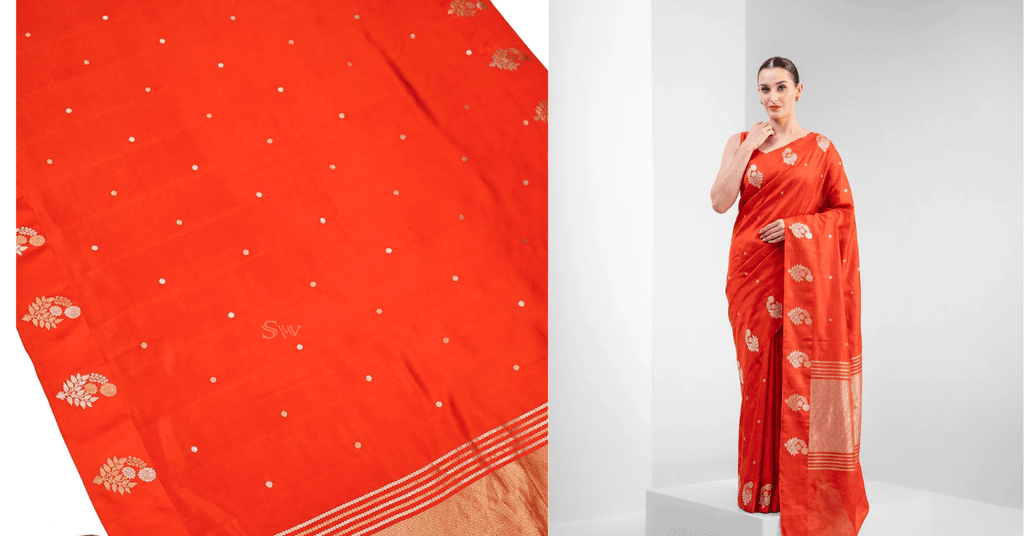
When the day calls for something rich and traditional, a Banarasi Katan silk saree is hard to beat. The zari work, the woven butis, and the floral motifs give it a naturally festive character — the kind of saree that doesn’t need much else around it to feel complete.
The structure of Katan silk also works in its favour here. The pleats hold their shape well, and the saree has enough body to carry itself through a puja, a temple visit, or a family meal without needing constant adjustment. Deep reds, festive golds, and traditional maroons are lovely choices, though softer shades work just as beautifully if that’s more your style.
A Banarasi saree also rarely feels like a one-festival purchase. The same piece that makes an appearance this Dussehra can just as easily show up at a wedding, an anniversary, or another family celebration months later.
Lighter Banarasi Weaves — For a Day That Keeps You Moving
Not every Dussehra looks like sitting comfortably at home. For many families, the day means an early start, a temple visit, a stop at a relative’s house, and another gathering in the evening. On days like this, a heavy silk saree can start to feel like more than you bargained for by the afternoon.
This is where lighter Banarasi weaves genuinely earn their place. A Banarasi Georgette saree gives you that same festive character in a softer, more flowing fabric that’s far easier to wear for hours at a stretch. Banarasi Organza offers a crisp, lightweight alternative with its own quiet elegance — you can read more about it in our fabric guides. And a Banarasi cotton silk saree sits somewhere between everyday comfort and festive dressing, which is genuinely useful when one saree needs to work across several parts of a long day.
To understand how these different Banarasi weaves actually differ in feel and weight, this guide explains it simply: Is Banarasi Silk Saree Soft or Hard?
The Best Colours for a Dussehra Saree
Ask ten women what colour they’re wearing for Dussehra, and you’ll likely get ten different answers — and honestly, that’s exactly how it should be.
- Red remains a familiar festive favourite, and it looks especially rich paired with gold zari on a Banarasi weave.
- Deep green, particularly emerald or bottle green, gives a more layered, festive richness — brighter greens work beautifully for daytime celebrations.
- Mustard and gold tones are wonderfully easy to wear for morning pujas, bringing warmth without needing much extra styling around them.
- Maroon and rust suit anyone drawn to deeper, more traditional festive shades.
- Ivory and soft gold are lovely for women who’d rather skip bright colours altogether — especially when paired with a traditional zari border, and useful well beyond festival season too.
My honest advice: choose a colour that suits the occasion, but also one you can genuinely picture yourself wearing again. That’s a far more practical way to shop than chasing whatever’s trending this particular year.
Combinations Worth Trying
Colour and weave don’t need to compete with each other — a good pairing usually lets both breathe. A few combinations I’d genuinely recommend: deep red with antique gold zari, mustard with rust-toned accents, ivory with a traditional temple-inspired border, and emerald green with a contrasting maroon border.
A heavily worked Banarasi saree usually doesn’t need an elaborate blouse alongside it — the saree is already saying enough. A lighter Georgette or cotton silk piece, on the other hand, gives you a little more room to dress up the blouse or jewellery if you’d like.
Traditional Doesn’t Have to Mean Heavy
This is worth remembering while you’re shopping. Dressing traditionally for Dussehra doesn’t automatically mean reaching for the heaviest silk and the most jewellery you own. A softer Banarasi Georgette with simple gold earrings can feel just as considered as a densely worked Katan silk piece with a full jewellery set.
The occasion sets the general direction — festive, respectful, a little celebratory. Your personal comfort and style decide everything else.
Choose a Saree You’ll Actually Reach For Again
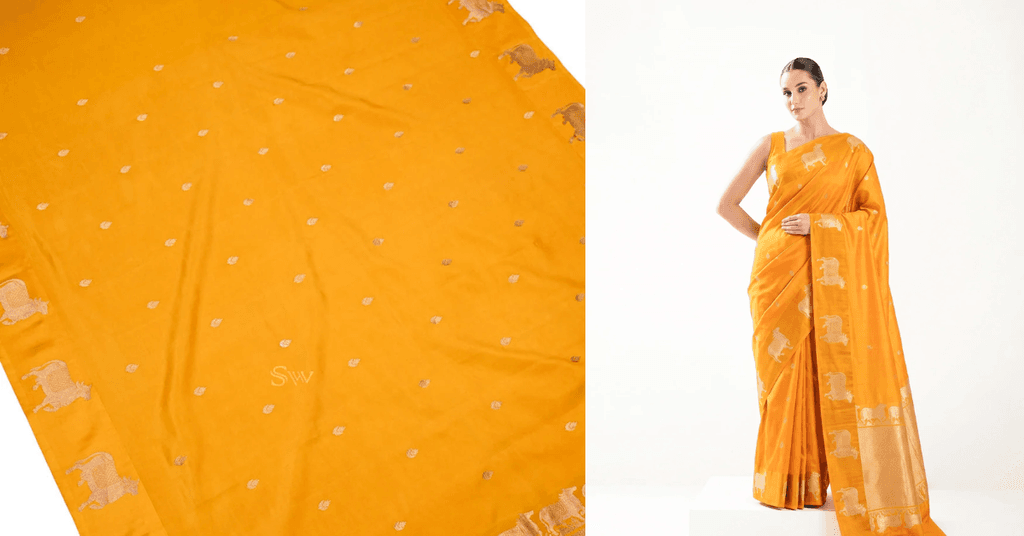
A saree bought for this Dussehra doesn’t need to disappear into the back of your wardrobe the moment Vijayadashami ends. This is really where genuine Banarasi weaves earn their keep — a Katan silk saree worn this year can just as easily show up at a wedding reception. A lighter Georgette can return for another family pooja or a festive lunch months later.
That kind of rewearability is worth thinking about before you buy, not after. If you’d like to understand more about the different Banarasi fabric types and which suits which occasion, this guide is a good starting point: What Type of Silk Is Used in Banarasi Sarees?
Expert Insight
Every festive season, we see the same lovely pattern at our showroom. Some women arrive knowing exactly what they want. Others come in looking for “something traditional” without quite knowing whether that means silk, cotton silk, or something lighter altogether. My honest advice is always the same: think about your actual day first, and let that decide the fabric. The festival will feel special either way — what matters is that you’re comfortable enough to actually enjoy it.
Some Dussehra Sarees Stay With You for Years
There’s often one saree in every family with a longer story than expected. Maybe it was worn for a Dussehra years ago and now shows up in old photographs. Maybe a daughter borrowed it eventually. Maybe it’s carefully folded away after every Vijayadashami and brought out again the following year, a little softer and a little more beautiful each time.
A genuine handwoven Banarasi saree ages this way — softening and gaining character with each wear rather than wearing out. Its value was never only in the silk or the zari. A good deal of it comes from the occasions it quietly collects along the way.
Making Sure Your Festive Saree Is Genuinely Handwoven
Since a Dussehra saree so often becomes one you’ll keep for years, it’s worth checking that what you’re buying is genuine before you take it home. Ask whether the zari is real — a quick scratch test reveals silver beneath the gold coating on genuine zari, while synthetic versions usually flake. Look for Silk Mark certification, which confirms real silk content. Our detailed guide walks through exactly how to check this yourself: Real Silk Versus the Fake: How to Identify.
Visit JDS Banaras This Festive Season
Whether you’re looking for a rich Katan silk for your Dussehra puja or something lighter for a long day of travelling between celebrations, we’d love to help you find the right one.
JDS Banaras — Jagdish Das & Company
D-58/1, Rathyatra Kamachha Road, Rathyatra Crossing, Varanasi 221010
Phone: +91 7269 055 695
Hours: Monday to Saturday, 10:30am to 8:30pm
Reach us through our contact page.
Frequently Asked Questions
It depends on your day. A rich Banarasi Katan silk saree suits a formal puja, temple visit, or family gathering, while a lighter Banarasi Georgette, Organza, or cotton silk saree is more comfortable for a longer day involving travel between temple, relatives, and celebrations.
Dussehra, or Vijayadashami, marks the end of Navratri and celebrates the victory of good over evil. Dressing in a traditional saree is part of how many families mark the occasion, whether for a morning puja, Ayudha Puja, a temple visit, or an evening family celebration.
Red, deep green, mustard, gold, and maroon are popular festive choices, especially paired with traditional zari work. Softer shades like ivory and muted gold also work beautifully, particularly with a traditional border, and tend to remain useful well beyond the festive season.
Yes. A Banarasi Katan silk saree with zari work and traditional motifs feels naturally festive for pujas and family gatherings. For a longer, more active day, a lighter Banarasi Georgette or Organza saree offers the same festive character with much easier all-day wear.
Absolutely. Traditional dressing doesn’t have to mean heavy silk and elaborate styling. A softer Banarasi Georgette or cotton silk saree, styled simply, can feel just as considered and festive as a richly worked piece, especially for a day that involves a lot of movement.
Yes, and it’s worth choosing with this in mind. A Banarasi Katan silk saree can easily reappear at a wedding or family celebration later in the year, while a lighter Georgette or Organza saree works well for another puja or festive gathering.
Check for Silk Mark certification confirming genuine silk content, and scratch-test any zari work — real zari shows silver beneath the gold coating, while synthetic zari usually flakes off. A trustworthy seller will always be clear about the fabric and technique used.