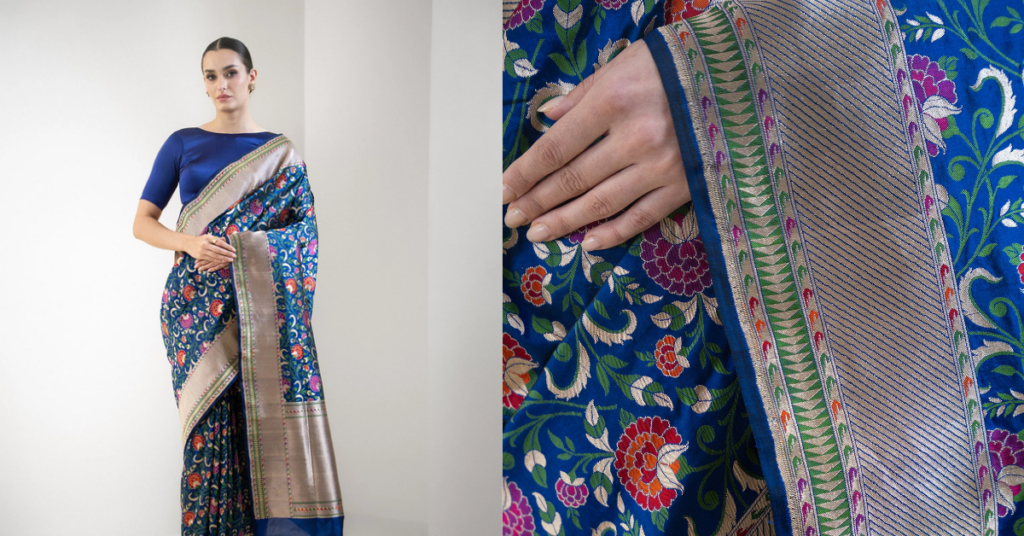
Two Banarasi sarees may look almost identical, with beautiful golden borders, intricate floral motifs and a luxurious sheen. Yet one may be handwoven using pure silk by artisans in Varanasi, while the other may be a machine-made imitation using synthetic materials.
For an inexperienced buyer, distinguishing between them can be challenging.
To identify an original Banarasi saree, you need to verify its geographical origin, fabric composition, weaving technique and zari quality. Appearance, weight, price or a single certification cannot independently establish every aspect of its authenticity.
With more than a century of Banarasi textile heritage, JDS Banaras brings together this practical buying guide to help you make an informed decision before investing in a Banarasi saree.
What Makes a Banarasi Saree Authentic?
Understanding Banarasi saree authenticity begins with separating four important characteristics.
| Authenticity Factor | What It Establishes |
|---|---|
| Geographical origin | Where the saree was produced |
| Fabric composition | Whether it contains pure silk, blended or synthetic fibres |
| Weaving technique | Whether it is handwoven or machine-made |
| Zari composition | Whether the zari contains precious metals or alternative materials |
These characteristics are not interchangeable.
A saree can be made from pure silk without being handwoven. Similarly, a traditional handwoven Banarasi saree can contain imitation zari without being a counterfeit product, provided its materials are accurately represented and it meets the applicable specifications.
The real concern arises when a seller misrepresents a saree’s origin, materials or craftsmanship.
1. Verify Where the Banarasi Saree Was Made
Banarasi sarees originate from the traditional weaving regions of Varanasi and its surrounding areas in Uttar Pradesh.
The Government of India registered Banaras Brocades and Sarees as a Geographical Indication (GI) in 2009, recognising their geographical and traditional identity.
A saree featuring Banarasi-inspired floral motifs or elaborate zari borders is not necessarily an authentic Banarasi handloom product.
Before purchasing, ask the seller:
- Where was this saree woven?
- Can you provide details about its manufacturing origin?
- Does it conform to the registered Banarasi textile specifications?
Remember that buying a saree in Varanasi does not automatically establish that it was manufactured there.
2. Check Whether the Saree Is Made From Pure Silk
The term “Banarasi silk saree” does not always guarantee that the fabric is made entirely from natural silk.
Different products may contain:
- Pure natural silk
- Silk blends
- Viscose or artificial silk
- Polyester and other synthetic fibres
While natural silk has distinctive texture, drape and lustre, modern synthetic materials can closely reproduce its appearance.
Instead of relying entirely on touch or shine, ask for the exact fibre composition.
If you are purchasing a Katan silk Banarasi saree, for example, confirm whether the base fabric is made from pure silk or a blended material.
You can also read our detailed guide on how to identify real silk versus fake silk to understand the differences between natural and artificial silk.
3. Look for an Authentic Silk Mark Label
Silk Mark is one of the most useful forms of assurance when purchasing a pure silk saree.
According to the Silk Mark Organisation of India, authorised users issue Silk Mark labels for eligible products made from 100% natural silk.
When checking a Silk Mark label, look for:
- The official Silk Mark identity.
- A hologram and unique identification number.
- Relevant verification features, such as a QR code where available.
- Information about the authorised seller.
However, Silk Mark has limitations that every buyer should understand.
Silk Mark assures silk purity. It does not independently certify handloom weaving, Banarasi geographical origin or the quality of zari.
A genuine Silk Mark-labelled saree may still require additional verification if you specifically want an authentic handwoven Banarasi saree with real zari.
4. Understand the Difference Between Handloom and Powerloom
Handloom Banarasi sarees are created through manually operated looms, requiring skilled artisans to construct the fabric and its decorative patterns.
Powerloom sarees are produced using mechanised weaving equipment, which can reproduce traditional-looking patterns at a faster rate.
| Feature | Handloom | Powerloom |
|---|---|---|
| Production | Manually operated loom | Mechanised loom |
| Craftsmanship | Artisan-controlled weaving | Mechanised production |
| Production time | Often longer | Generally shorter |
| Uniformity | May show subtle variations | Often highly consistent |
| Cost | Depends on craftsmanship and materials | Generally lower for comparable designs |
These are general differences, not conclusive identification tests.
A skilled handloom weaver can produce exceptionally consistent designs, while machine-made fabrics may also display irregularities.
Ask the seller about the specific weaving technique rather than relying entirely on visual inspection.
5. Examine the Reverse Side of the Saree
Turning the saree over can help you understand how its motifs have been constructed.
However, one of the most widespread misconceptions about Banarasi sarees is that every genuine handloom saree must have loose threads on its reverse side.
Different weaving techniques produce different finishes.
For example:
- Fekua weaving: May leave supplementary threads running between motifs.
- Cutwork weaving: May show trimmed threads behind decorative patterns.
- Kadhua weaving: Creates individual motifs separately and can produce a considerably cleaner reverse-side finish.
A clean reverse side does not automatically indicate a machine-made saree.
Our detailed guide to Kadhua weaving explains why this distinction matters when identifying authentic Banarasi craftsmanship.
Examine the construction of the motifs, borders and pallu together, and ask the seller to explain the technique used.
6. Identify the Type of Zari Used
The golden or silver appearance of zari cannot establish its actual composition.
Banarasi sarees may incorporate different types of decorative metallic threads.
These include:
- Traditional real zari containing precious metals.
- Tested zari made with alternative metal compositions.
- Imitation zari using metallic-looking synthetic materials.
The difference can significantly influence the value of a saree.
Two sarees with similar designs and pure silk fabric may have substantially different prices because of their zari composition.
Before paying a premium for real zari, request a clear explanation of its material and supporting documentation where available.
Avoid scratching, burning or damaging the zari to determine its composition.
Read our dedicated guide on how to identify real and imitation zari in Banarasi sarees for a better understanding of zari materials.
7. Understand Why Similar Banarasi Sarees Have Different Prices
Price is an important consideration when purchasing an authentic Banarasi saree, but it should never be treated as independent proof of authenticity.
Consider these three illustrative examples:
| Saree | Fabric | Weaving | Zari |
|---|---|---|---|
| Saree A | Pure silk | Handloom | Real zari |
| Saree B | Pure silk | Handloom | Imitation zari |
| Saree C | Silk blend | Powerloom | Imitation zari |
All three sarees may appear similar in photographs, but their materials, production methods and craftsmanship differ considerably.
The price of a Banarasi saree is influenced by:
- Quality and composition of the silk.
- Type of zari used.
- Complexity and density of motifs.
- Weaving technique.
- Artisan labour and production time.
An affordable saree is not necessarily fake, just as an expensive saree is not necessarily authentic.
The important question is whether the price is justified by the product’s actual specifications.
8. Check the Purchase Invoice and Product Details
A detailed purchase invoice provides a written record of what you have purchased and helps protect your interests as a customer.
When buying a premium Banarasi saree, request that relevant product details are documented, including:
- Fabric composition.
- Handloom or powerloom production.
- Type of weaving technique.
- Zari composition, particularly when paying for real zari.
- Product price and seller details.
You may also encounter HSN Code 5007 when purchasing woven silk fabrics.
However, an HSN code is primarily a product classification used for taxation. It is not an independent certification of silk purity, geographical origin, handloom craftsmanship or zari composition.
Always assess the invoice alongside relevant certifications, product information and seller credibility.
9. Buy From a Knowledgeable and Established Saree Seller
Purchasing from a knowledgeable textile manufacturer or retailer can help reduce uncertainty when investing in authentic Banarasi sarees.
A reliable seller should be able to explain:
- Where the saree was manufactured.
- Which weaving technique was used.
- What type of silk and zari the saree contains.
- Why one saree costs more than another.
- Which authenticity certifications are applicable.
Be cautious if a seller avoids answering straightforward questions, provides vague product descriptions or pressures you to make an immediate purchase.
If you are planning to shop in Varanasi, read our guide on what makes a saree shop trustworthy in Varanasi before selecting a retailer.
Silk Mark vs Handloom Mark vs GI Tag: What Is the Difference?
These three forms of identification serve different purposes when verifying textile authenticity.
| Identification | What It Relates To | What It Does Not Independently Establish |
|---|---|---|
| Silk Mark | Natural silk purity | Weaving method, geographical origin or zari purity |
| Handloom Mark | Genuine handwoven production | Silk purity or zari composition |
| GI registration | Geographical origin and registered product specifications | Exact fibre and zari composition of an individual saree |
No single label should be treated as proof of every aspect of a Banarasi saree.
Buyers should evaluate the relevant certifications together with accurate product information.
5 Common Myths About Identifying Original Banarasi Sarees
Myth 1: Every Pure Silk Saree Is Handwoven
Pure silk describes the fibre used in the fabric, not the method of weaving.
Myth 2: Genuine Banarasi Sarees Always Have Loose Threads on the Back
Different weaving techniques produce different reverse-side finishes. Genuine Kadhua work can have a particularly neat finish.
Myth 3: Every Authentic Banarasi Saree Contains Real Gold or Silver Zari
Traditional Banarasi weaving may incorporate different zari compositions. The seller should accurately disclose the materials used.
Myth 4: Expensive Banarasi Sarees Are Always Authentic
Price alone cannot verify geographical origin, material composition or craftsmanship.
Myth 5: A Silk Burn Test Proves Banarasi Saree Authenticity
A fibre test may provide limited information about a particular thread, but it cannot establish the saree’s geographical origin, weaving method or zari composition.
For valuable sarees, professional fibre testing is preferable to destructive home tests.
How to Identify an Original Banarasi Saree When Shopping Online
Online shopping requires additional attention because buyers cannot physically inspect the saree before purchasing.
Before placing an order, check whether the website provides:
- Detailed fabric specifications.
- Clear information about the weaving technique.
- Close-up photographs of motifs, borders and pallu.
- Reverse-side photographs, where available.
- Information about relevant certifications.
- Transparent pricing.
- Return and exchange policies.
- Verified business contact details.
If important information is missing, contact the retailer before completing your purchase.
Photographs can help you evaluate the appearance of a saree, but they cannot independently establish its authenticity.
Quick Banarasi Saree Authenticity Checklist
Use this checklist before finalising your purchase.
| What to Check | Question to Ask |
|---|---|
| Geographical origin | Where was this saree woven? |
| Fabric | Is it pure silk or a blend? |
| Weaving | Is it handloom or powerloom? |
| Technique | Is it Kadhua, Cutwork, Fekua or another weave? |
| Zari | What material is the zari made from? |
| Silk Mark | Does the pure silk product carry an authentic label? |
| Price | What factors justify its price? |
| Invoice | Are the important product specifications documented? |
| Seller credibility | Can the seller explain the product’s origin and craftsmanship? |
A transparent seller should help you understand what you are purchasing, regardless of your budget.
Where to Buy Authentic Banarasi Sarees in Varanasi?
Established in 1913, JDS Banaras carries forward four generations of Banarasi textile expertise, with family textile roots dating back to 1805.
At JDS Banaras, customers can explore authentic Banarasi handloom sarees, including Katan silk, Kadhua, Organza, Tissue, Georgette and traditional brocade creations.
Visiting our Banarasi saree showroom in Varanasi allows you to examine fabrics, compare weaving techniques and understand the craftsmanship behind different sarees before making your purchase.
Whether you are selecting a bridal saree or investing in a traditional handloom masterpiece, understanding what you buy is just as important as choosing a beautiful design.
Discover the heritage of JDS Banaras and its longstanding association with Banarasi textile craftsmanship.
Visit JDS Banaras
Address: D-58/1, Rathyatra Kamachha Road, Rathyatra Crossing, Varanasi, Uttar Pradesh – 221010
Phone: +91 72690 55695
Contact JDS Banaras for assistance with your Banarasi saree purchase.
Frequently Asked Questions
How Can I Identify an Original Banarasi Saree?
Verify its geographical origin, fabric composition, weaving method and zari quality. Relevant certifications, detailed product specifications and a trustworthy seller provide additional assurance.
Does Silk Mark Guarantee an Authentic Banarasi Saree?
Silk Mark provides assurance of natural silk purity. It does not independently certify Banarasi geographical origin, handloom weaving or zari quality.
How Can I Identify a Handloom Banarasi Saree?
Examine the motif construction, reverse-side finish and weaving details. Ask the seller about the specific weaving technique and check for applicable handloom identification. Visual characteristics alone are not conclusive.
Are Banarasi Sarees With Imitation Zari Fake?
Not necessarily. A saree can be genuinely handwoven within the Banarasi textile tradition while using imitation zari. Misrepresentation occurs when imitation zari is incorrectly sold as real zari.
Does HSN Code 5007 Prove That a Banarasi Saree Is Authentic?
No. HSN Code 5007 relates to the classification of woven silk fabrics. It does not independently verify silk purity, handloom production or Banarasi origin.
Can I Identify a Genuine Banarasi Saree by Its Price?
No. Prices depend on fabric composition, zari quality, weaving complexity and craftsmanship. An expensive saree is not automatically authentic.
Can I Buy an Authentic Banarasi Saree Online?
Yes. Choose an established retailer that provides transparent product specifications, applicable certifications, detailed photographs and clear purchase policies.