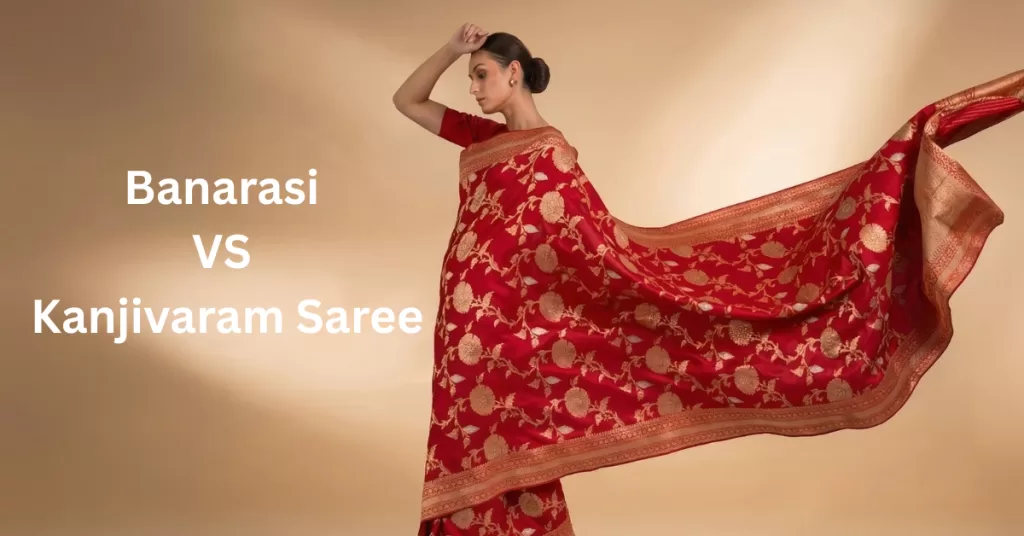
Banarasi and Kanjivaram are both handwoven pure silk sarees, but they come from different regions, use different weaving techniques, and are built for different purposes. Banarasi sarees are woven in Varanasi, Uttar Pradesh, using fine silk threads and intricate brocade or Kadwa weaving to create Mughal-inspired floral and paisley motifs — the result is a lighter, softer saree (roughly 350g to 1,000g) suited to long wear and detailed artistry. Kanjivaram sarees are woven in Kanchipuram, Tamil Nadu, from thicker pure Mulberry silk using the korvai technique, where body and border are woven separately and interlocked — producing a heavier, more structured saree (typically 600g to 1,200g+) with bold contrasting borders and temple-inspired motifs. Neither is objectively “better.” Banarasi suits long ceremonies, receptions, and detailed bridal photography; Kanjivaram suits South Indian bridal rituals and pieces meant to be passed down as rigid, structural heirlooms. The right choice depends on the occasion, the region’s tradition, and how many hours you’ll actually be wearing it.
Banarasi vs Kanjivaram Saree — At a Glance
| Feature | Banarasi Saree | Kanjivaram Saree |
| Origin | Varanasi, Uttar Pradesh (North India) | Kanchipuram, Tamil Nadu (South India) |
| Historical Root | Mughal era, 14th–16th century onward | Chola dynasty era, temple-town weaving tradition |
| Silk Used | Fine Mulberry silk, tightly twisted thread (Katan) | Thicker Mulberry silk, three-ply thread |
| Weaving Technique | Brocade / Kadwa (motifs woven individually, no floating threads) | Korvai (body and border woven separately, then interlocked) |
| Typical Motifs | Floral vines, paisley (kalga/bel), Jangla, Shikargah hunting scenes | Temple gopuram borders, peacocks, checks, mythological figures |
| Zari Placement | Spread across body and border in fine brocade | Concentrated heavily in the border and pallu |
| Approx. Weight | 350g – 1,000g+ (Organza lightest, heavy Kadwa heaviest) | 600g – 1,200g+ (generally heavier throughout) |
| Drape | Soft, fluid, flows with the body | Structured, firm, holds pleats rigidly |
| Price Range (authentic) | ₹1,500 – ₹2,00,000+ | ₹5,000 – ₹2,00,000+ (record pieces into lakhs) |
| Best Suited For | Long events, receptions, engagement, all-day wear | Main wedding ceremony, temple rituals, South Indian traditions |
| GI Protection | Yes — Banaras Brocades and Sarees GI tag | Yes — Kanchipuram Silk GI tag |
Expert Insight
At JDS Banaras, we get asked this comparison question almost daily — usually from a bride trying to decide between her mother’s Kanjivaram heirloom and a new Banarasi piece for her own wedding. Our honest answer is always the same: these are not competing versions of the same thing. They are two entirely different textile traditions that happen to share one ingredient — pure silk. Everything else, from the loom to the final drape, is built differently.
Banarasi vs Kanjivaram Saree: What Is the Real Difference?
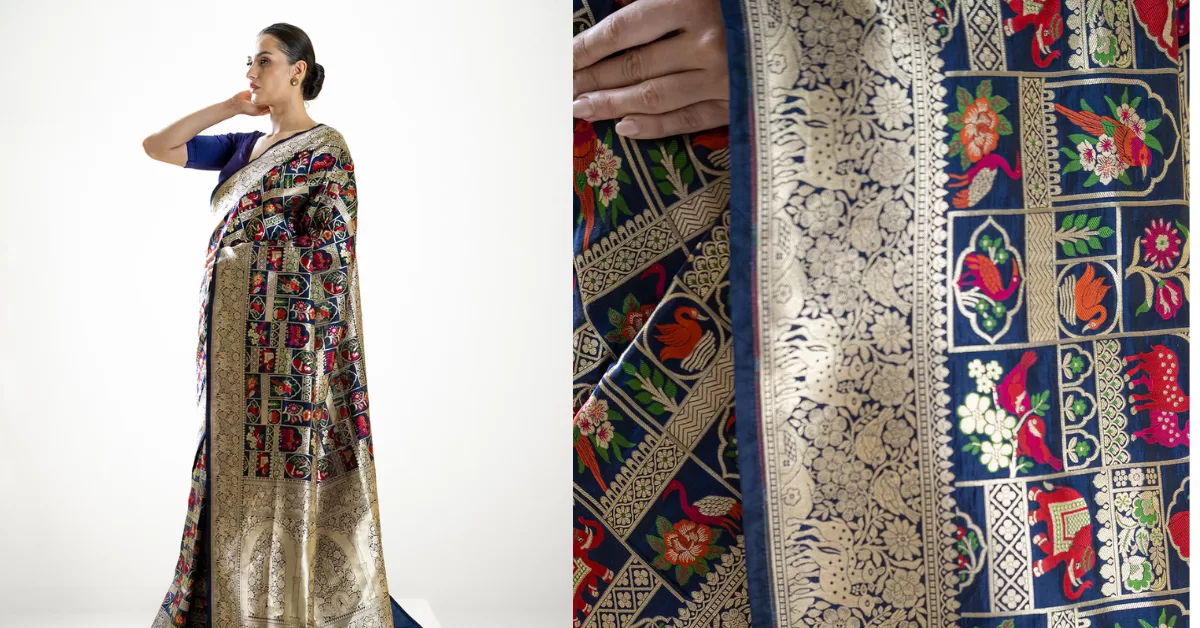
The most basic and most misunderstood distinction is this: Banarasi and Kanjivaram are not “silk saree flavours” from the same recipe. They come from two entirely separate weaving civilisations that developed independently — one in North India shaped by Mughal court artistry, the other in South India shaped by Dravidian temple architecture.
A Banarasi saree is defined by brocade weaving — where metallic zari thread is woven directly into the fabric structure to create motifs, rather than embroidered or printed on afterward. A Kanjivaram saree is defined by korvai construction — where three separate pieces (the body, and two borders) are woven independently, often in different colours, and then locked together at the loom using an interlocking weft technique so precise that the join is nearly invisible from the front.
Put simply: a Banarasi saree tells its story across the entire body of the fabric. A Kanjivaram saree tells its story primarily at the border and pallu, while the body stays comparatively plain or subtly textured. This single structural difference explains almost every other difference on this list — the weight, the drape, the price logic, and the occasions each is suited for.
Origin and History: Varanasi vs Kanchipuram
Banarasi Saree History
Banarasi weaving traces its roots to Varanasi (historically Banaras), one of the world’s oldest continuously inhabited cities and India’s most storied silk-weaving centre. Weaving historians and the city’s own weaving families generally place the tradition’s major growth in the Mughal period, roughly the 14th to 16th centuries, when Persian textile artistry merged with existing Indian weaving practices. The result was a hybrid design language — Persian floral vines and paisleys rendered in Indian silk using local Kadwa and Jangla weaving methods. This is why Banarasi motifs consistently echo Mughal architecture and miniature painting rather than any purely Indian source.
Kanjivaram Saree History
Kanjivaram weaving developed in and around Kanchipuram, Tamil Nadu — a temple town whose weaving tradition is closely tied to the region’s Chola-era temple architecture and Dravidian artistic vocabulary. Where Banarasi absorbed an external (Persian/Mughal) influence, Kanjivaram’s design language grew almost entirely from local sources: temple gopuram (gateway) silhouettes, mythological figures, and South Indian flora and fauna, particularly peacocks and elephants.
The two traditions therefore represent two different answers to the same question — how do you turn silk and precious metal thread into a wearable expression of regional identity? Varanasi answered with Mughal-inflected brocade. Kanchipuram answered with temple-inflected structural weaving.
Weaving Technique: Kadwa Brocade vs Korvai Construction
This is the single most important technical difference between the two weaves, and the one that most online comparisons explain only superficially. Here is the real mechanical difference.
How Banarasi Brocade and Kadwa Weaving Actually Work
In standard Banarasi brocade, a shuttle carrying the zari or coloured silk thread runs across the loom, creating motifs by floating over and under the base warp threads in a repeating pattern. In the premium Kadwa technique, this floating-thread approach is abandoned: each individual motif is woven separately using its own small shuttle, and the thread reverses at the edge of the motif rather than floating across the back of the fabric. The result is a saree whose reverse side is almost as clean as the front — no loose threads, no floating strands.
This is not a minor technical footnote. It is the reason premium Banarasi sarees can take anywhere from a few weeks (standard brocade) to 3–8 months (dense Kadwa work) to complete, and it is the same technique behind the Kadwa Banarasi Katan silk saree that Nita Ambani wore to the Venice Biennale in 2026 — a piece that took two master artisans five months to weave. For the full story on how the Kadwa technique determines Banarasi pricing, see our guide: Which Silk Saree Is Most Expensive? India’s Heritage Silks Ranked.
How Kanjivaram Korvai Weaving Actually Works
Kanjivaram uses an entirely different logic. Instead of weaving one continuous fabric and adding motifs onto it, the weaver constructs the saree in three separate pieces on the same loom simultaneously — the body, and the two borders — often in contrasting colours. At the point where body meets border, the weaver interlocks the wefts of each section using a technique that produces a join strong enough to survive decades of wear without unravelling. This is the korvai technique, and it is why authentic Kanjivaram sarees can be identified by gently tugging at the border-to-body junction: a genuine korvai join feels seamless and secure, while an imitation piece (where the border is simply stitched or printed on) will show a visible seam or stitch line.
The korvai technique is also why Kanjivaram borders can be a completely different colour from the body without the fabric puckering or the join weakening — a visual signature that is instantly recognisable and one that Banarasi brocade, which is woven as one continuous piece, does not replicate.
Expert Insight
People sometimes ask us at JDS Banaras why we don’t also make Kanjivaram-style sarees since we’re already master weavers. The honest answer is that korvai and Kadwa are not two settings on the same loom — they are two entirely different weaving disciplines requiring years of separate training. A Kadwa master in Varanasi and a korvai master in Kanchipuram could both look at each other’s work and genuinely not know how to begin replicating it. That specialisation is exactly why both traditions have survived for centuries without merging into a generic “silk saree” — the skill itself is regionally locked.
Zari Work: How the Metal Thread Differs Between the Two Weaves
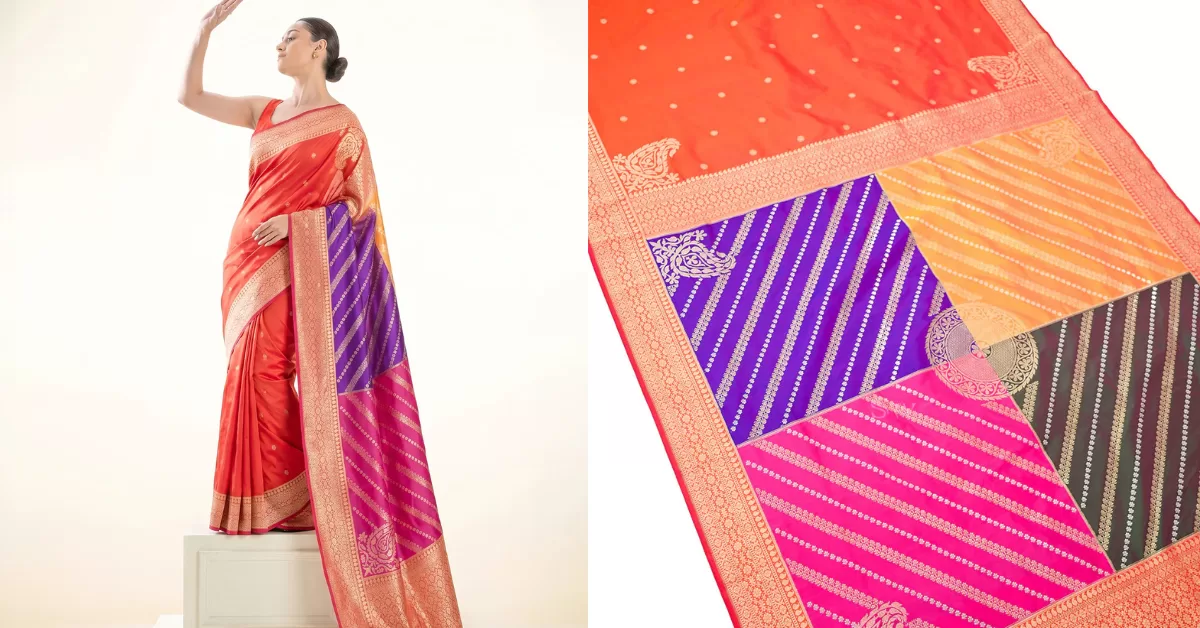
Both traditions use real zari — pure silver wire electroplated with gold, wrapped around a silk core thread — as the premium standard, and both markets are equally flooded with synthetic imitations sold under the same name. The placement and density of that zari, however, is where the two traditions diverge sharply.
In Banarasi sarees, zari is woven into fine, dense patterns that spread across the body, border, and pallu — floral jaals, butidar motifs, and paisleys rendered in a continuous brocade. The zari lies relatively flat against the fabric, producing a soft, distributed shimmer rather than a single bold accent.
In Kanjivaram sarees, zari is concentrated much more heavily in the border and pallu, often in thicker gauge thread, creating a bold, structural accent that contrasts sharply against a comparatively plain or lightly patterned body.
Because real zari construction is identical in principle across both traditions — pure silver wire, gold-plated, wound around silk — the authentication tests are shared. For the full breakdown of how to scratch-test, burn-test, and weight-test zari to tell real from synthetic (including why real zari ages into a warm patina rather than tarnishing), see our detailed guide: Is Zari in Banarasi Sarees Real or Fake? How to Tell the Difference. Every test described there — the scratch test, the burn test, the weight comparison, the reverse-side check — applies equally to Kanjivaram zari, since both use the same underlying silver-gold-silk construction.
Which Is Heavier: Banarasi or Kanjivaram Saree?
Kanjivaram sarees are generally heavier than Banarasi sarees. This comes down directly to the weaving logic explained above: Kanjivaram uses thicker, three-ply Mulberry silk threads throughout the body, plus dense zari concentrated in the border, while Banarasi uses finer, more tightly twisted silk threads with zari distributed more thinly across a larger surface area.
| Saree Type | Approximate Weight (6 yards) | Feel |
| Banarasi Organza | 350g – 500g | Crisp, nearly weightless |
| Banarasi Georgette | 400g – 600g | Soft, flowing |
| Banarasi Katan Silk (standard brocade) | 550g – 750g | Structured, substantial |
| Banarasi Katan Silk (Kadwa + real zari) | 800g – 1,000g+ | Dense, sculptural |
| Kanjivaram (light zari, plain body) | 600g – 800g | Firm, thick base silk |
| Kanjivaram (heavy bridal, dense border zari) | 900g – 1,200g+ | Very structured, rigid pleats |
Worth noting: the heaviest Banarasi pieces (dense Kadwa with full-body real zari) can weigh more than a lighter Kanjivaram with a plain body and modest border. Weight is a function of technique and zari density in both traditions — not a fixed rule of “Kanjivaram always heavier.” For a full breakdown of how weave type and zari coverage change a Banarasi saree’s weight and feel, see our guide: Is Banarasi Silk Saree Soft or Hard? The Honest Fabric Guide by Weave Type.
Motifs and Design Language: Mughal Florals vs Temple Architecture
If you can only remember one visual rule to instantly tell the two apart, use this: Banarasi motifs are inspired by gardens and Persian art; Kanjivaram motifs are inspired by temples and mythology.
Common Banarasi Motifs
- Kalga and Bel: a curved paisley (kalga) and a vertical vine > border (bel) running along the saree’s edge — the most > recognisable Banarasi signature
- Jangla: dense, all-over floral and vine coverage across the > entire body
- Shikargah: hunting-scene narratives with animals and hunters > woven into the fabric, a legacy of Mughal court art
- Butidar: small, evenly scattered floral motifs (buttis) across > the body
Common Kanjivaram Motifs
- Temple (gopuram) borders: stepped, triangular patterns echoing > South Indian temple gateways
- Peacocks and elephants (mayil and yaali): mythological and > natural motifs symbolising prosperity
- Checks and stripes: geometric contrast patterns, often on the > body while the border carries the temple motif
- Rudraksha and mango motifs: auspicious symbols drawn from South > Indian religious tradition
A useful shorthand: if the saree’s body is densely patterned edge to edge with vines and paisleys, it is almost certainly Banarasi. If the body is comparatively plain or lightly checked with all the visual weight concentrated in a bold, contrasting border, it is almost certainly Kanjivaram.
Colour Palette: How Each Tradition Uses Colour Differently
Banarasi sarees traditionally lean toward a broad, flexible palette — deep reds and maroons for bridal wear, but equally common in emerald green, royal blue, antique gold, and increasingly, soft contemporary pastels for lighter occasions. Because the zari and motif work is distributed across the entire body rather than concentrated in a border, Banarasi colour transitions tend to feel more blended and painterly.
Kanjivaram sarees traditionally favour bold, high-contrast pairings — a body in one strong colour (maroon, mustard, bottle green, royal blue) set against a border in a deliberately contrasting shade (gold, cream, deep red). This is a direct visual consequence of the korvai technique: since the border is physically woven as a separate piece, using a sharply different colour for it is both technically easy and visually traditional in a way it simply isn’t for a single continuous Banarasi weave.
Price Comparison: Is Kanjivaram More Expensive Than Banarasi?
Neither saree is categorically more expensive than the other — both range from a few thousand rupees to several lakhs, and the determining factors are the same in both traditions: silk quality, the type and coverage of zari, weaving technique complexity, and time taken.
| Category | Banarasi Price Range | Kanjivaram Price Range |
| Entry-level (synthetic zari, simple weave) | ₹1,500 – ₹8,000 | ₹5,000 – ₹12,000 |
| Mid-range (real zari border, moderate brocade/korvai) | ₹25,000 – ₹60,000 | ₹30,000 – ₹70,000 |
| Premium (dense real zari, Kadwa/heavy korvai) | ₹80,000 – ₹2,00,000+ | ₹80,000 – ₹2,00,000+ |
| Record / commission pieces | Not publicly priced (bespoke commissions) | Up to ₹39,31,627 (Guinness World Record) |
That record-holding figure is not a rounding exercise — it refers to a real, documented saree. The Vivaah Pattu, a Kanjivaram silk saree created by The Chennai Silks, holds the Guinness World Record as the most expensive silk saree ever sold, at ₹39,31,627. It took 36 master weavers 4,760 hours to complete and features 11 Raja Ravi Varma paintings handwoven into the silk. For the complete story of the most expensive saree ever documented — and how it illustrates the same fabric-plus-technique principle that applies to Banarasi pricing — read: What Is the World’s Most Expensive Saree? The Vivaah Pattu Story.
Key Takeaway
Price in both traditions is driven by the same three variables — silk grade, zari authenticity, and weaving time — not by which regional tradition the saree belongs to. A humble Kanjivaram costs less than a premium Banarasi, and vice versa; the region tells you the style, not the price tier.
Is Banarasi or Kanjivaram Saree Better for a Wedding?
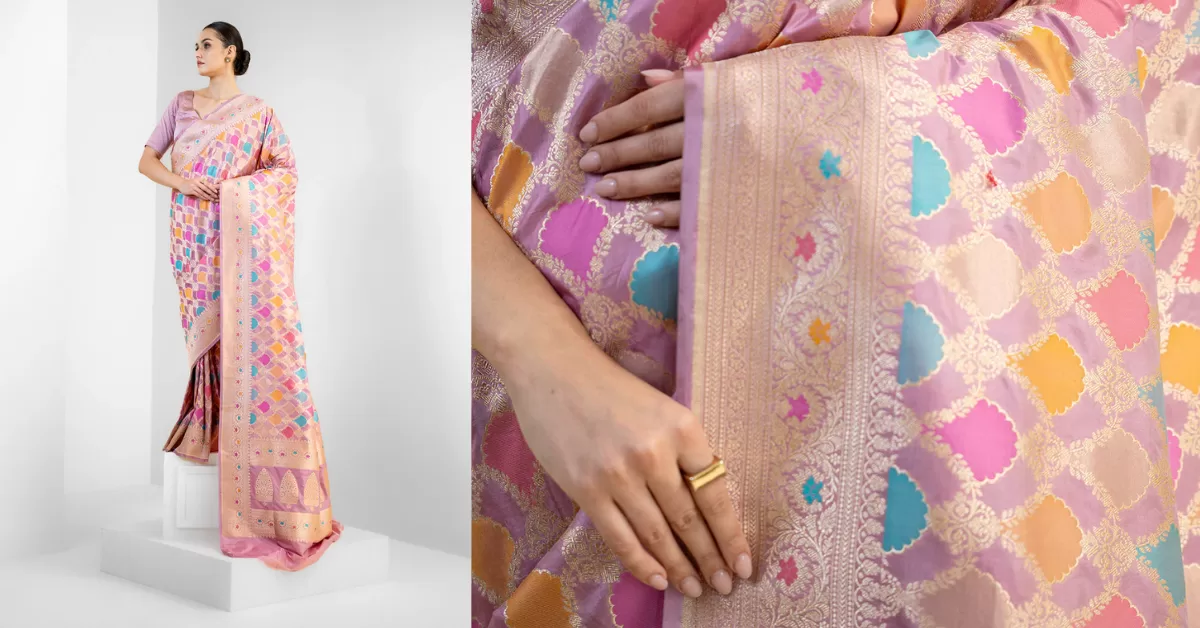
Both are considered top-tier bridal choices in India — the right one depends heavily on your regional tradition and the specific part of the wedding you’re dressing for.
| Wedding Moment | Better Suited | Why |
| Main ceremony (South Indian tradition) | Kanjivaram | Structural weight and temple motifs suit ritual settings; culturally the expected choice |
| Main ceremony (North Indian tradition) | Banarasi | Centuries of association with North Indian bridal ritual; Mughal-inspired opulence photographs beautifully |
| Reception / evening event | Banarasi | Lighter weight and fluid drape suit long hours of standing, greeting guests, and dancing |
| Temple wedding rituals | Kanjivaram | Structured drape holds shape through repeated bowing and seated rituals |
| Pre-wedding photoshoots | Banarasi | Dense body-wide brocade motifs read beautifully in close-up photography |
| Multi-day wedding — one saree for everything | Neither ideal — plan for at least two pieces | Both traditions are built for specific moments, not universal duty across a multi-day event |
Many contemporary brides now do both — a Kanjivaram (or a heavy Kadwa Banarasi) for the main ceremony, and a lighter Banarasi Georgette or Organza for the reception. There is no rule against combining traditions in one trousseau; increasingly, it is the norm rather than the exception.
Which Saree Lasts Longer: Banarasi or Kanjivaram?
Both, if genuine and properly cared for, are built to last for decades and are routinely passed down as heirlooms — the difference is in how they age, not whether they survive.
Kanjivaram’s thicker silk and korvai-locked construction gives it a reputation for structural durability — the border-to-body join, once secured, rarely weakens even after decades of folding and unfolding. Genuine Kanjivaram pieces are frequently the ones families keep entirely unworn except for a handful of major ceremonies across a lifetime, which itself preserves them further.
Banarasi’s finer silk and dense brocade age differently: rather than staying structurally static, pure Katan silk actually softens and develops a richer, warmer lustre with each wearing and gentle wash — a well-maintained Banarasi Katan silk saree from 30 years ago is often more beautiful than the same design new, because the silk protein fibre itself matures. This progressive softening is one of the clearest tests for genuine pure silk, since synthetic imitations simply degrade rather than improve. For the full explanation of how and why pure Banarasi silk changes over decades of wear, see: Is Banarasi Silk Saree Soft or Hard?
How to Identify a Genuine Banarasi or Kanjivaram Saree — A Combined Authentication Guide
Because both traditions share the same underlying zari construction (real silver wire, gold-plated, wound on a silk core), most authentication tests apply to both. A handful of tests are specific to one weave. Here is the complete combined protocol.
Tests That Apply to Both Banarasi and Kanjivaram
- The scratch test: Scratch the zari thread firmly with a > thumbnail. Real zari reveals silver beneath the gold plating. > Synthetic zari flakes off or shows plastic underneath.
- The burn test (loose thread only): Pull a single thread from an > inconspicuous edge and burn it. Pure silk burns slowly, smells > like burnt hair, and leaves soft grey ash. Synthetic melts, smells > of plastic, and leaves a hard bead.
- The weight test: Real zari has genuine metal content and adds > noticeable weight. A saree described as heavily worked in real > zari that feels suspiciously light warrants further checking.
- Silk Mark certification: Look for the Silk Mark tag issued by > the Silk Mark Organisation of India, a body under the Central Silk > Board, Government of India. This independently verifies pure silk > content regardless of which regional tradition the saree belongs > to.
- GI tag verification: Both Banarasi and Kanjivaram silk hold > Geographical Indication (GI) protection under Indian law, meaning > only sarees genuinely woven within each region’s designated > production zone can legally carry the name. Ask for GI > documentation on any high-value purchase.
Test Specific to Kanjivaram: The Border-Join Check
Gently examine (do not pull hard) the point where the border meets the body. A genuine korvai join feels seamlessly interlocked, with no visible stitch line and no puckering. A printed, embroidered, or machine-stitched imitation border will show a distinct seam or an uneven, glued-looking transition.
Test Specific to Banarasi: The Reverse-Side Check
Turn the saree over and examine the back of the motifs. A genuine Kadwa-woven Banarasi shows a clean reverse with no floating threads — each motif was woven individually and reversed cleanly. A standard brocade will show some floating threads on the back, which is normal for that (less expensive) technique, but a saree sold specifically as “Kadwa” should show a clean back; if it doesn’t, the Kadwa claim itself is worth questioning.
Expert Insight
The single best piece of advice we give every customer at JDS Banaras, regardless of which tradition they’re buying into: ask the seller to explain the weaving technique out loud, in their own words, before you look at the price tag. A seller who genuinely understands Kadwa, korvai, or any premium technique will explain it fluently and specifically. A seller reciting a memorised sales script will not be able to answer a genuine follow-up question. That single conversation tells you more than any single physical test.
Celebrities Who Chose Banarasi and Kanjivaram Sarees — And What Their Choices Tell You
One of the most convincing ways to understand the real difference between Banarasi and Kanjivaram sarees is to look at how celebrities — and their stylists — choose between the two for different occasions. The pattern is remarkably consistent: Banarasi for fashion-forward moments, contemporary styling, and events where comfort and photography matter; Kanjivaram for traditional ceremonies, bridal rituals, and occasions rooted in South Indian heritage.
Banarasi Sarees on the Red Carpet and Beyond
Priyanka Chopra Jonas made one of the most talked-about Banarasi statements at the NMACC (Nita Mukesh Ambani Cultural Centre) Fashion Gala in 2023, wearing a 60-year-old vintage Banarasi brocade saree reimagined by designer Amit Aggarwal. The piece — handwoven in Varanasi six decades earlier — was transformed into a neo-traditional ensemble paired with a sequin holographic bustier, proving that Banarasi craftsmanship holds its relevance across generations. The vintage textile had been carefully crafted for six months, with the original handwoven Varanasi brocade featuring silver threads and gold electroplating on khadi silk.
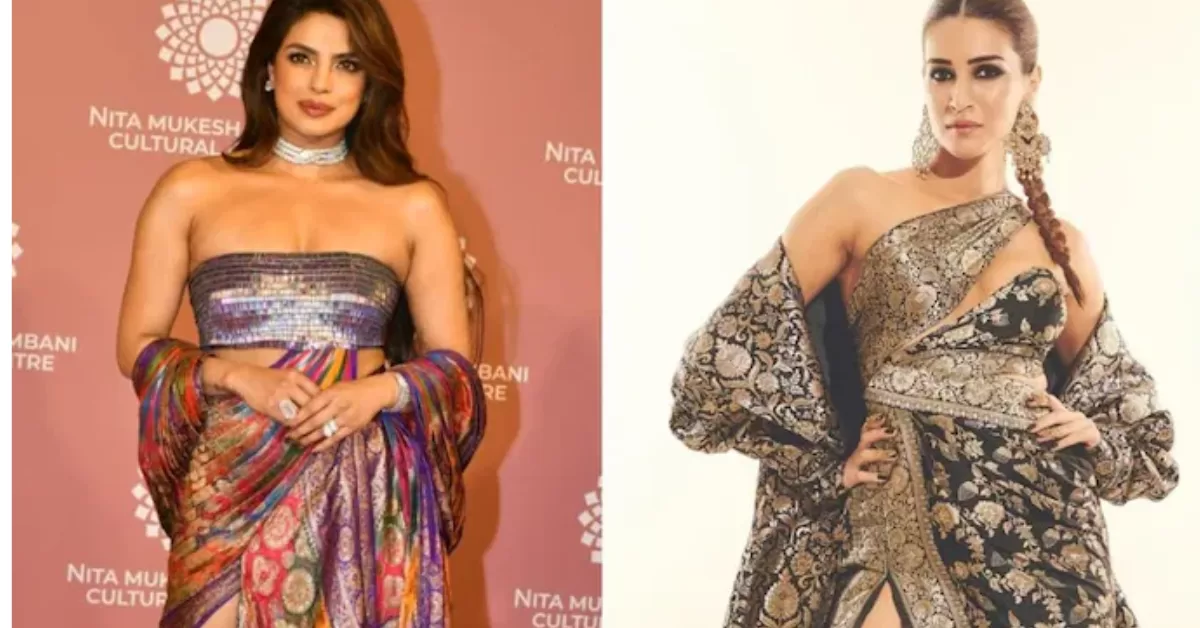
(Source: India Today, Zee Zest)**
At the same event, Kriti Sanon took the Banarasi tradition a step further, wearing a black-and-golden Banarasi saree reimagined as a thigh-slit gown with one-shoulder detail and a matching cape. It was a scene-stealing moment that showcased the versatility of Banarasi weaving — the same brocade technique that produces traditional bridal sarees can, in the right designer’s hands, become a contemporary red-carpet gown. *(Source: India Today, JDS Banaras Blog)**
Samantha Ruth Prabhu chose a deep red Banarasi saree by designer Arpita Mehta for her 2025 wedding to Raj Nidimoru at the Isha Yoga Centre. The saree was handwoven in Katan satin silk with gold zardozi embroidery — a choice that combined handloom authenticity with a simple, elevated aesthetic. She styled it with a classic bun adorned with white mogra (jasmine) gajra and minimalist makeup, letting the Banarasi weave speak for itself.
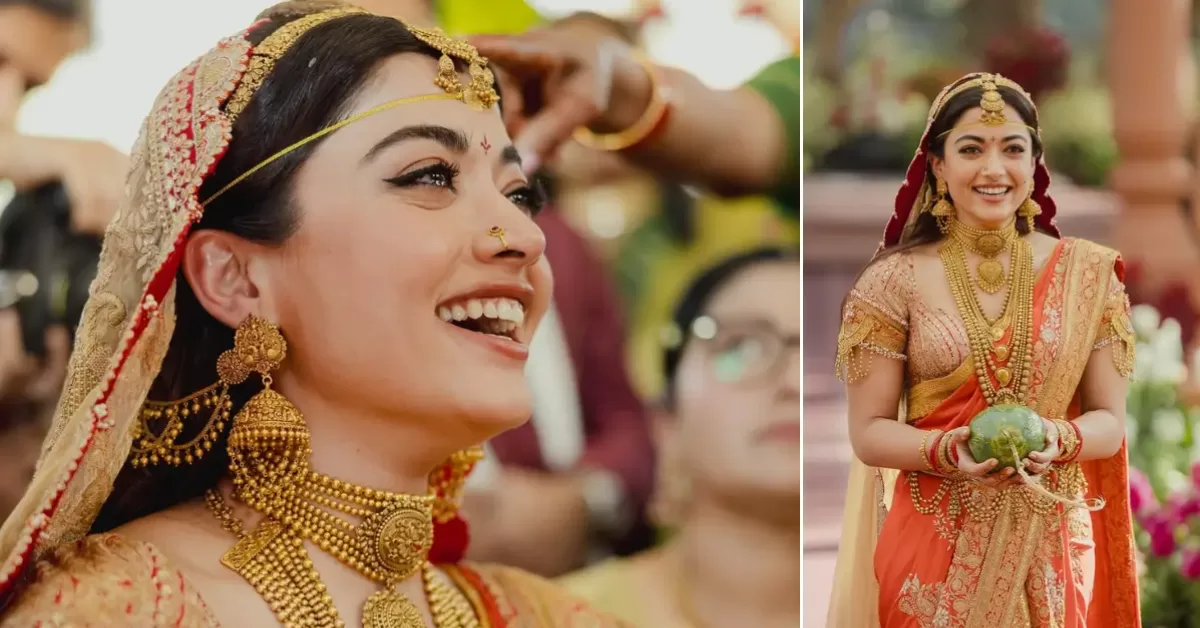
*(Source: WION News)**
Alia Bhatt’s approach to the saree has consistently leaned toward modern minimalism. Her 2022 wedding saree was a custom ivory organza piece by Sabyasachi with fine tilla embroidery — a deliberate choice of lightweight fabric over heavy traditional silk that started an entire trend around minimal bridal dressing. More recently, her sage saree moment in 2026, documented by ELLE India, demonstrated how muted tones and fluid draping can make a stronger statement than heavy ornamentation — a philosophy that aligns perfectly with the lighter Banarasi weaves like Georgette and Organza.
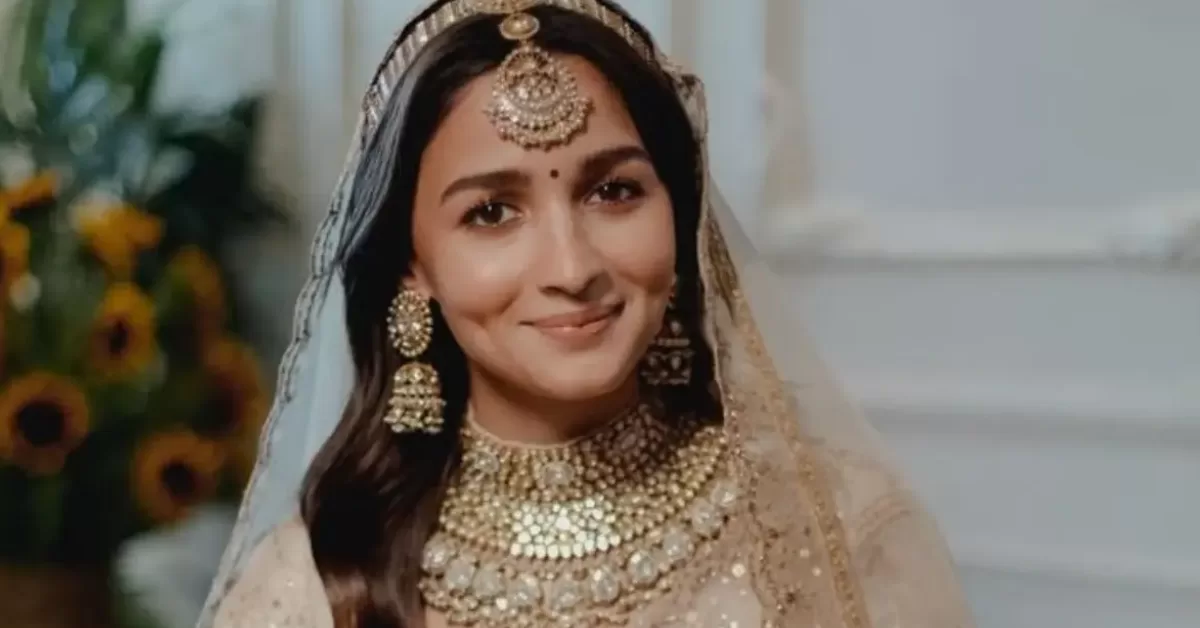
*(Source: WION News, ELLE India)**
Disha Patani surprised the fashion world by stepping out in a modern Kanjivaram saree styled by Tarun Tahiliani, proving that even South Indian silk can be worn in fluid, minimalist ways when the draping and blouse design break away from the traditional template. The look was widely covered by ELLE India as an example of how Indian dressing is being “reinterpreted, not reinvented.” *(Source: ELLE India)**
Kanjivaram Sarees at Weddings and Ceremonies
The bridal wedding space tells a different story — and here, Kanjivaram consistently dominates among South Indian brides, while Banarasi leads in the North.
Deepika Padukone chose a red and gold Kanjeevaram saree — gifted by her mother — for one of her two wedding ceremonies with Ranveer Singh. The saree featured the Gandaberunda (two-headed bird) motif representing wisdom and prosperity, styled by Sabyasachi. It was a deeply personal, heritage-driven choice that reflected her Mangalorean roots. *(Source: WION News)**
Aishwarya Rai Bachchan wore a custom golden Kanjeevaram saree designed by Neeta Lulla for her 2007 wedding to Abhishek Bachchan, featuring real gold zari work and traditional temple jewellery — an iconic look that cemented the Kanjivaram’s status as the ultimate South Indian bridal choice. *(Source: WION News)**
Rashmika Mandanna wore a rich rust-orange silk saree with a thick red and gold border — rooted in South Indian tradition — for her February 2026 wedding to Vijay Deverakonda. She styled it with layered temple-style gold necklaces, deity-motif chains, and traditional bangles. *(Source: WION News)**
Vidya Balan chose a traditional Tamil-style red and mustard yellow silk saree by Sabyasachi for her wedding, embracing her South Indian roots with temple jewellery and a classic gajra-adorned bun. *(Source: WION News)**
Nayanthara wore a custom vermillion red handcrafted ensemble from JADE by Monica and Karishma for her wedding, featuring embroidery inspired by temple carvings, Goddess Lakshmi motifs, and a personalised veil with the couple’s names and the “Fourth Vow” embroidered — a deeply ceremonial Kanjivaram-rooted aesthetic. *(Source: WION News)**
What the Pattern Tells You
The celebrity choices above aren’t random — they reflect the same structural differences this article explains. Banarasi’s lighter weight, finer brocade, and Mughal-influenced detailing make it the natural choice when a saree needs to photograph well, drape fluidly, or be styled in unconventional ways. Kanjivaram’s heavier structure, bold contrasting borders, and temple-inspired motifs make it the natural choice for formal ceremonies where tradition, heritage, and a firm silhouette matter most.
Neither is “better” for bridal wear in an absolute sense. But the pattern is clear: Banarasi for the reception, Kanjivaram for the ceremony is a formula that Bollywood’s best stylists have validated again and again.
Common Myths About Banarasi and Kanjivaram Sarees
Myth 1: They’re Basically the Same Thing, Just From Different Regions
Reality: Beyond both being handwoven pure silk with zari, the construction methods are fundamentally different — continuous brocade weaving (Banarasi) versus separate-piece korvai construction (Kanjivaram). A weaver trained in one tradition cannot simply switch to the other without years of separate training.
Myth 2: Heavier Always Means More Valuable
Reality: Weight reflects silk thickness and zari density, not necessarily craftsmanship or value. A lightweight Banarasi Organza with delicate, labour-intensive motifs can be more technically demanding — and more expensive — than a heavier but simply patterned piece in either tradition.
Myth 3: Kanjivaram Is Always More Expensive Than Banarasi
Reality: Both traditions range from a few thousand rupees to several lakhs. Price is determined by silk grade, zari authenticity, and weaving complexity in both cases — not by which region the saree comes from.
Myth 4: You Can’t Wear a Banarasi Saree at a South Indian Wedding, or Vice Versa
Reality: While each tradition is most strongly associated with its home region’s rituals, both are widely worn across India today at receptions, engagements, and festive events regardless of regional origin. The “correct” saree for a specific ceremony is a matter of family and regional custom, not a fixed national rule.
Myth 5: All Real Zari Looks the Same Regardless of Region
Reality: The underlying material (silver wire, gold-plated, silk core) is the same, but placement and density differ sharply — fine and distributed in Banarasi, bold and border-concentrated in Kanjivaram. Authentic zari from either tradition will pass the same scratch and burn tests, but will look and feel different on the finished saree.
Which Saree Should You Choose First?
If you are building a silk saree collection and can only start with one, here is the honest, occasion-based way to decide:
| If You… | Choose |
| Attend long, multi-hour events regularly and want comfort with elegance | Banarasi (Georgette or standard Katan) |
| Want one heirloom piece built for maximum structural durability | Kanjivaram |
| Are marrying into or attending a North Indian wedding tradition | Banarasi |
| Are marrying into or attending a South Indian / temple wedding tradition | Kanjivaram |
| Want the most detailed, photograph-friendly motifs across the entire body | Banarasi |
| Want bold, high-contrast colour statements with a striking border | Kanjivaram |
| Want a saree that gets better and softer with every wear | Banarasi (pure Katan silk specifically) |
There is no wrong answer here — only the answer that matches your occasions, your comfort priorities, and the tradition your family follows.
The JDS Banaras Perspective
As a Banarasi silk manufacturer, our answer to “which is better” will always be shaped by what we know best — but we’d be doing you a disservice if we pretended Kanjivaram wasn’t a genuinely extraordinary tradition in its own right. What we can speak to with full authority, having done it for four generations, is Banarasi craftsmanship specifically — and on that front, we can tell you exactly what separates an authentic, master-woven Banarasi saree from an imitation sold under the same name.
Every pure silk saree at JDS Banaras — a Silk Mark-certified Banarasi saree manufacturer established in 1913 at Rathyatra Crossing, Varanasi — comes with a certificate of authenticity specifying the exact fabric type, weaving technique, and zari grade. Explore the complete range on our JDS Banarasi Saree collection page, or as a Banarasi saree wholesaler supplying retailers across India and internationally.
To read what over 8,000 customers have said about buying from JDS Banaras, visit our customer reviews page.
Visit JDS Banaras — Compare Real Weaves in Person
No article, including this one, can fully replace holding a Kadwa Banarasi and a korvai Kanjivaram side by side. At JDS Banaras at Rathyatra Crossing, our staff can show you exactly what separates dense Kadwa brocade from standard weaving, how real zari differs from synthetic under a fingernail scratch, and how a saree’s weight and drape actually feel once it’s out of a photograph and in your hands.
JDS Banaras — Jagdish Das & Company
D-58/1, Rathyatra Kamachha Road, Rathyatra Crossing, Varanasi 221010
Phone: +91 7269 055 695
Hours: Monday to Saturday, 10:30am to 8:30pm
Online: sacredweaves.com — JDS Banaras’s official online store